Definium Therapeutics Launches Wired for Worry, a Health Care Provider Initiative to Advance the Understanding of Generalized Anxiety Disorder (GAD) Patient Impact and Neurobiology
GAD affects approximately 26 million U.S. adults, and when left untreated, can cause chronic, pervasive, and debilitating symptoms1,2,3
Patients experience high rates of pharmacotherapy switching, discontinuation, and prolonged gaps in care4
Wired for WorryTM addresses the urgent need for greater understanding of GAD by equipping healthcare providers with education on its symptoms, lifelong impact, and underlying neurobiology
NEW YORK--(BUSINESS WIRE)-- Definium Therapeutics, Inc. (“Definium” or the “Company”), a late-stage clinical biopharmaceutical company developing a new generation of therapeutics intended to address underlying causes of psychiatric and neurological disorders, today announced the launch of Wired for Worry, a new healthcare provider disease education initiative focused on generalized anxiety disorder (GAD).
This press release features multimedia. View the full release here: https://www.businesswire.com/news/home/20260709964486/en/
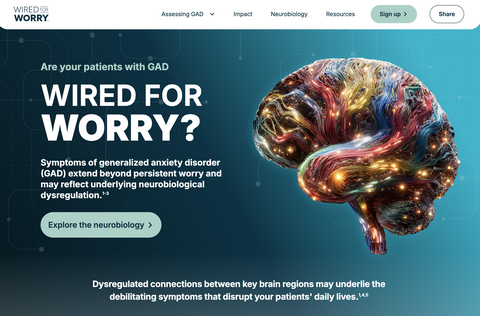
Wired for Worry features interactive clinical resources and information on generalized anxiety disorder (GAD) for healthcare professionals.
Wired for Worry is designed to meet a critical need to broaden understanding of GAD through evidence-based education, including how it may result from dysregulated brain circuitry that contributes to chronic symptoms and functional impairment.5,6 The initiative also highlights how consistent use of the Generalized Anxiety Disorder-7 (GAD-7) screening scale can significantly improve patient identification and outcomes.7,8,9 GAD can have a profound impact on daily life, with patients reporting up to 10 days of limitations in daily and occupational responsibilities in the past month.10 People with GAD may also experience an increased risk of suicidal ideation and behavior.3,7 Healthcare professionals can learn more by visiting www.WiredforWorry.com.
“The mental health providers who care for the millions of people living with GAD deserve more support,” said Dan Karlin, MD, Chief Medical Officer, Definium Therapeutics. “Wired for Worry equips healthcare providers with the emerging science of the neural dysregulation underlying this disorder and increased knowledge of how patients’ GAD symptoms can manifest well beyond excessive worry. A deeper understanding of disease-related information, including tools and resources for GAD assessment and management, is essential to advancing our knowledge of this complex disorder. This initiative can help bolster healthcare providers’ clinical toolkit.”
Wired for Worry features interactive clinical resources and information on symptoms, assessment, disease burden, and neurobiology for healthcare professionals. Together, these resources are designed to deepen understanding of GAD, reinforce the importance of ongoing assessment, and help healthcare professionals better understand the neurobiological mechanisms that may contribute to the disorder. The company plans to expand the platform over time with additional educational content and resources for healthcare professionals as well as other psychiatric disorders.
About Wired for Worry™
Wired for Worry is a disease education initiative developed by Definium Therapeutics for healthcare professionals to advance understanding of generalized anxiety disorder (GAD). The platform provides evidence-based educational resources on the symptoms, burden, assessment, and neurobiology of GAD to support greater understanding of the disorder.
About Generalized Anxiety Disorder (GAD)
GAD is one of the most common psychiatric disorders, affecting approximately 26 million U.S. adults.1,2 People with GAD experience constant, overwhelming worry that is hard to control. Common symptoms include fatigue, muscle tension, trouble concentrating, and difficulty sleeping.11 GAD is associated with the development of other chronic physical illnesses, as well as depression, other anxiety disorders, and trauma-related conditions. Together, these issues can seriously impact a person’s daily life, including substantial functional, economic, and quality-of-life burdens, and are associated with increased healthcare utilization and costs.12,13,14 Despite the significant personal and societal burden of GAD, there has been little innovation in the treatment of GAD in the past several decades, with the last new drug approval occurring in 2007.15
About Definium Therapeutics
The mission of Definium Therapeutics is to forge a new era of psychiatry by applying scientific rigor to psychedelics, with the goal of developing accessible treatments that unlock healing at scale. Guided by a recognition that patients deserve more than better, Definium is relentlessly advancing a new generation of therapeutics intended to address underlying causes of psychiatric and neurological disorders. By turning evidence into impact, Definium aims to change the trajectory of today’s mental health care crisis and enable a healthier future. Headquartered in New York, Definium Therapeutics trades on Nasdaq under the symbol DFTX.
References:
- Ringeisen, H., et al. (2023). Mental and substance use disorders prevalence study (MDPS): Findings report. RTI International and current U.S. Census data and internal company estimates.
- Ferries, E., et al. The Prevalence and Burden of Generalized Anxiety Disorder in the United States Healthcare System: Real-World Prevalence and Incidence from 2020-2023. Journal of Mood and Anxiety Disorders. 2026;13.
- American Psychiatric Association. Diagnostic and Statistical Manual of Mental Disorders. 5th ed, text rev. American Psychiatric Association; 2022.
- Louie D, Ferries E, Suponcic S, et al. Treatment Instability in Generalized Anxiety Disorder (GAD): A U.S. Real-World Evidence Study. CNS Spectrums. Published online 2026:1-33. doi:10.1017/S1092852926101059
- Kenwood MM, Kalin NH, Barbas H. The prefrontal cortex, pathological anxiety, and anxiety disorders. Neuropsychopharmacology. 2022;47(1):260-275.
- Kolesar TA, Bilevicius E, Wilson AD, Kornelsen J. Systematic review and meta-analyses of neural structural and functional differences in generalized anxiety disorder and healthy controls using magnetic resonance imaging. Neuroimage Clin. 2019;24:102016.
- Forand NR, Nettiksimmons J, Brownell A, et al. The impact of measurement based care at scale: examining the effects of implementation on patient outcomes and provider behaviors. Front Health Serv. 2025;5:1659238.
- Spitzer RL, Kroenke K, Williams JBW, Löwe B. A brief measure for assessing generalized anxiety disorder: the GAD-7. Arch Intern Med. 2006;166(10):1092-1097.
- Munir S, Takov V. Generalized anxiety disorder. StatPearls [Internet]. StatPearls Publishing; 2026-. Updated October 17, 2022. Accessed March 19, 2025.
- Wittchen HU, Kessler RC, Beesdo K, Krause P, Höffler M, Hoyer J. Generalized anxiety and depression in primary care: prevalence, recognition, and management. J Clin Psychiatry. 2002;63 Suppl8:24-34.
- Patriquin, M. A., & Mathew, S. J. (2017). The neurobiological mechanisms of generalized anxiety disorder and chronic stress. Chronic Stress, 1, 2470547017703993. https://doi.org/10.1177/2470547017703993
- Barrera, T. L., & Norton, P. J. (2009). Quality of life impairment in generalized anxiety disorder, social phobia, and panic disorder. Journal of Anxiety Disorders, 23, 1086–1090. https://doi.org/10.1016/j.janxdis.2009.07.011
- Armbrecht, E., Shah, R., Poorman, G. W., et al. (2021). Economic and humanistic burden associated with depression and anxiety among adults with non-communicable chronic diseases (NCCDs) in the United States. Journal of Multidisciplinary Healthcare, 14, 887–896. https://doi.org/10.2147/jmdh.s280200
- Newman, M. G., Llera, S. J., Erickson, T. M., Przeworski, A., & Castonguay, L. G. (2013). Worry and generalized anxiety disorder: A review and theoretical synthesis of evidence on nature, etiology, mechanisms, and treatment. Annual Review of Clinical Psychology, 9, 275–297. https://doi.org/10.1146/annurev-clinpsy-050212-185544
- U.S. Food and Drug Administration. (2007, August 9). FDA approves Cymbalta for treatment of generalized anxiety disorder [Press release]. https://investor.lilly.com/static-files/499f0aa3-281f-49f4-9655-049aae179593
View source version on businesswire.com: https://www.businesswire.com/news/home/20260709964486/en/
Investors:
Gitanjali Jain
VP, Head of Investor Relations ir@definiumtx.com
Media:
media@definiumtx.com
Source: Definium Therapeutics, Inc.
Released July 16, 2026