EXHIBIT 99.2
Published on September 14, 2026
Exhibit 99.2
Phase 3 Panorama Study Topline Data Readout
This presentation (the “Presentation”) has been prepared by Definium Therapeutics, Inc. (“Definium”, the “Company”, “we”, “ou r” or “us") solely for informational purposes. This Presentation does not constitute an offering of, or a solicitation of an off er to purchase, securities of Definium and under no circumstances is it to be construed as a prospectus or advertisement or public offering of securitie s. Any trademarks included herein are the property of the owners thereof and are used for reference purposes only. Such use shou ld not be construed as an endorsement of the products or services of Definium. Any amounts are in USD unless otherwise noted. Definium’s securities hav e not been approved or disapproved by the U.S. Securities and Exchange Commission (the "SEC") or by any state, provincial or oth er securities regulatory authority, nor has the SEC or any state, provincial or other securities regulatory authority passed on the accurac y o r adequacy of this Presentation. Any representation to the contrary is a criminal offense. Cautionary Note Regarding Forward - Looking Statements This Presentation contains, and our officers and representatives may from time to time make, “forward - looking statements” within the meaning of applicable securities laws and are prospective in nature. Forward - looking statements are not based on historical facts, but rather on current expectations and projections about future events and are therefore subject to risks and uncertainties which could cau se actual results to differ materially from the future results expressed or implied by the forward - looking statements. These sta tements generally can be identified by the use of forward - looking words such as “will”, “may", “should”, “could”, “intend”, “estimate”, “plan”, “antic ipate”, “expect”, “believe”, “potential”, “continue”, “budget”, “scheduled”, “forecasts”, “intends”, “anticipates”, “projects ” o r the negative thereof or similar variations. Forward - looking statements in this Presentation include, but are not limited to, statements regarding the an ticipated design, timing, progress and results of our investigational programs for DT120 oral disintegrating tablet (“ODT”), a p roprietary, pharmaceutically optimized form of lysergide tartrate for the treatment of generalized anxiety disorder, major depressive dis ord er and posttraumatic stress disorder (including the anticipated topline readout for the Ascend study); the timing of our pre - NDA meeting scheduled for the fourth quarter of 2026; our anticipated NDA filing in the first half of 2027; the success and timing of our development activities; our ability to meet the milestones set forth herein; the likelihood of success of any clinical trials or of obtai nin g U.S. Food and Drug Administration (“FDA”) or other regulatory approvals; our beliefs regarding potential benefits and side effects (or lack ther eof ) of DT120 ODT; our belief that DT120 ODT represents a best - in - class profile; the potential commercial opportunity for DT120 ODT , if approved, including total addressable market and revenue opportunity; our plans to continue to advance commercial readiness activities, including pa tient education, access and support, and site of care readiness; our cash runway; our ability to successfully execute on our pla nned clinical, regulatory and commercial preparation activities; and the potential for psychedelics as a class of treatment options in psych iat ry. There are numerous risks and uncertainties that could cause actual results, plans and objectives to differ materially from th ose expressed in forward - looking statements, including history of negative cash flows, limited operating history, incurrence of fut ure losses, availability of additional capital, compliance with laws and regulations, difficulty associated with research and development, risks associat ed with clinical trials or studies, heightened regulatory scrutiny, early stage product development, clinical trial risks, regul ato ry approval processes, novelty of the psychedelic inspired medicines industry, our ability to maintain effective patent rights and other intellectua l p roperty protection for our product candidates, our expectations regarding the size of the eligible patient populations for ou r l ead product candidates, if approved and commercialized; our ability to identify third - party treatment sites to conduct our trials and our ability to identi fy and train appropriate qualified healthcare practitioners to administer our treatments; the pricing, coverage and reimburse men t of our lead product candidates, if approved and commercialized; the rate and degree of market acceptance and clinical utility of our lead product ca ndidates, in particular, and controlled substances, in general; as well as those risk factors described in the Company's Annu al Report on Form 10 - K for the fiscal year ended December 31, 2025, the Company’s Quarterly Report on Form 10 - Q for the quarterly period ended March 31, 20 26, and the Company’s Quarterly Report on Form 10 - Q for the quarterly period ended June 30, 2026, under headings such as “Specia l Note Regarding Forward - Looking Statements,” and “Risk Factors” and “Management's Discussion and Analysis of Financial Condition and R esults of Operations” and other filings and furnishings made by the Company with the securities regulatory authorities in all pr ovinces and territories of Canada which are available under the Company's profile on SEDAR+ at www.sedarplus.ca and with the SEC on EDGAR at www.sec.gov. Any forward - looking statement made by Definium in this Presentation is based only on information currently available to the Comp any and speaks only as of the date on which it is made. Except as required by law, the Company undertakes no duty or obligati on to update any forward - looking statements contained in this Presentation as a result of new information, future events, changes in expectations or otherwise. Cautionary Note Regarding Regulatory Matters The United States federal government regulates drugs through the Controlled Substances Act. DT120 ODT is a proprietary, pharm ace utically optimized form of lysergide D - tartrate and DT402, or R( - ) - MDMA, is our proprietary form of the R - enantiomer of MDMA (3, 4 - methylenedioxymethamphetamine). Lysergide and MDMA are Schedule I substances under the Controlled Substances Act. While the C omp any is focused on programs using psychedelic or hallucinogenic compounds and non - hallucinogenic derivatives of these compounds, including in DT120 ODT, DT402 and its other product candidates, the Company does not have any direct or indirect involvement wit h the illegal selling, production or distribution of any substances in the jurisdictions in which it operates. The Company is a neuro - pharmaceutical drug development company and does not deal with psychedelic or hallucinogenic substances except within laboratory and clinica l t rial settings conducted within approved regulatory frameworks. The Company's products will not be commercialized prior to app lic able regulatory approval, which will only be granted if clinical evidence of safety and efficacy for the intended uses is successfully develo ped . Market and Industry Data This Presentation includes market and industry data that has been obtained from third party sources, including industry publi cat ions. Definium believes that the industry data is accurate and that the estimates and assumptions are reasonable, but there i s n o assurance as to the accuracy or completeness of this data. Third party sources generally state that the information contained therein has been ob tai ned from sources believed to be reliable, but there is no assurance as to the accuracy or completeness of included informatio n. Although the data is believed to be reliable, Definium has not independently verified any of the data from third party sources referred to in this Pr esentation or ascertained the underlying economic assumptions relied upon by such sources. References in this Presentation to re search reports or to articles and publications should not be construed as depicting the complete findings of the entire referenced report or artic le. Definium does not make any representation as to the accuracy of such information. Panorama Topline Results | September 2026 2 Disclaimer

Opening Remarks Rob Barrow Chief Executive Officer

Thank you to our study participants, investigators and partners who made Panorama possible
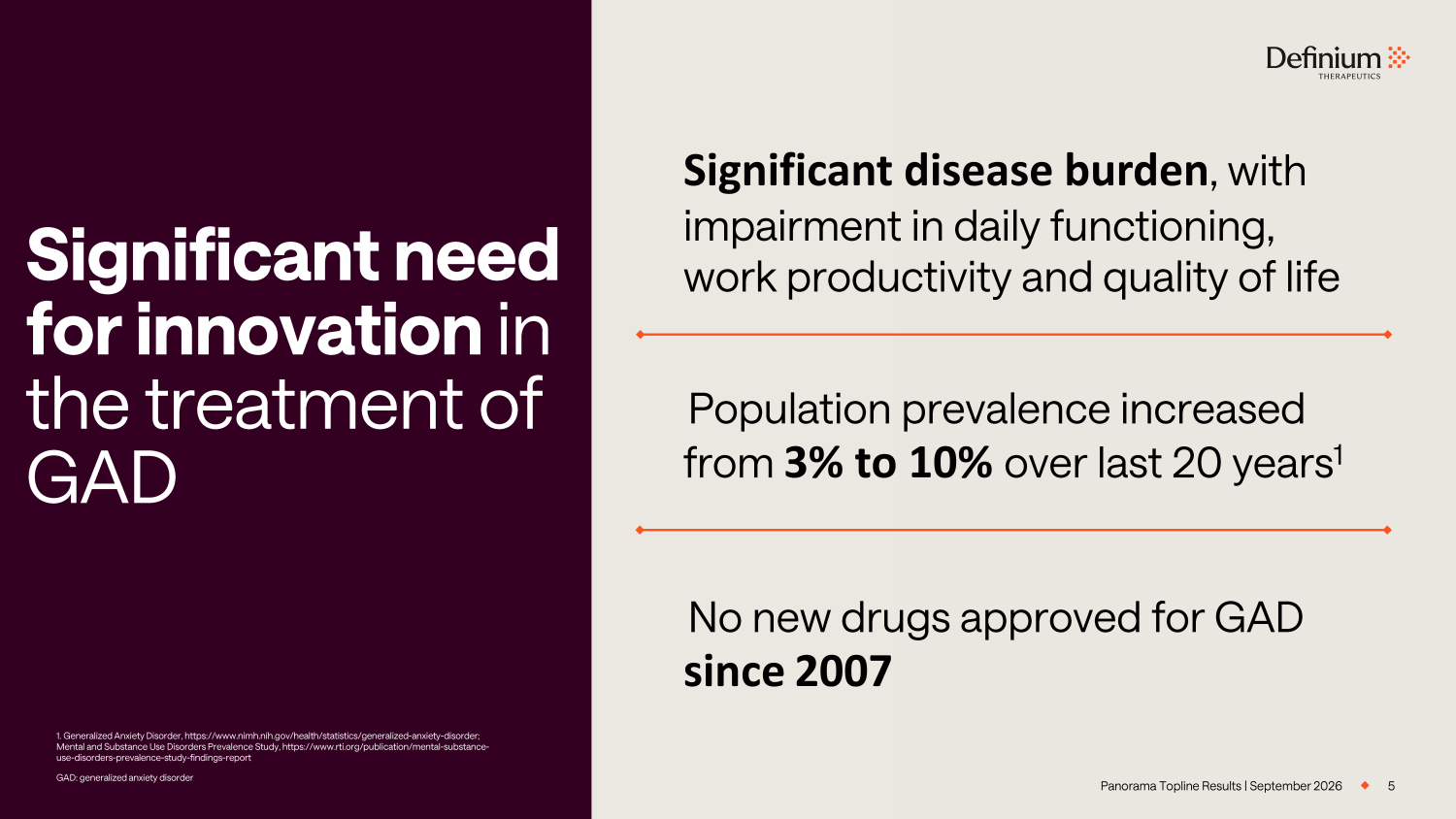
Significant need for innovation in the treatment of GAD 5 Population prevalence increased from 3% to 10% over last 20 years 1 No new drugs approved for GAD since 2007 Significant disease burden , with impairment in daily functioning, work productivity and quality of life Panorama Topline Results | September 2026 1. Generalized Anxiety Disorder, https://www.nimh.nih.gov/health/statistics/generalized - anxiety - disorder; Mental and Substance Use Disorders Prevalence Study, https://www.rti.org/publication/mental - substance - use - disorders - prevalence - study - findings - report GAD: generalized anxiety disorder
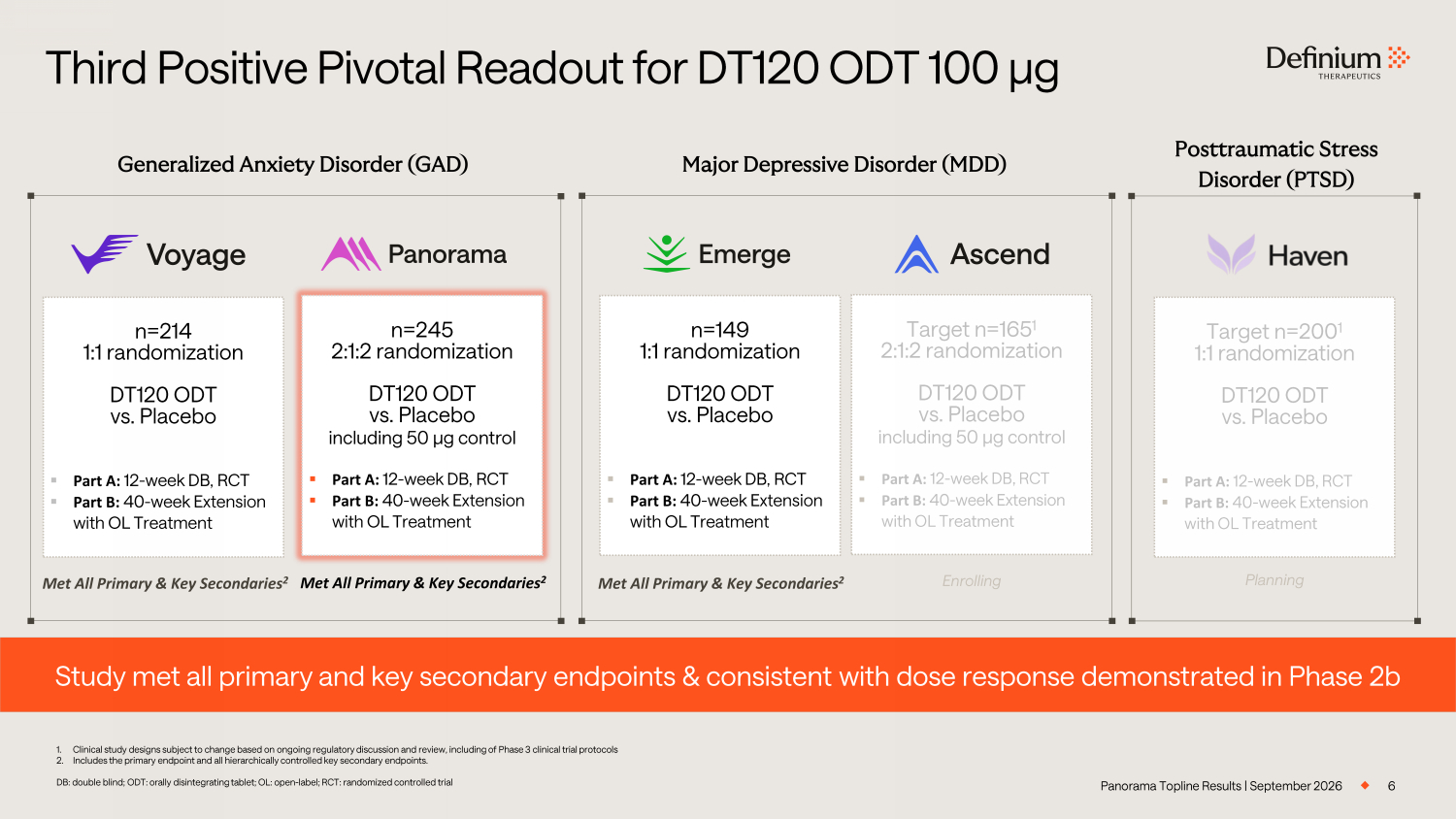
Panorama Topline Results | September 2026 6 Third Positive Pivotal Readout for DT120 ODT 100 µg 1. Clinical study designs subject to change based on ongoing regulatory discussion and review, including of Phase 3 clinical tri al protocols 2. Includes the primary endpoint and all hierarchically controlled key secondary endpoints. DB: double blind; ODT: orally disintegrating tablet; OL: open - label; RCT: randomized controlled trial Generalized Anxiety Disorder (GAD) Major Depressive Disorder (MDD) n=214 1 :1 randomization DT120 ODT vs. Placebo ▪ Part A: 12 - week DB, RCT ▪ Part B: 40 - week Extension with OL Treatment n=245 2:1:2 randomization DT120 ODT vs. Placebo including 50 µg control ▪ Part A: 12 - week DB, RCT ▪ Part B: 40 - week Extension with OL Treatment n=149 1:1 randomization DT120 ODT vs. Placebo ▪ Part A: 12 - week DB, RCT ▪ Part B: 40 - week Extension with OL Treatment Target n=165 1 2:1:2 randomization DT120 ODT vs. Placebo including 50 µg control ▪ Part A: 12 - week DB, RCT ▪ Part B: 40 - week Extension with OL Treatment Target n=200 1 1:1 randomization DT120 ODT vs. Placebo ▪ Part A: 12 - week DB, RCT ▪ Part B: 40 - week Extension with OL Treatment Posttraumatic Stress Disorder (PTSD) Met All Primary & Key Secondaries 2 Met All Primary & Key Secondaries 2 Enrolling Planning Met All Primary & Key Secondaries 2 Study met all primary and key secondary endpoints & consistent with dose response demonstrated in Phase 2bRF1 JS2
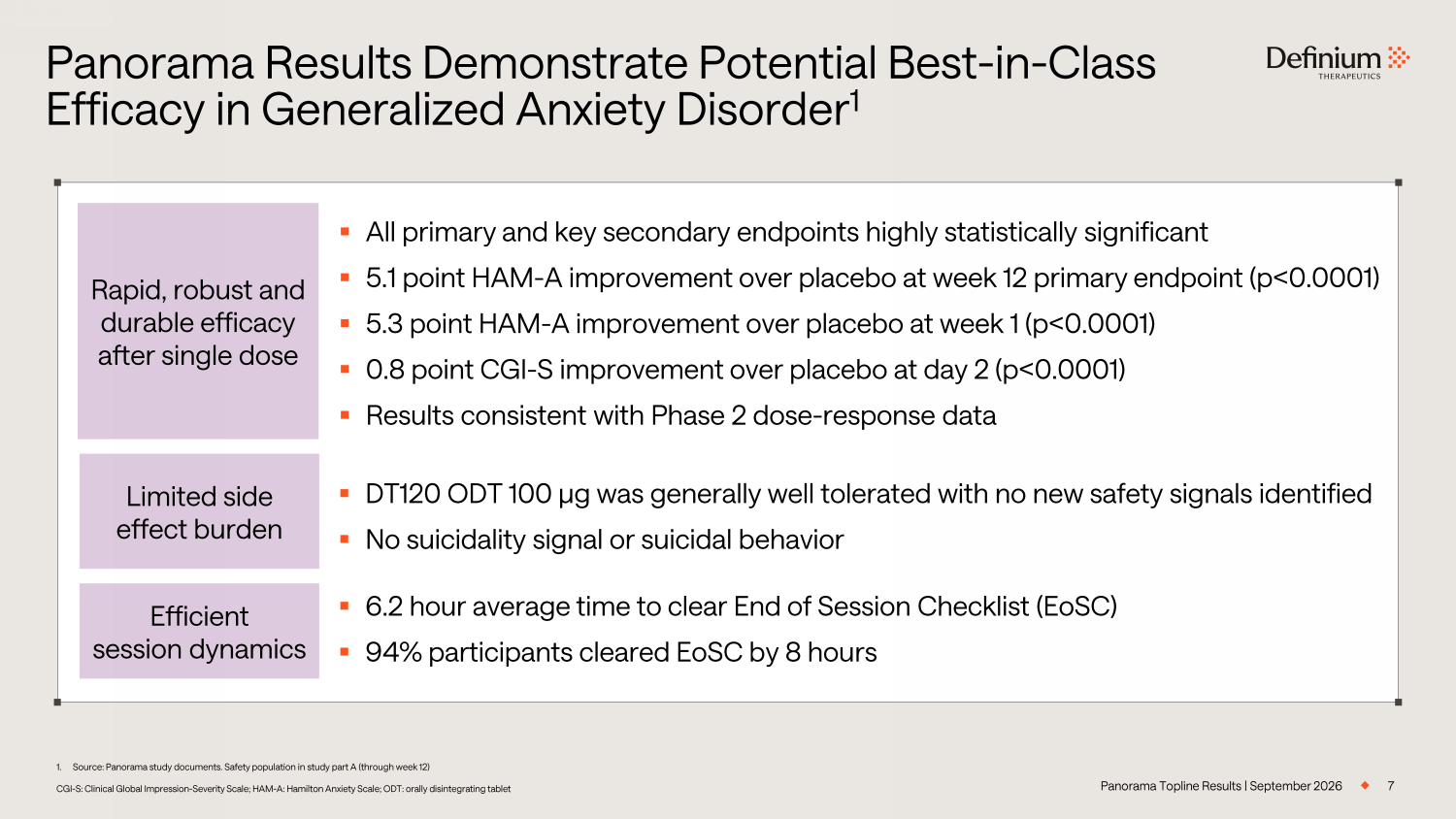
Panorama Topline Results | September 2026 7 Panorama Results Demonstrate Potential Best - in - Class Efficacy in Generalized Anxiety Disorder 1 Limited side effect burden Efficient session dynamics Rapid, robust and durable efficacy after single dose ▪ All primary and key secondary endpoints highly statistically significant ▪ 5.1 point HAM - A improvement over placebo at week 12 primary endpoint (p<0.0001) ▪ 5.3 point HAM - A improvement over placebo at week 1 (p<0.0001) ▪ 0.8 point CGI - S improvement over placebo at day 2 (p<0.0001) ▪ Results consistent with Phase 2 dose - response data ▪ DT120 ODT 100 µg was generally well tolerated with no new safety signals identified ▪ No suicidality signal or suicidal behavior ▪ 6.2 hour average time to clear End of Session Checklist (EoSC) ▪ 94% participants cleared EoSC by 8 hours 1. Source: Panorama study documents. Safety population in study part A (through week 12) CGI - S: Clinical Global Impression - Severity Scale; HAM - A: Hamilton Anxiety Scale; ODT: orally disintegrating tablet JS1 RB2 JS3 JS4JS5JS6 JS7 RF8 JS9 JS10 JS11
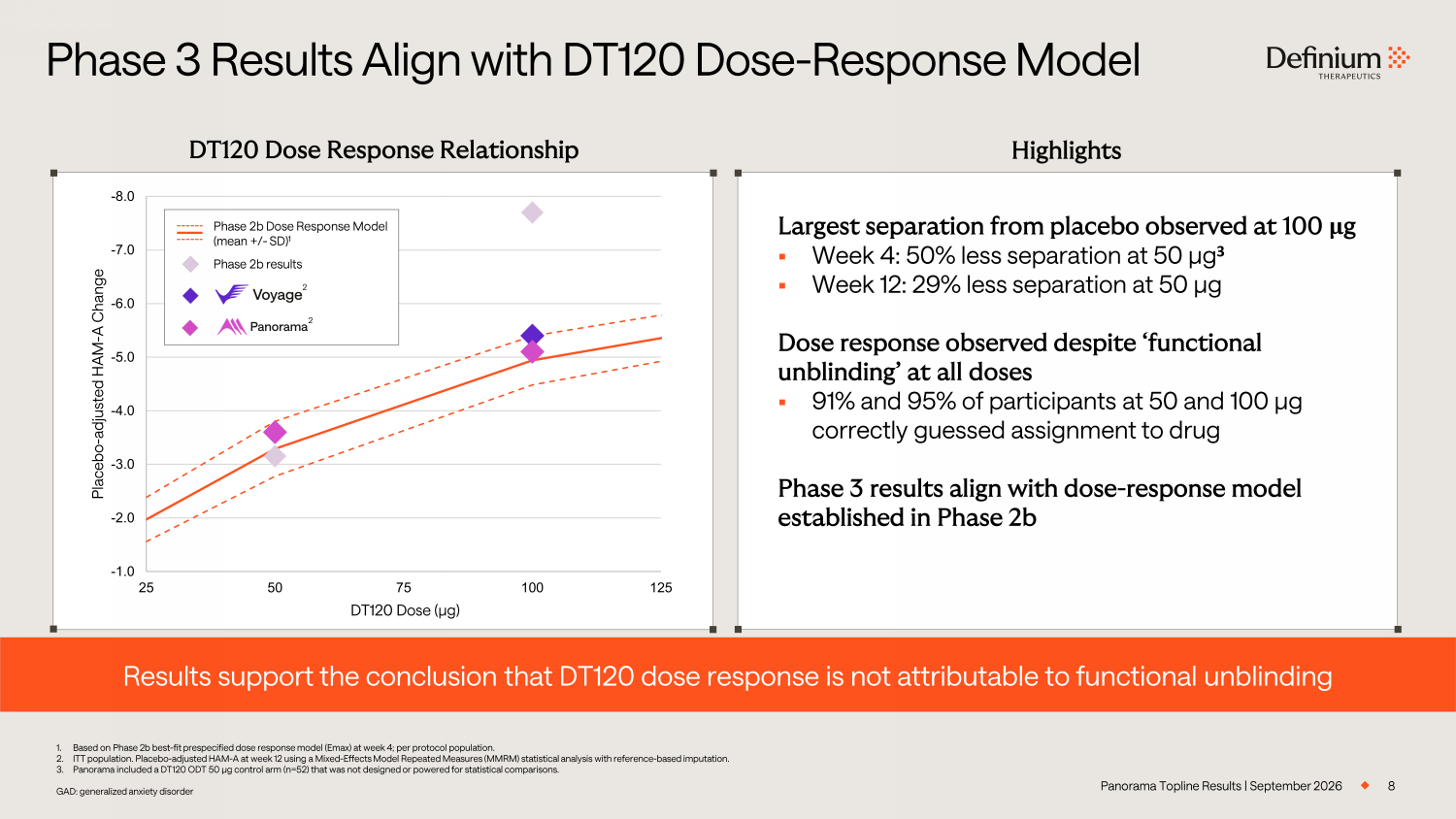
8 Panorama Topline Results | September 2026 DT120 Dose Response Relationship Highlights 1. Based on Phase 2b best - fit prespecified dose response model (Emax) at week 4; per protocol population. 2. ITT population. Placebo - adjusted HAM - A at week 12 using a Mixed - Effects Model Repeated Measures (MMRM) statistical analysis with reference - based imputation. 3. Panorama included a DT120 ODT 50 µg control arm (n=52) that was not designed or powered for statistical comparisons. GAD: generalized anxiety disorder Phase 3 Results Align with DT120 Dose - Response Model Largest separation from placebo observed at 100 µ g ▪ Week 4: 50% less separation at 50 µg 3 ▪ Week 12: 29% less separation at 50 µg Dose response observed despite ‘functional unblinding’ at all doses ▪ 91% and 95% of participants at 50 and 100 µg correctly guessed assignment to drug Phase 3 results align with dose - response model established in Phase 2b Results support the conclusion that DT120 dose response is not attributable to functional unblinding -8.0 -7.0 -6.0 -5.0 -4.0 -3.0 -2.0 -1.0 25 50 75 100 125 Placebo - adjusted HAM - A Change DT120 Dose (µg) Phase 2b Dose Response Model (mean +/ - SD) 1 2 2 Phase 2b results RB1 RB2 JS3JS4 JS5JS6 JS7 JS8 BR9
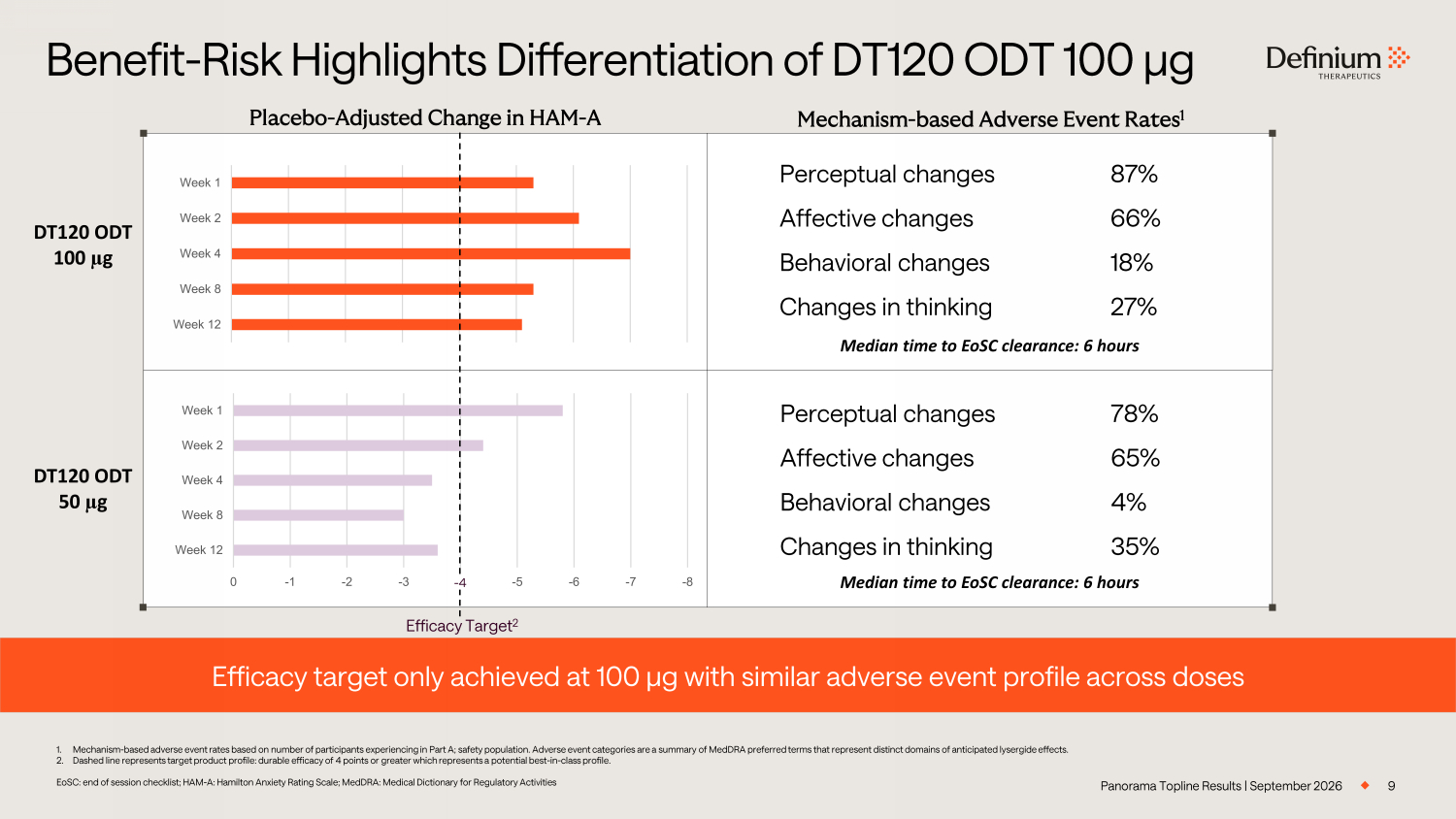
Panorama Topline Results | September 2026 9 Benefit - Risk Highlights Differentiation of DT120 ODT 100 µg 1. Mechanism - based adverse event rates based on number of participants experiencing in Part A; safety population. Adverse event cat egories are a summary of MedDRA preferred terms that represent distinct domains of anticipated lysergide effects. 2. Dashed line represents target product profile: durable efficacy of 4 points or greater which represents a potential best - in - clas s profile. EoSC: end of session checklist; HAM - A: Hamilton Anxiety Rating Scale; MedDRA: Medical Dictionary for Regulatory Activities Efficacy target only achieved at 100 µg with similar adverse event profile across doses Placebo - Adjusted Change in HAM - A Mechanism - based Adverse Event Rates 1 DT120 ODT 100 µ g DT120 ODT 50 µ g Median time to EoSC clearance: 6 hours Week 1 Week 2 Week 4 Week 8 Week 12 -8 -7 -6 -5 -4 -3 -2 -1 0 Week 1 Week 2 Week 4 Week 8 Week 12 Efficacy Target 2 87% Perceptual changes 66% Affective changes 18% Behavioral changes 27% Changes in thinking 78% Perceptual changes 65% Affective changes 4% Behavioral changes 35% Changes in thinking - 4 Median time to EoSC clearance: 6 hoursRB1 JS2
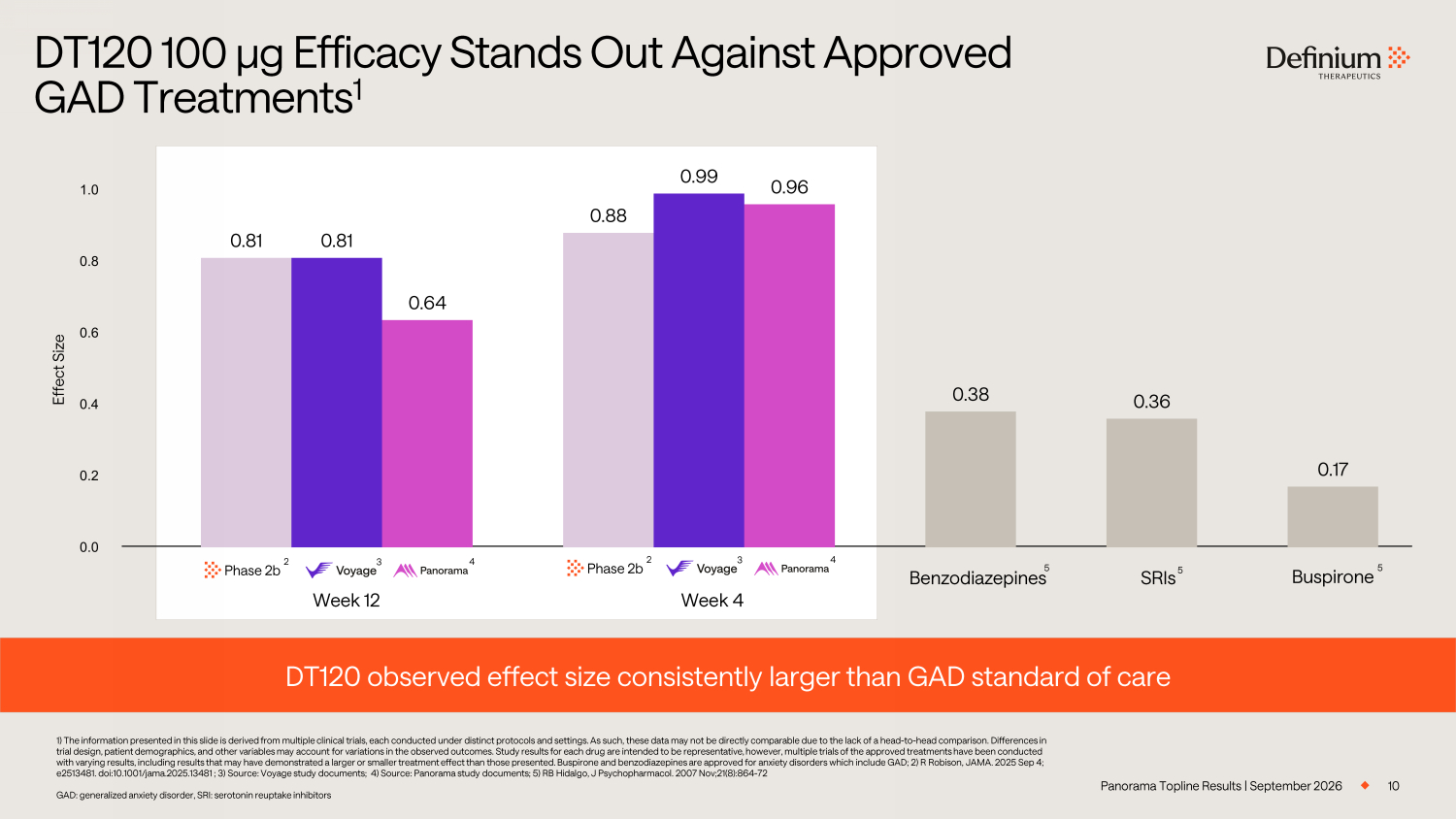
Panorama Topline Results | September 2026 10 DT120 100 µg Efficacy Stands Out Against Approved GAD Treatments 1 DT120 observed effect size consistently larger than GAD standard of care 1) The information presented in this slide is derived from multiple clinical trials, each conducted under distinct protocols and settings. As such, these data may not be directly comparable due to the lack of a head - to - head comparison. Differences in trial design, patient demographics, and other variables may account for variations in the observed outcomes. Study results fo r e ach drug are intended to be representative, however, multiple trials of the approved treatments have been conducted with varying results, including results that may have demonstrated a larger or smaller treatment effect than those presented. Bu spirone and benzodiazepines are approved for anxiety disorders which include GAD; 2) R Robison, JAMA. 2025 Sep 4; e2513481. doi:10.1001/jama.2025.13481 ; 3) Source: Voyage study documents; 4) Source: Panorama study documents ; 5) RB Hidalgo, J Psychopharmacol. 2007 Nov;21(8):864 - 72 GAD: generalized anxiety disorder, SRI: serotonin reuptake inhibitors 5 Benzodiazepines SRIs Buspirone 5 5 3 4 Phase 2b 2 3 4 Phase 2b 2 0.81 0.81 0.64 0.88 0.99 0.96 0.38 0.36 0.17 0.0 0.2 0.4 0.6 0.8 1.0 Effect Size Week 4 Week 12 JS1 JS2 RB3
Phase 3 Panorama Study Results Part A – Topline Results Dan Karlin, MD Chief Medical Officer
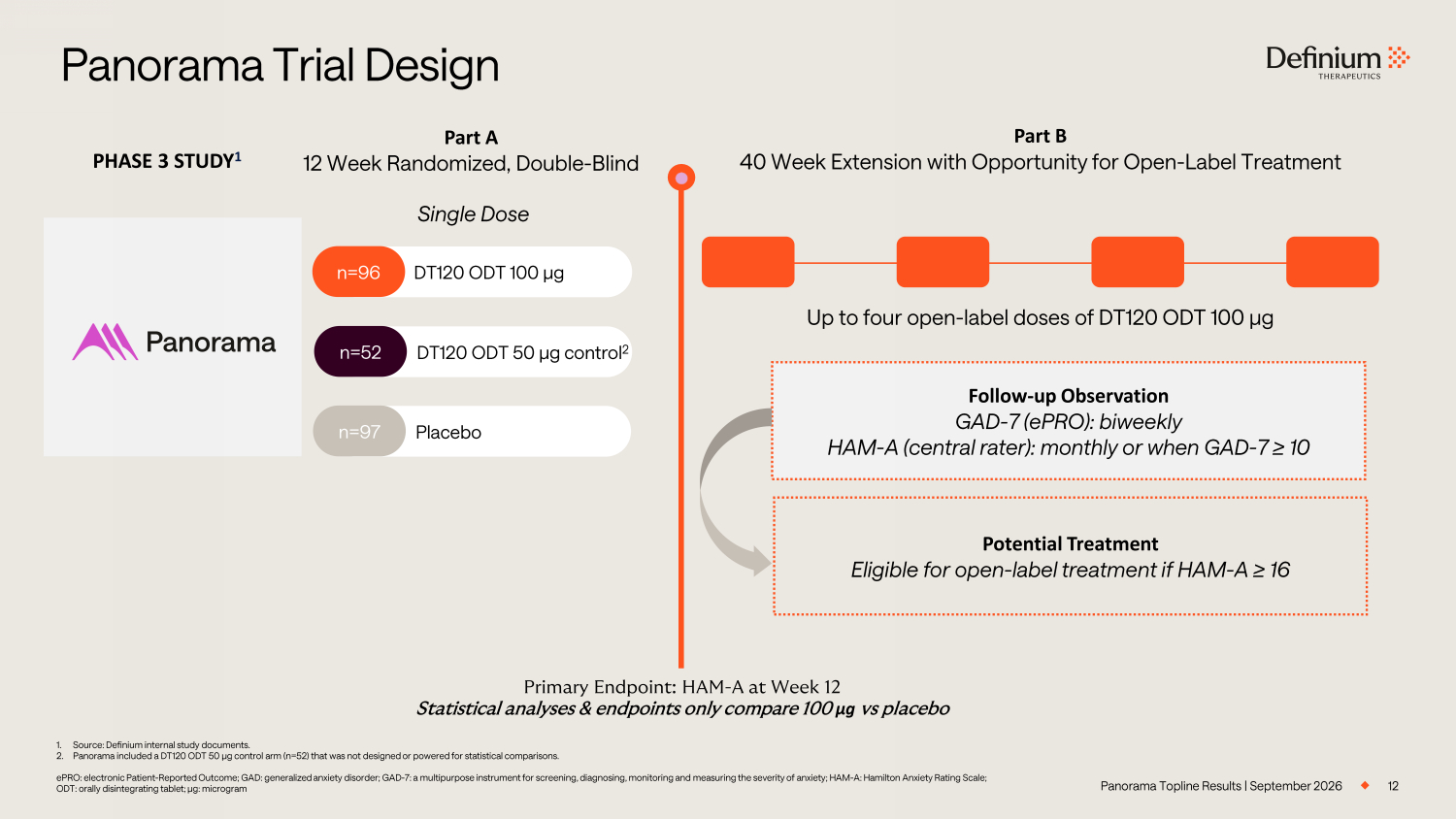
Panorama Trial Design 1. Source: Definium internal study documents. 2. Panorama included a DT120 ODT 50 µg control arm (n=52) that was not designed or powered for statistical comparisons. ePRO: electronic Patient - Reported Outcome; GAD: generalized anxiety disorder; GAD - 7: a multipurpose instrument for screening, di agnosing, monitoring and measuring the severity of anxiety; HAM - A: Hamilton Anxiety Rating Scale; ODT: orally disintegrating tablet; µg: microgram DT120 ODT 1 00 µg n=96 DT120 ODT 5 0 µg control 2 n=52 Part A 12 Week Randomized, Double - Blind Part B 40 Week Extension with Opportunity for Open - Label Treatment PHASE 3 STUDY 1 Single Dose Primary Endpoint: HAM - A at Week 12 Statistical analyses & endpoints only compare 100 µg vs placebo Up to four open - label doses of DT120 ODT 1 00 µg Follow - up Observation GAD - 7 (ePRO): biweekly HAM - A (central rater): monthly or when GAD - 7 ≥ 10 Potential Treatment Eligible for open - label treatment if HAM - A ≥ 16 12 Panorama Topline Results | September 2026 Placebo n=97 JS1 JS2
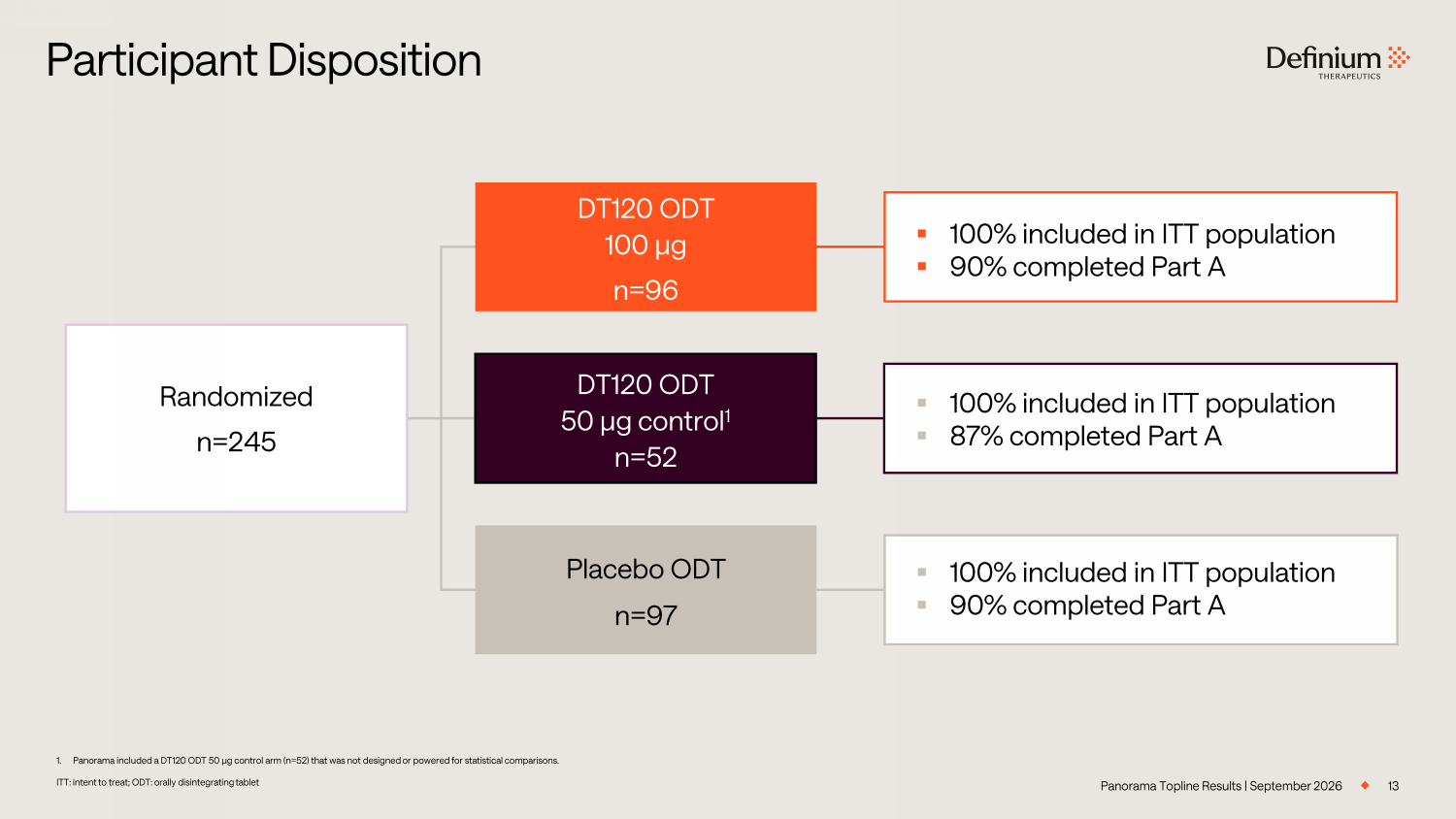
13 1. Panorama included a DT120 ODT 50 µg control arm (n=52) that was not designed or powered for statistical comparisons. ITT: intent to treat; ODT: orally disintegrating tablet Participant Disposition Panorama Topline Results | September 2026 Randomized n=245 DT120 ODT 100 µg n=96 DT120 ODT 50 µg control 1 n=52 Placebo ODT n=97 ▪ 100% included in ITT population ▪ 90% completed Part A ▪ 100% included in ITT population ▪ 90% completed Part A ▪ 100% included in ITT population ▪ 87% completed Part A DF1 JS2
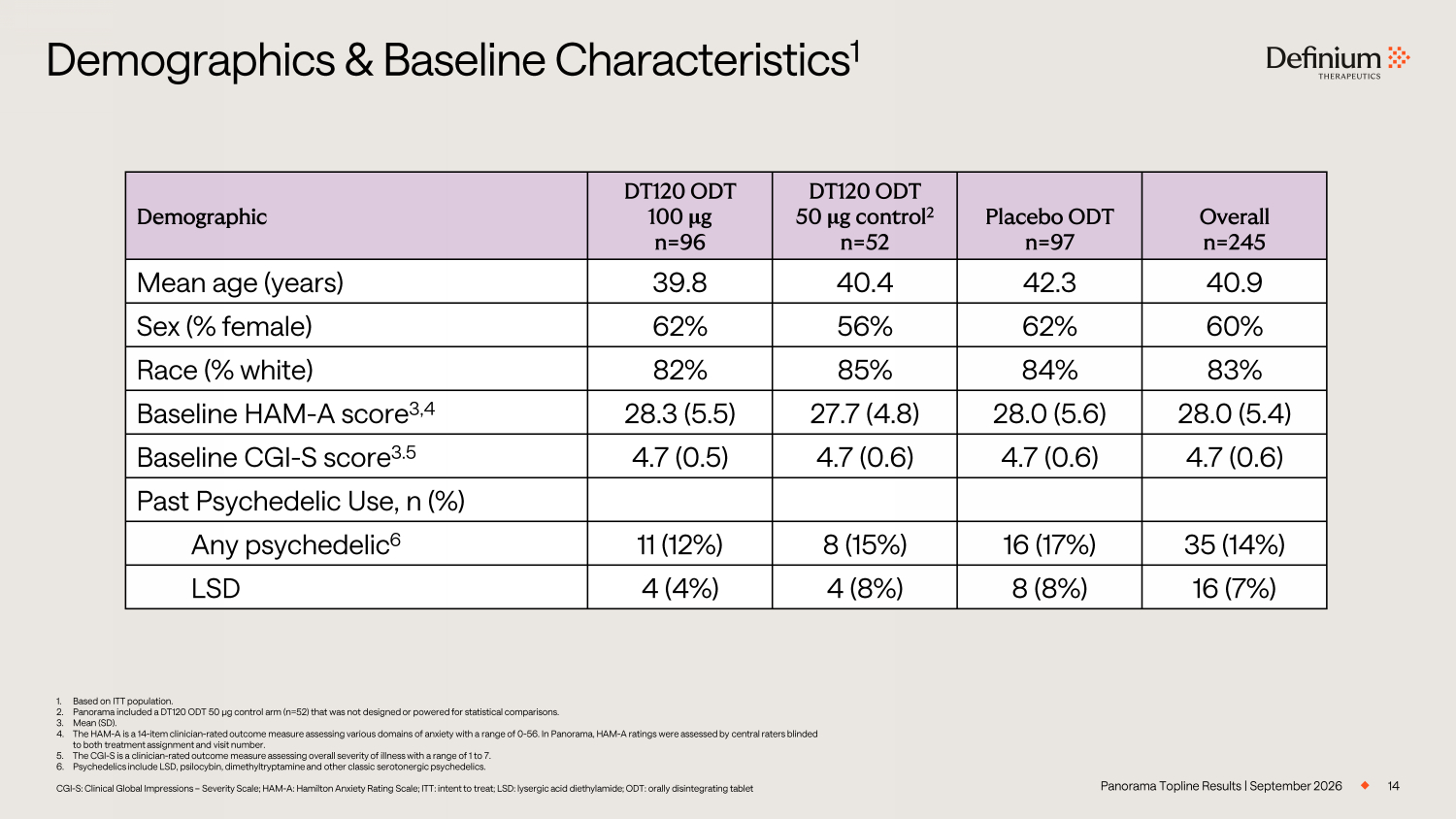
14 1. Based on ITT population. 2. Panorama included a DT120 ODT 50 µg control arm (n=52) that was not designed or powered for statistical comparisons. 3. Mean (SD). 4. The HAM - A is a 14 - item clinician - rated outcome measure assessing various domains of anxiety with a range of 0 - 56. In Panorama, H AM - A ratings were assessed by central raters blinded to both treatment assignment and visit number. 5. The CGI - S is a clinician - rated outcome measure assessing overall severity of illness with a range of 1 to 7. 6. Psychedelics include LSD, psilocybin, dimethyltryptamine and other classic serotonergic psychedelics. CGI - S: Clinical Global Impressions – Severity Scale; HAM - A: Hamilton Anxiety Rating Scale; ITT: intent to treat; LSD: lysergic a cid diethylamide; ODT: orally disintegrating tablet Demographics & Baseline Characteristics 1 Overall n=245 Placebo ODT n=97 DT120 ODT 50 µ g control 2 n=52 DT120 ODT 100 µ g n=96 Demographic 40.9 42.3 40.4 39.8 Mean age (years) 60% 62% 56% 62% Sex (% female) 83% 84% 85% 82% Race (% white) 28.0 (5.4) 28.0 (5.6) 27.7 (4.8) 28.3 (5.5) Baseline HAM - A score 3,4 4.7 (0.6) 4.7 (0.6) 4.7 (0.6) 4.7 (0.5) Baseline CGI - S score 3.5 Past Psychedelic Use, n (%) 35 (14%) 16 (17%) 8 (15%) 11 (12%) Any psychedelic 6 16 (7%) 8 (8%) 4 (8%) 4 (4%) LSD Panorama Topline Results | September 2026DF1PJ2 JS3 RB4
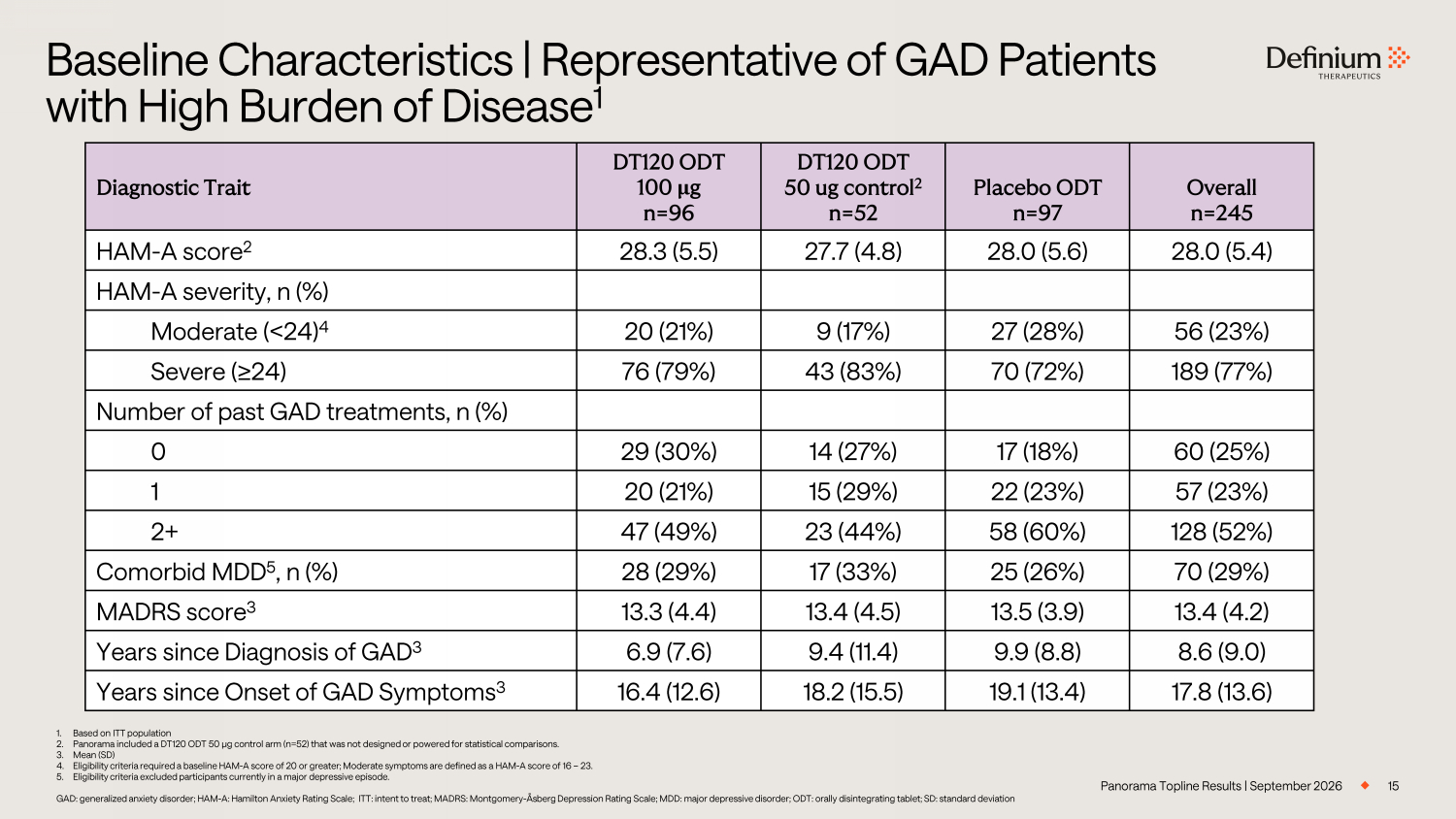
15 1. Based on ITT population 2. Panorama included a DT120 ODT 50 µg control arm (n=52) that was not designed or powered for statistical comparisons. 3. Mean (SD) 4. Eligibility criteria required a baseline HAM - A score of 20 or greater; Moderate symptoms are defined as a HAM - A score of 16 – 23 . 5. Eligibility criteria excluded participants currently in a major depressive episode. GAD: generalized anxiety disorder; HAM - A: Hamilton Anxiety Rating Scale; ITT: intent to treat; MADRS: Montgomery - Åsberg Depress ion Rating Scale; MDD: major depressive disorder; ODT: orally disintegrating tablet; SD: standard deviation Baseline Characteristics | Representative of GAD Patients with High Burden of Disease 1 Panorama Topline Results | September 2026 Overall n=245 Placebo ODT n=97 DT120 ODT 50 ug control 2 n=52 DT120 ODT 100 µ g n=96 Diagnostic Trait 28.0 (5.4) 28.0 (5.6) 27.7 (4.8) 28.3 (5.5) HAM - A score 2 HAM - A severity, n (%) 56 (23%) 27 (28%) 9 (17%) 20 (21%) Moderate (<24) 4 189 (77%) 70 (72%) 43 (83%) 76 (79%) Severe (≥24) Number of past GAD treatments, n (%) 60 (25%) 17 (18%) 14 (27%) 29 (30%) 0 57 (23%) 22 (23%) 15 (29%) 20 (21%) 1 128 (52%) 58 (60%) 23 (44%) 47 (49%) 2+ 70 (29%) 25 (26%) 17 (33%) 28 (29%) Comorbid MDD 5 , n (%) 13.4 (4.2) 13.5 (3.9) 13.4 (4.5) 13.3 (4.4) MADRS score 3 8.6 (9.0) 9.9 (8.8) 9.4 (11.4) 6.9 (7.6) Years since Diagnosis of GAD 3 17.8 (13.6) 19.1 (13.4) 18.2 (15.5) 16.4 (12.6) Years since Onset of GAD Symptoms 3PJ1 RF2 JS3 RB4
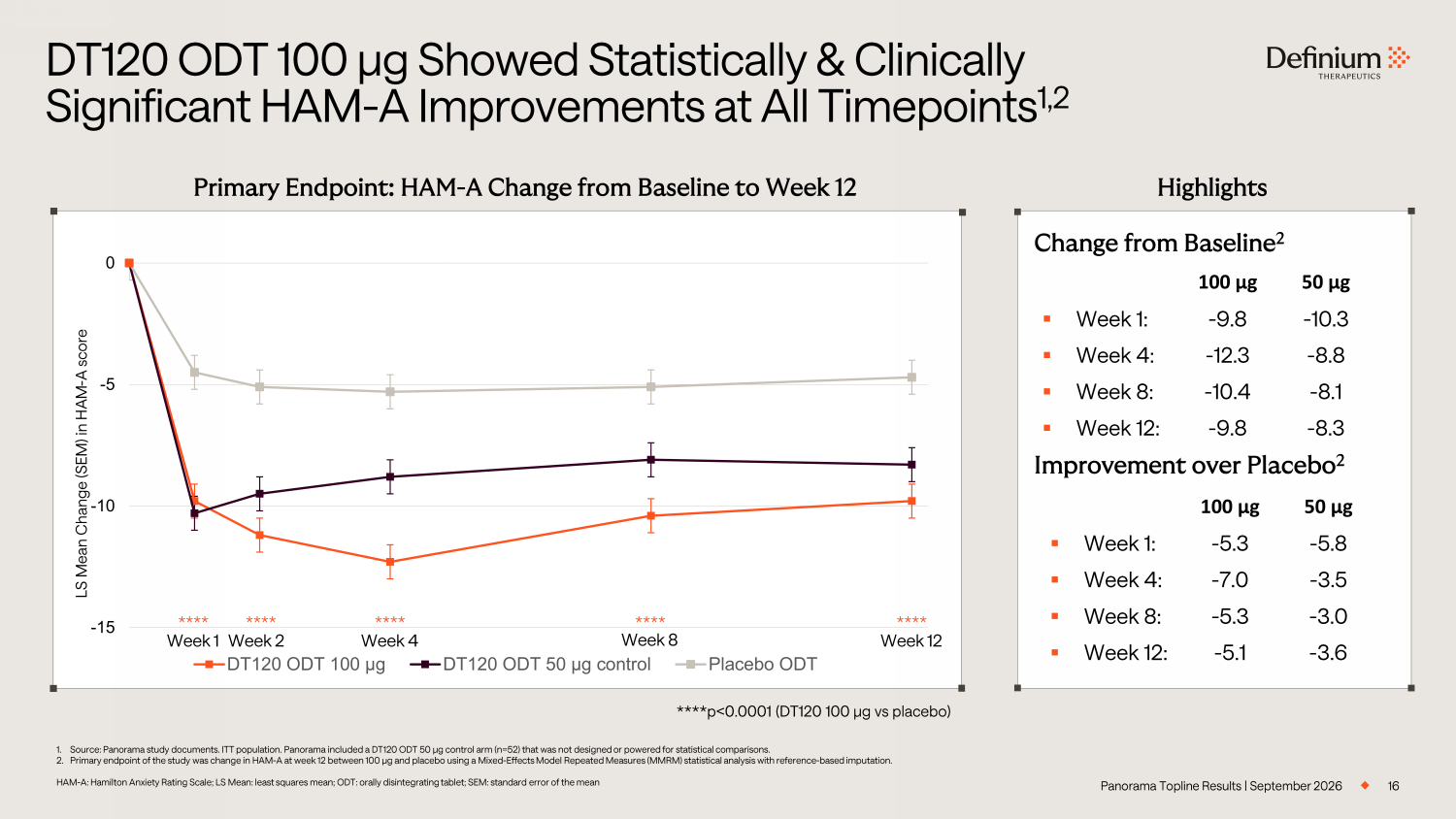
Primary Endpoint: HAM - A Change from Baseline to Week 12 16 1. Source: Panorama study documents. ITT population. Panorama included a DT120 ODT 50 µg control arm (n=52) that was not designe d o r powered for statistical comparisons. 2. Primary endpoint of the study was change in HAM - A at week 12 between 100 µg and placebo using a Mixed - Effects Model Repeated Mea sures (MMRM) statistical analysis with reference - based imputation. HAM - A: Hamilton Anxiety Rating Scale; LS Mean: least squares mean; ODT: orally disintegrating tablet; SEM: standard error of the mean DT120 ODT 100 µg Showed Statistically & Clinically Significant HAM - A Improvements at All Timepoints 1,2 Panorama Topline Results | September 2026 **** **** **** **** **** Week 1 Week 2 Week 4 Week 8 Week 12 Change from Baseline 2 Improvement over Placebo 2 ****p<0.0001 (DT120 100 µg vs placebo) Highlights -15 -10 -5 0 LS Mean Change (SEM) in HAM - A score DT120 ODT 100 µg DT120 ODT 50 µg control Placebo ODT 50 µg 100 µg - 10.3 - 9.8 ▪ Week 1: - 8.8 - 12.3 ▪ Week 4: - 8.1 - 10.4 ▪ Week 8: - 8.3 - 9.8 ▪ Week 12: 50 µg 100 µg - 5.8 - 5.3 ▪ Week 1: - 3.5 - 7.0 ▪ Week 4: - 3.0 - 5.3 ▪ Week 8: - 3.6 - 5.1 ▪ Week 12: BR1 PJ2 JS3 JS4
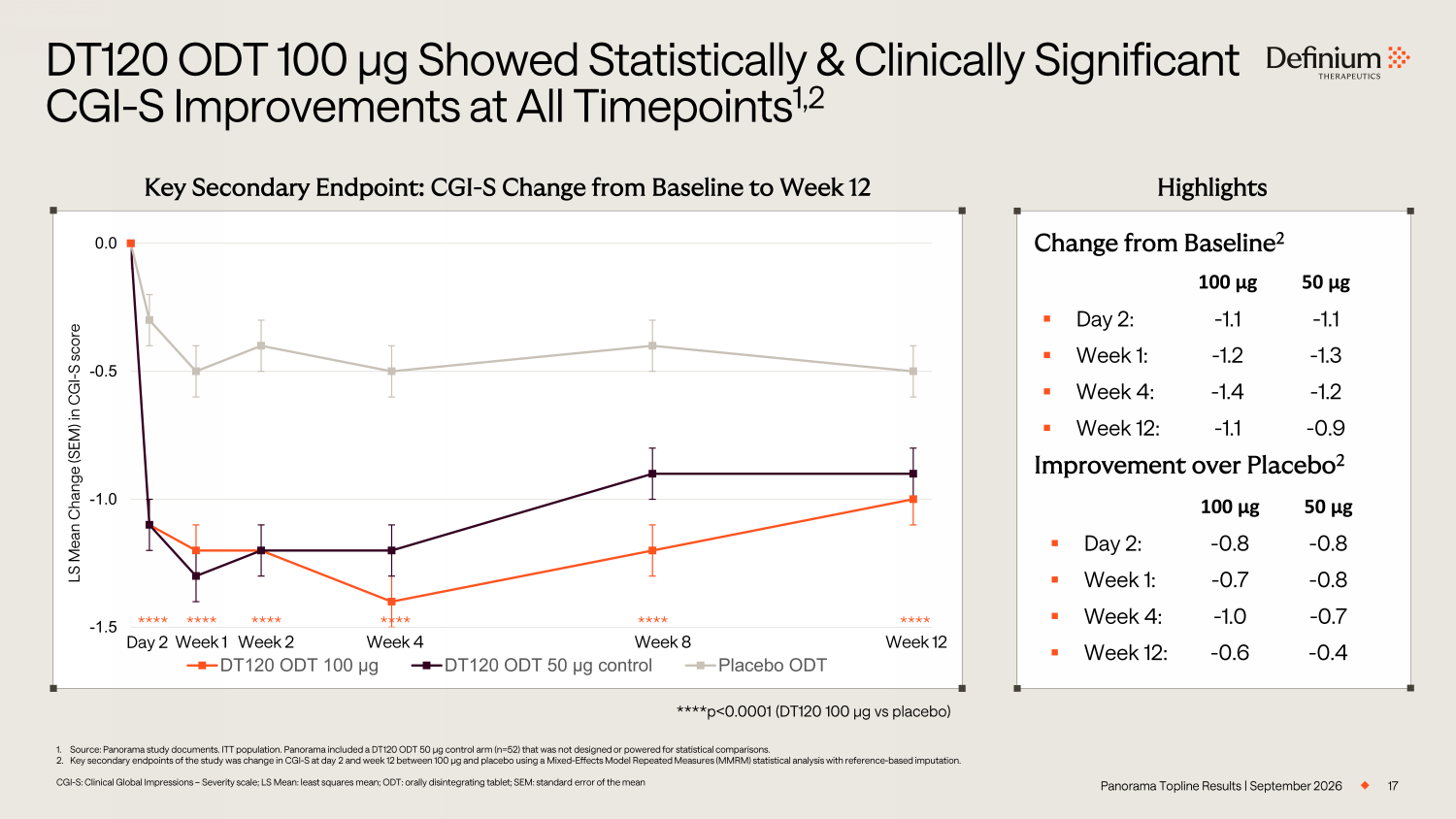
Change from Baseline 2 Improvement over Placebo 2 17 1. Source: Panorama study documents. ITT population. Panorama included a DT120 ODT 50 µg control arm (n=52) that was not designe d o r powered for statistical comparisons. 2. Key secondary endpoints of the study was change in CGI - S at day 2 and week 12 between 100 µg and placebo using a Mixed - Effects M odel Repeated Measures (MMRM) statistical analysis with reference - based imputation. CGI - S: Clinical Global Impressions – Severity scale; LS Mean: least squares mean; ODT: orally disintegrating tablet; SEM: standa rd error of the mean DT120 ODT 100 µg Showed Statistically & Clinically Significant CGI - S Improvements at All Timepoints 1,2 Panorama Topline Results | September 2026 **** **** **** **** **** Week 1 Week 2 Week 4 Week 8 Week 12 **** Day 2 Key Secondary Endpoint: CGI - S Change from Baseline to Week 12 Highlights ****p<0.0001 (DT120 100 µg vs placebo) -1.5 -1.0 -0.5 0.0 LS Mean Change (SEM) in CGI - S score DT120 ODT 100 µg DT120 ODT 50 µg control Placebo ODT 50 µg 100 µg - 1.1 - 1.1 ▪ Day 2: - 1.3 - 1.2 ▪ Week 1: - 1.2 - 1.4 ▪ Week 4: - 0.9 - 1.1 ▪ Week 12: 50 µg 100 µg - 0.8 - 0.8 ▪ Day 2: - 0.8 - 0.7 ▪ Week 1: - 0.7 - 1.0 ▪ Week 4: - 0.4 - 0.6 ▪ Week 12:PJ1 JS2 JS3
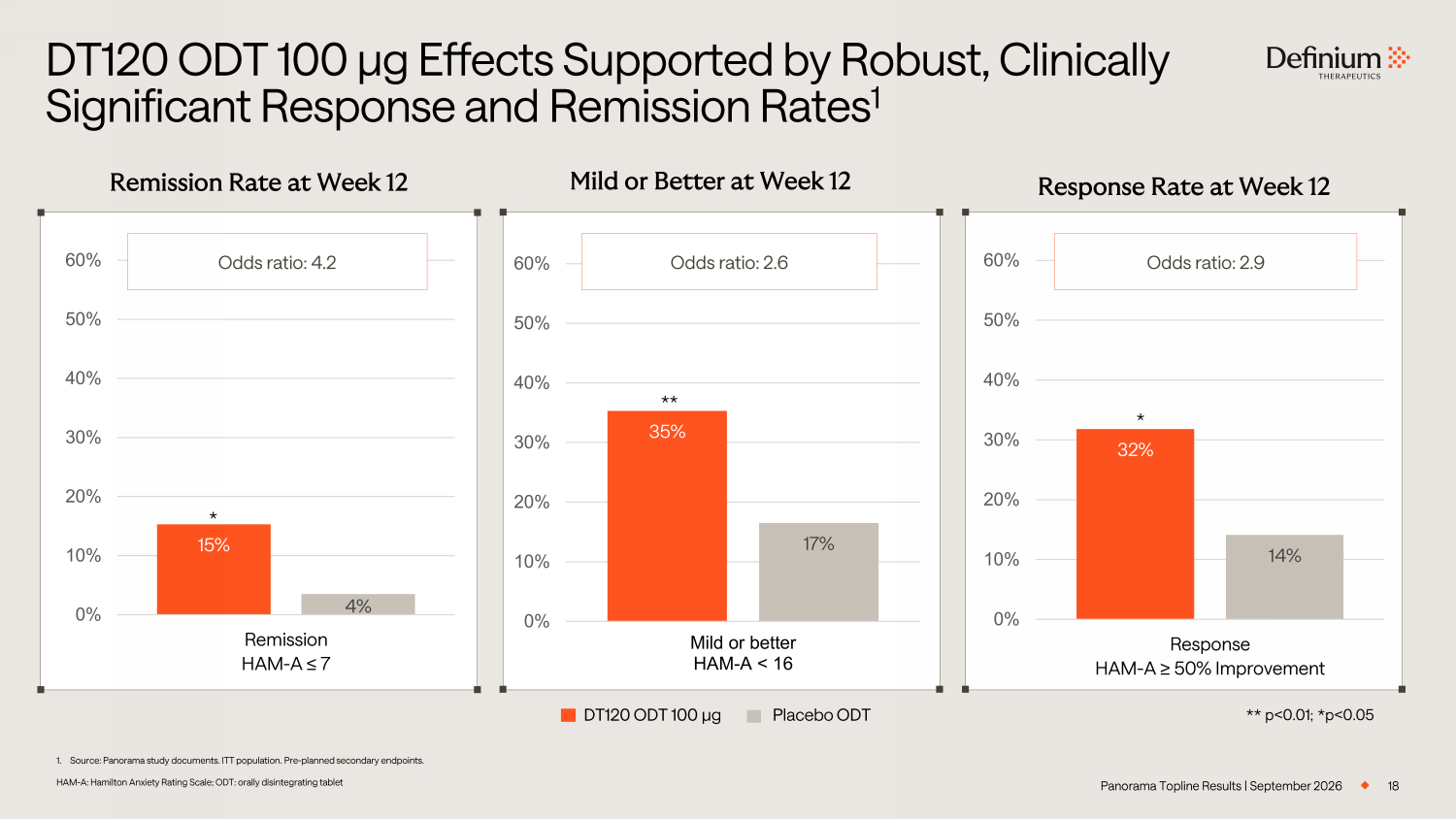
18 DT120 ODT 100 µg Effects Supported by Robust, Clinically Significant Response and Remission Rates 1 Panorama Topline Results | September 2026 Remission Rate at Week 12 Response Rate at Week 12 1. Source: Panorama study documents. ITT population. Pre - planned secondary endpoints. HAM - A: Hamilton Anxiety Rating Scale; ODT: orally disintegrating tablet ** p<0.01; *p<0.05 * * Placebo ODT DT120 ODT 100 µg ** Mild or Better at Week 12 15% 4% 0% 10% 20% 30% 40% 50% 60% Remission HAM - A ≤ 7 Odds ratio: 4.2 35% 17% 0% 10% 20% 30% 40% 50% 60% Mild or better HAM-A < 16 Odds ratio: 2.6 32% 14% 0% 10% 20% 30% 40% 50% 60% Response HAM - A ≥ 50% Improvement Odds ratio: 2.9 BR1 DF2 PJ3 JS4
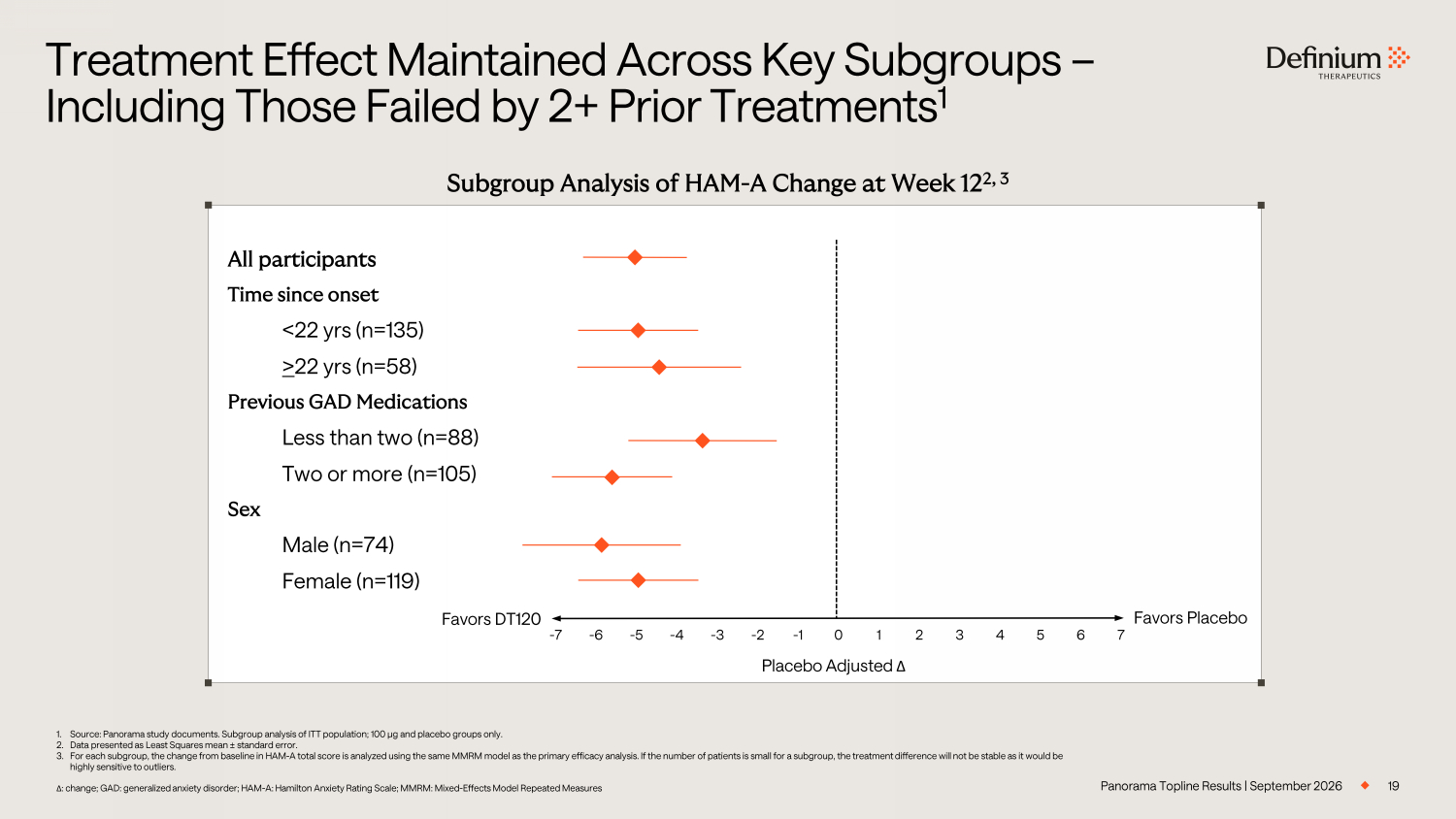
19 1. Source: Panorama study documents. Subgroup analysis of ITT population; 100 µg and placebo groups only. 2. Data presented as Least Squares mean ± standard error. 3. For each subgroup, the change from baseline in HAM - A total score is analyzed using the same MMRM model as the primary efficacy a nalysis. If the number of patients is small for a subgroup, the treatment difference will not be stable as it would be highly sensitive to outliers. Δ : change; GAD: generalized anxiety disorder; HAM - A: Hamilton Anxiety Rating Scale; MMRM: Mixed - Effects Model Repeated Measures Treatment Effect Maintained Across Key Subgroups – Including Those Failed by 2+ Prior Treatments 1 Panorama Topline Results | September 2026 Placebo Adjusted Δ Subgroup Analysis of HAM - A Change at Week 12 2, 3 7 6 5 4 3 2 1 0 - 1 - 2 - 3 - 4 - 5 - 6 - 7 All participants Time since onset <22 yrs (n=135) > 22 yrs (n=58) Previous GAD Medications Less than two (n=88) Two or more (n=105) Sex Male (n=74) Female (n=119) Favors DT120 Favors Placebo DF1 RF2 RB3 JS4 JS5
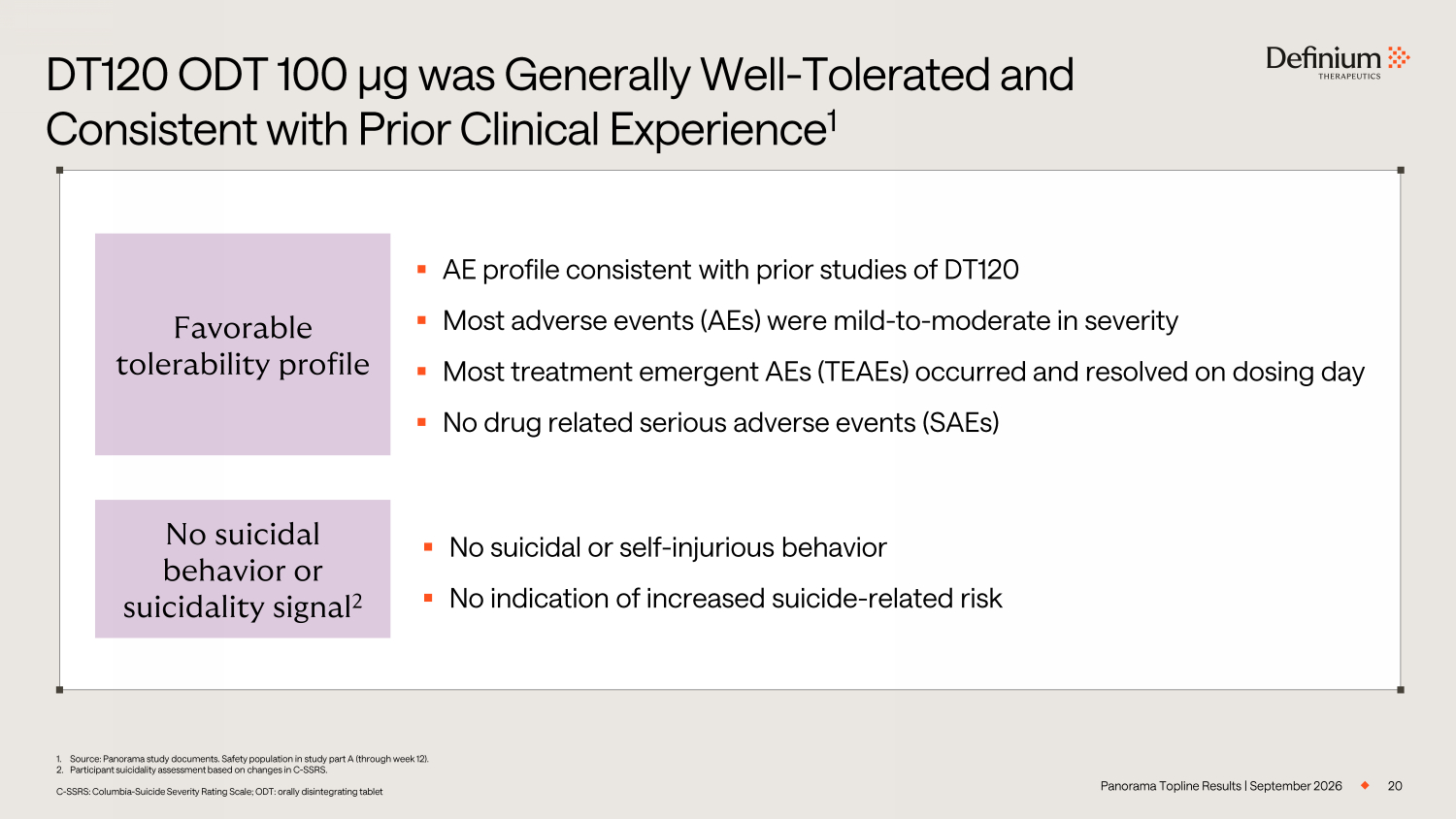
DT120 ODT 100 µg was Generally Well - Tolerated and Consistent with Prior Clinical Experience 1 1. Source: Panorama study documents. Safety population in study part A (through week 12). 2. Participant suicidality assessment based on changes in C - SSRS. C - SSRS: Columbia - Suicide Severity Rating Scale; ODT: orally disintegrating tablet ▪ AE profile consistent with prior studies of DT120 ▪ Most adverse events (AEs) were mild - to - moderate in severity ▪ Most treatment emergent AEs (TEAEs) occurred and resolved on dosing day ▪ No drug related serious adverse events (SAEs) Favorable tolerability profile No suicidal behavior or suicidality signal 2 ▪ No suicidal or self - injurious behavior ▪ No indication of increased suicide - related risk 20 Panorama Topline Results | September 2026 RF1 JS2 JS3 JS4 JS5 JS6
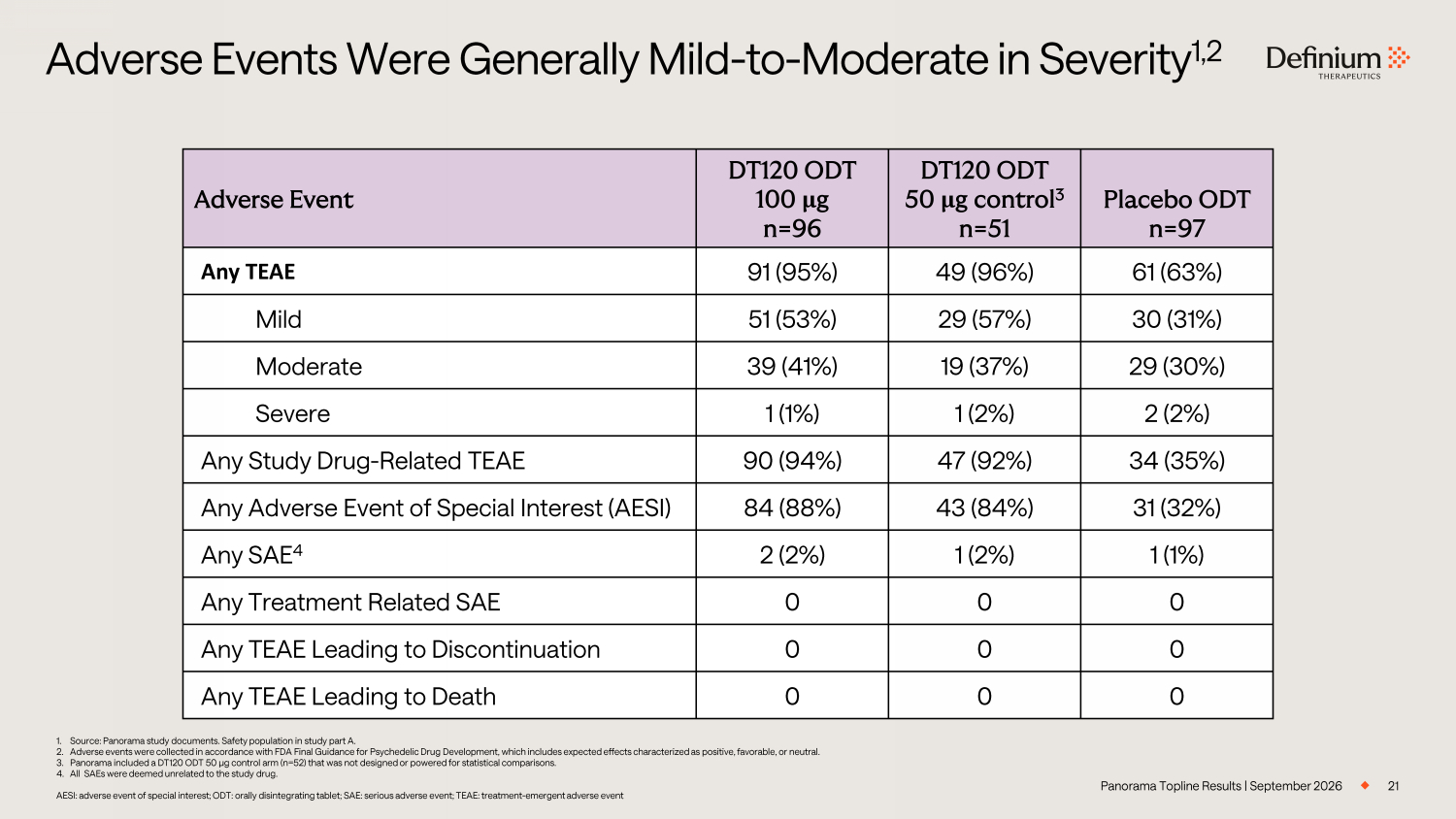
Panorama Topline Results | September 2026 21 Adverse Events Were Generally Mild - to - Moderate in Severity 1,2 Placebo ODT n=97 DT120 ODT 50 µ g control 3 n=51 DT120 ODT 100 µ g n=96 Adverse Event 61 (63%) 49 (96%) 91 (95%) Any TEAE 30 (31%) 29 (57%) 51 (53%) Mild 29 (30%) 19 (37%) 39 (41%) Moderate 2 (2%) 1 (2%) 1 (1%) Severe 34 (35%) 47 (92%) 90 (94%) Any Study Drug - Related TEAE 31 (32%) 43 (84%) 84 (88%) Any Adverse Event of Special Interest (AESI) 1 (1%) 1 (2%) 2 (2%) Any SAE 4 0 0 0 Any Treatment Related SAE 0 0 0 Any TEAE Leading to Discontinuation 0 0 0 Any TEAE Leading to Death 1. Source: Panorama study documents. Safety population in study part A. 2. Adverse events were collected in accordance with FDA Final Guidance for Psychedelic Drug Development, which includes expected ef fects characterized as positive, favorable, or neutral. 3. Panorama included a DT120 ODT 50 µg control arm (n=52) that was not designed or powered for statistical comparisons. 4. All SAEs were deemed unrelated to the study drug. AESI: adverse event of special interest; ODT: orally disintegrating tablet; SAE: serious adverse event; TEAE: treatment - emergent adverse eventPJ1 PJ2 RF3 RF4 JS5 JS6 JS7 JS8 RB9
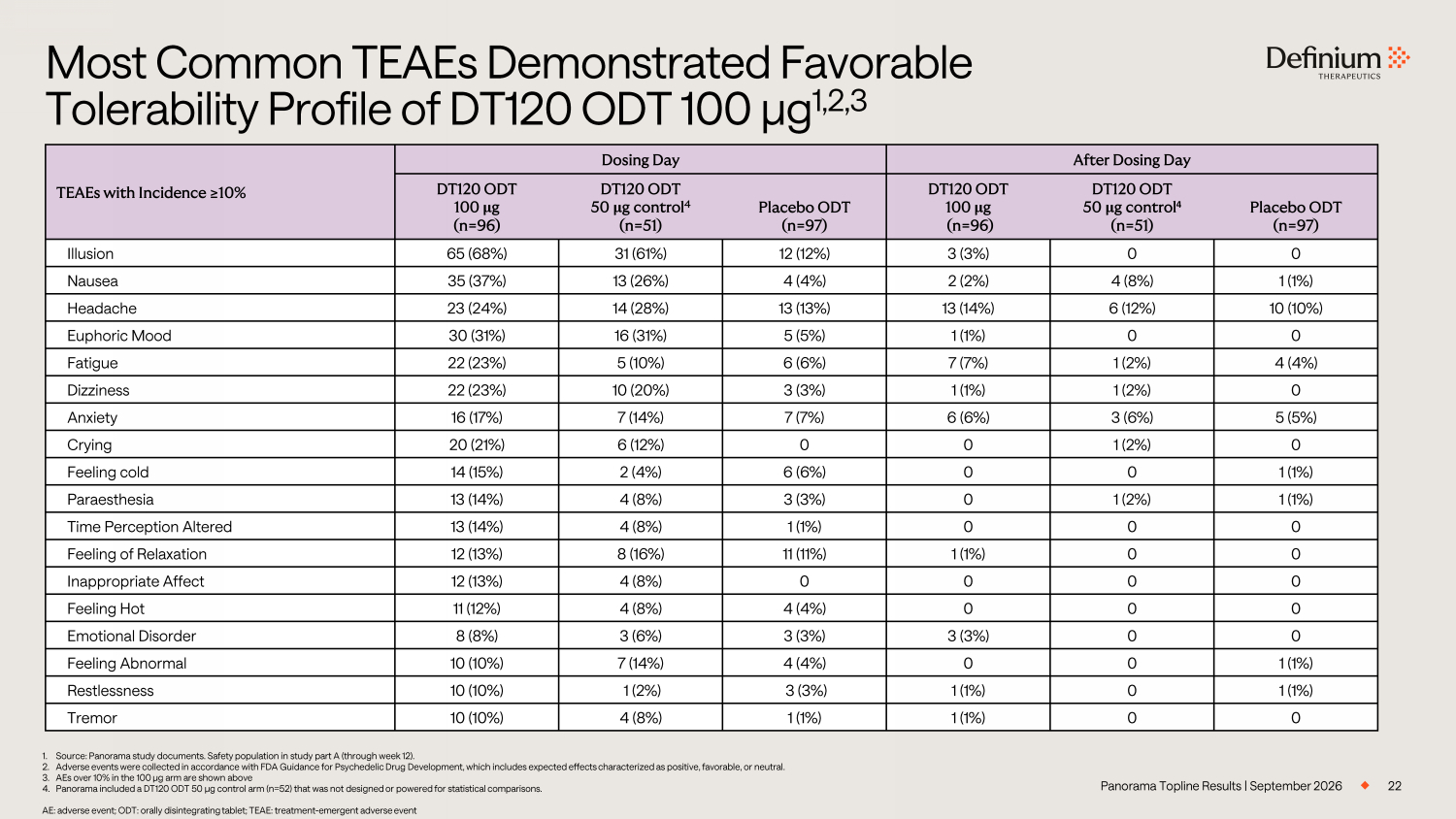
22 Most Common TEAEs Demonstrated Favorable Tolerability Profile of DT120 ODT 100 µg 1,2,3 Panorama Topline Results | September 2026 After Dosing Day Dosing Day TEAEs with Incidence ≥10% Placebo ODT (n=97) DT120 ODT 50 µ g control 4 (n=51) DT120 ODT 100 µ g (n=96) Placebo ODT (n=97) DT120 ODT 50 µ g control 4 (n=51) DT120 ODT 100 µ g (n=96) 0 0 3 (3%) 12 (12%) 31 (61%) 65 (68%) Illusion 1 (1%) 4 (8%) 2 (2%) 4 (4%) 13 (26%) 35 (37%) Nausea 10 (10%) 6 (12%) 13 (14%) 13 (13%) 14 (28%) 23 (24%) Headache 0 0 1 (1%) 5 (5%) 16 (31%) 30 (31%) Euphoric Mood 4 (4%) 1 (2%) 7 (7%) 6 (6%) 5 (10%) 22 (23%) Fatigue 0 1 (2%) 1 ( 1%) 3 (3%) 10 (20%) 22 (23%) Dizziness 5 (5%) 3 (6%) 6 (6%) 7 (7%) 7 (14%) 16 (17%) Anxiety 0 1 (2%) 0 0 6 (12%) 20 (21%) Crying 1 (1%) 0 0 6 (6%) 2 (4%) 14 (15%) Feeling cold 1 (1%) 1 (2%) 0 3 (3%) 4 (8%) 13 (14%) Paraesthesia 0 0 0 1 (1%) 4 (8%) 13 (14%) Time Perception Altered 0 0 1 (1%) 11 (11%) 8 (16%) 12 (13%) Feeling of Relaxation 0 0 0 0 4 (8%) 12 (13%) Inappropriate Affect 0 0 0 4 (4%) 4 (8%) 11 (12%) Feeling Hot 0 0 3 (3%) 3 (3%) 3 (6%) 8 (8%) Emotional Disorder 1 (1%) 0 0 4 (4%) 7 (14%) 10 (10%) Feeling Abnormal 1 (1%) 0 1 (1%) 3 (3%) 1 (2%) 10 (10%) Restlessness 0 0 1 (1%) 1 (1%) 4 (8%) 10 (10%) Tremor 1. Source: Panorama study documents. Safety population in study part A (through week 12). 2. Adverse events were collected in accordance with FDA Guidance for Psychedelic Drug Development, which includes expected effec ts characterized as positive, favorable, or neutral. 3. AEs over 10% in the 100 µg arm are shown above 4. Panorama included a DT120 ODT 50 µg control arm (n=52) that was not designed or powered for statistical comparisons. AE: adverse event; ODT: orally disintegrating tablet; TEAE: treatment - emergent adverse eventPJ1 RF2 RF3 JS4 JS5 JS6 JS7 JS8 JS9
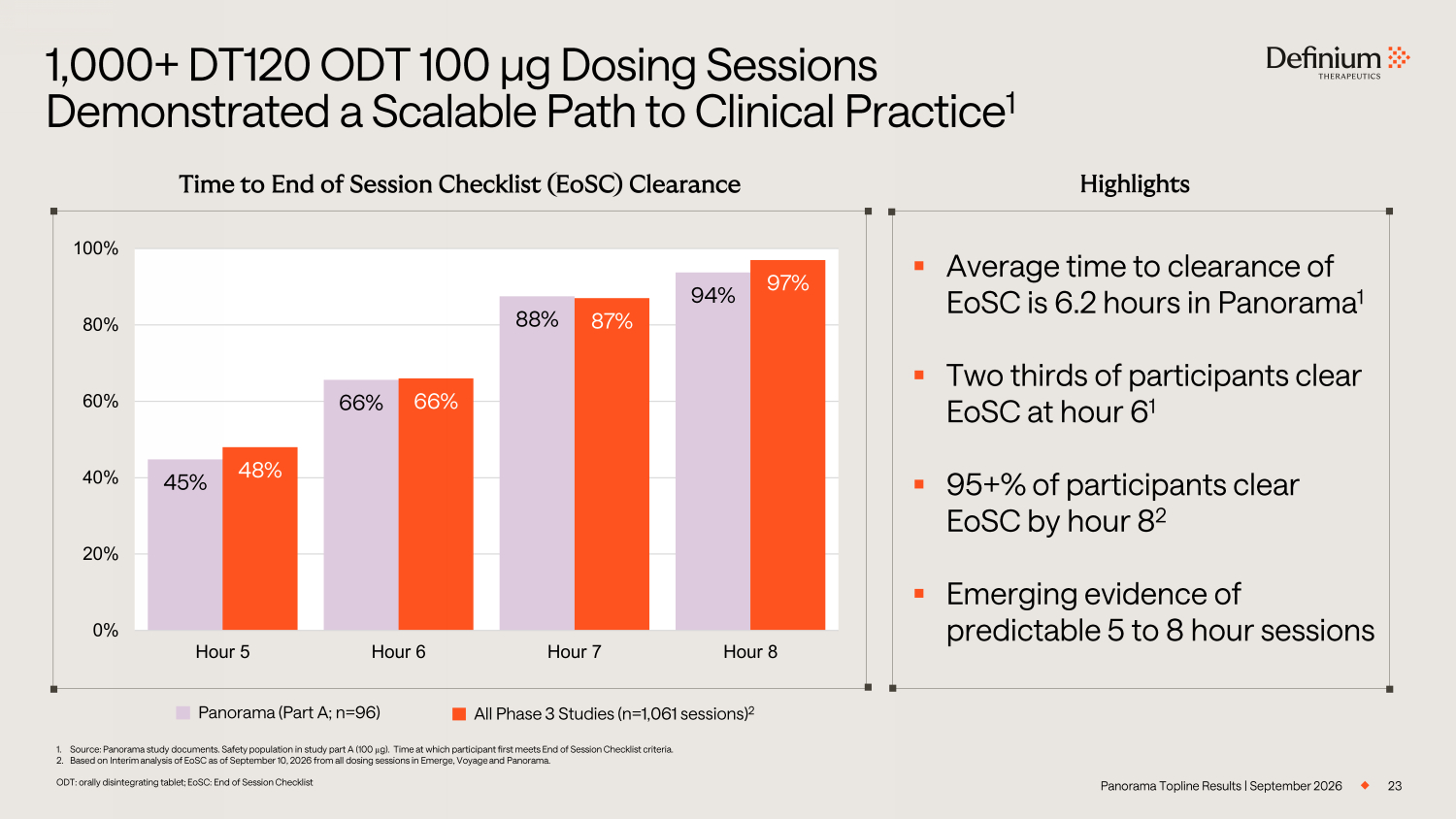
23 1. Source: Panorama study documents. Safety population in study part A (100 µ g). Time at which participant first meets End of Session Checklist criteria. 2. Based on Interim analysis of EoSC as of September 10, 2026 from all dosing sessions in Emerge, Voyage and Panorama. ODT: orally disintegrating tablet; EoSC: End of Session Checklist 1,000+ DT120 ODT 100 µg Dosing Sessions Demonstrated a Scalable Path to Clinical Practice 1 Panorama Topline Results | September 2026 Time to End of Session Checklist (EoSC) Clearance Highlights ▪ Average time to clearance of EoSC is 6.2 hours in Panorama 1 ▪ Two thirds of participants clear EoSC at hour 6 1 ▪ 95+% of participants clear EoSC by hour 8 2 ▪ Emerging evidence of predictable 5 to 8 hour sessions All Phase 3 Studies (n=1,061 sessions) 2 Panorama (Part A; n=96) 45% 66% 88% 94% 48% 66% 87% 97% 0% 20% 40% 60% 80% 100% Hour 5 Hour 6 Hour 7 Hour 8 DF1 PJ2 RF3 BR4
Phase 3 Panorama Topline Results Part B – Interim Analysis Dan Karlin, MD Chief Medical Officer
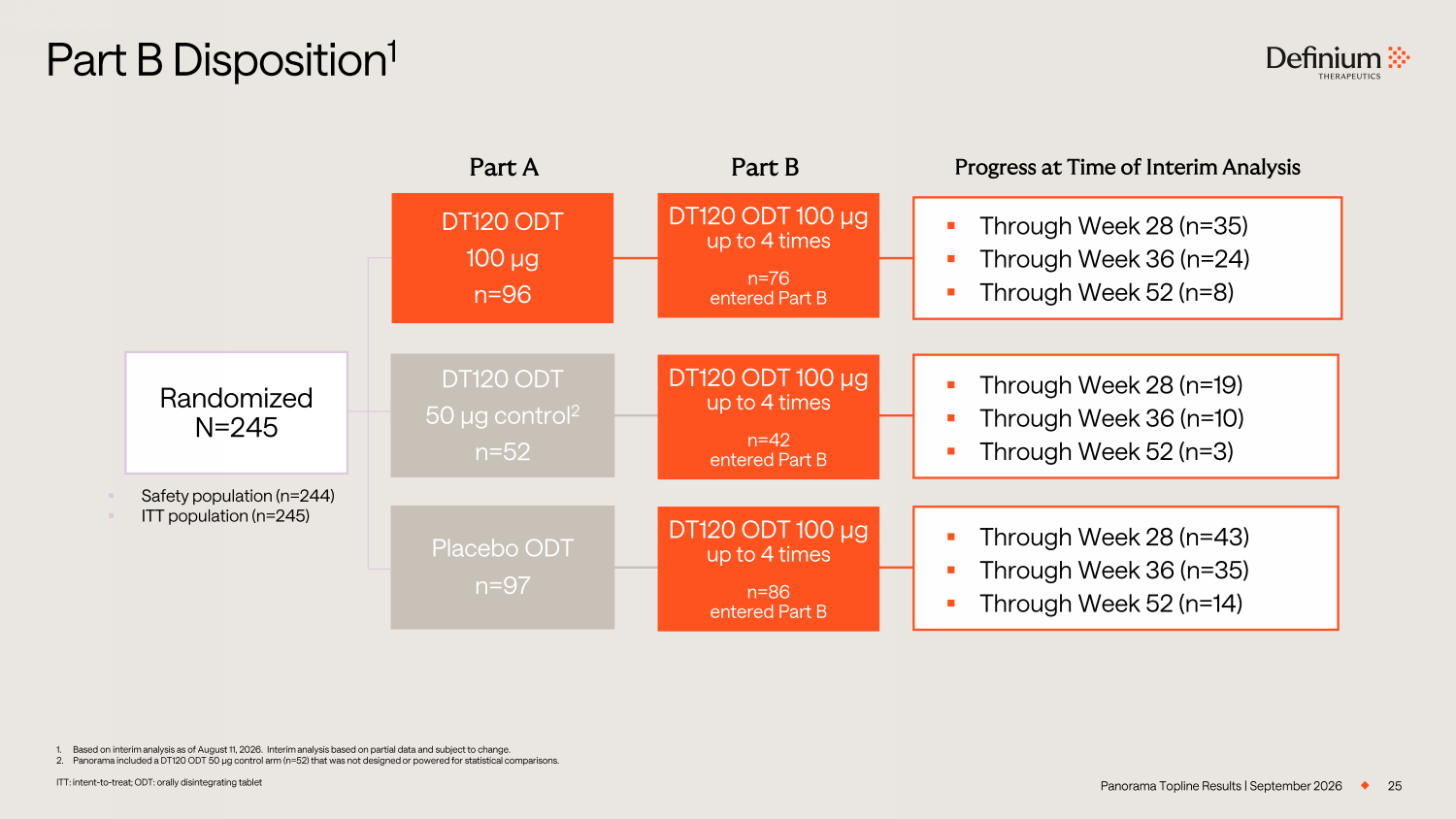
25 1. Based on interim analysis as of August 11, 2026. Interim analysis based on partial data and subject to change. 2. Panorama included a DT120 ODT 50 µg control arm (n=52) that was not designed or powered for statistical comparisons. ITT: intent - to - treat; ODT: orally disintegrating tablet Part B Disposition 1 Panorama Topline Results | September 2026 ▪ Safety population (n=244) ▪ ITT population (n=245) Part A Progress at Time of Interim Analysis Part B Randomized N=245 DT120 ODT 100 µg n=96 Placebo ODT n=97 DT120 ODT 100 µg up to 4 times n= 86 e ntered Part B ▪ Through Week 28 (n=35) ▪ Through Week 36 (n=24) ▪ Through Week 52 (n=8) ▪ Through Week 28 (n=43) ▪ Through Week 36 (n=35) ▪ Through Week 52 (n=14) DT120 ODT 100 µg up to 4 times n=76 e ntered Part B DT120 ODT 50 µg control 2 n=52 DT120 ODT 100 µg up to 4 times n=42 e ntered Part B ▪ Through Week 28 (n=19) ▪ Through Week 36 (n=10) ▪ Through Week 52 (n=3) BR1 DF2 PJ3 RF4 JS5
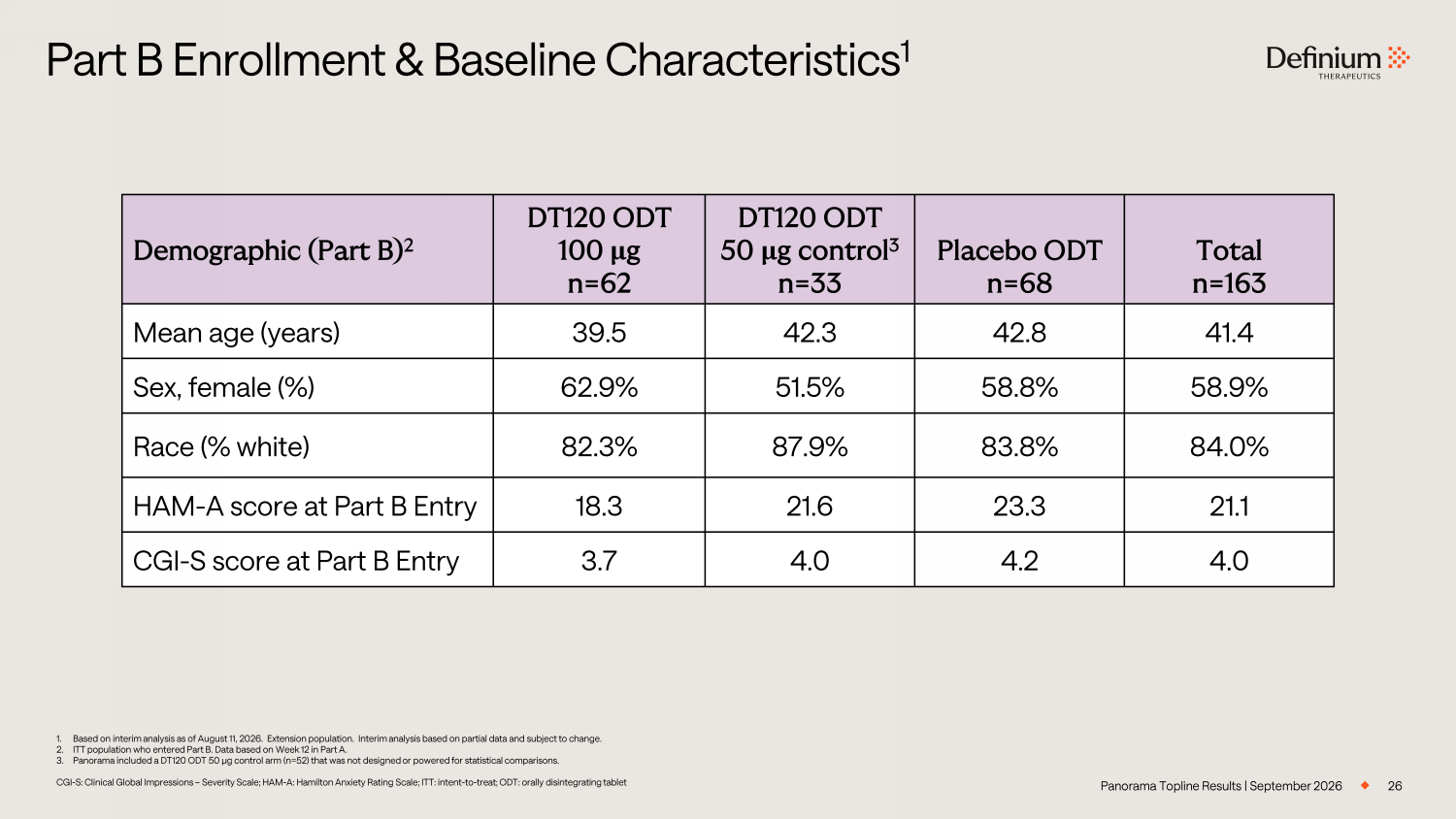
26 1. Based on interim analysis as of August 11, 2026. Extension population. Interim analysis based on partial data and subject t o c hange. 2. ITT population who entered Part B. Data based on Week 12 in Part A. 3. Panorama included a DT120 ODT 50 µg control arm (n=52) that was not designed or powered for statistical comparisons. CGI - S: Clinical Global Impressions – Severity Scale; HAM - A: Hamilton Anxiety Rating Scale; ITT: intent - to - treat; ODT: orally dis integrating tablet Part B Enrollment & Baseline Characteristics 1 Panorama Topline Results | September 2026 Total n=163 Placebo ODT n=68 DT120 ODT 50 µ g control 3 n=33 DT120 ODT 100 µ g n=62 Demographic (Part B) 2 41.4 42.8 42.3 39.5 Mean age (years) 58.9% 58.8% 51.5% 62.9% Sex, female (%) 84.0% 83.8% 87.9% 82.3% Race (% white) 21.1 23.3 21.6 18.3 HAM - A score at Part B Entry 4.0 4.2 4.0 3.7 CGI - S score at Part B Entry DF1 PJ2 RF3 JS4
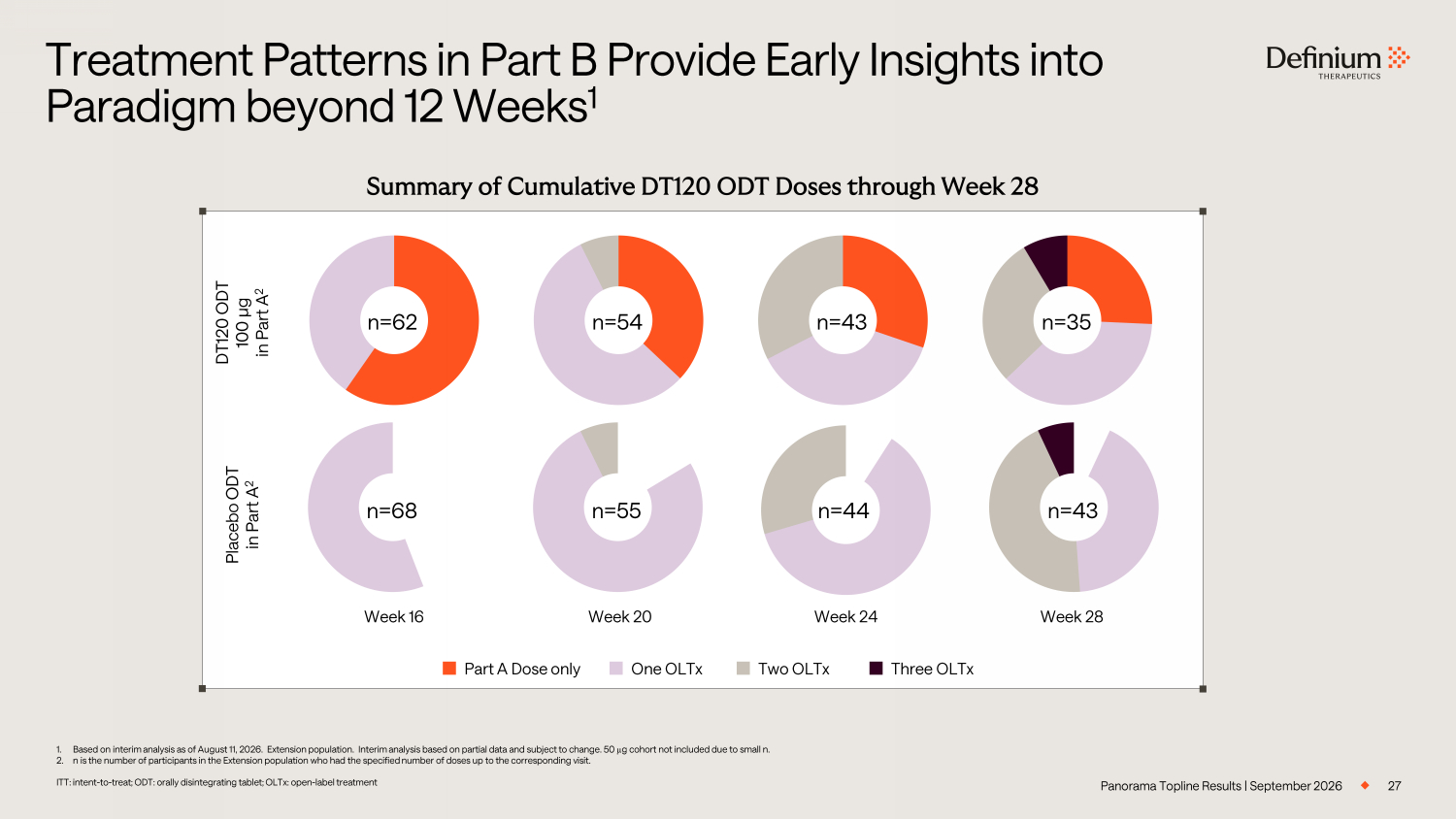
27 1. Based on interim analysis as of August 11, 2026. Extension population. Interim analysis based on partial data and subject t o c hange. 50 µ g cohort not included due to small n. 2. n is the number of participants in the Extension population who had the specified number of doses up to the corresponding vis it. ITT: intent - to - treat; ODT: orally disintegrating tablet; OLTx: open - label treatment Treatment Patterns in Part B Provide Early Insights into Paradigm beyond 12 Weeks 1 Panorama Topline Results | September 2026 Summary of Cumulative DT120 ODT Doses through Week 28 Week 28 Week 24 Week 20 Week 16 DT120 ODT 100 µg in Part A 2 Placebo ODT in Part A 2 Part A Dose only One OLTx Two OLTx Three OLTx n=62 n=54 n=43 n=35 n=68 n=55 n=44 n=43 BR1 DF2 BR3 RF4
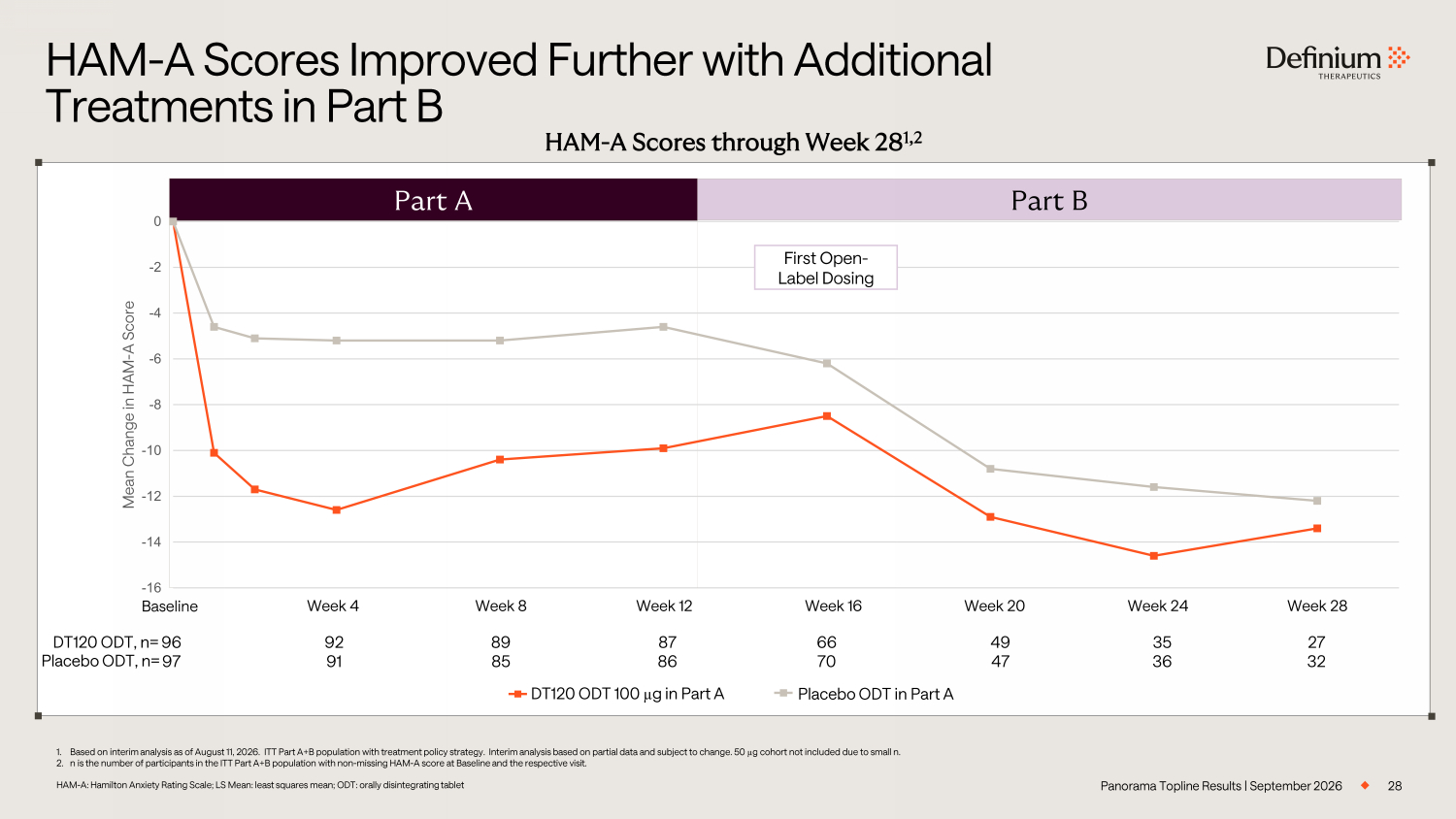
28 1. Based on interim analysis as of August 11, 2026. ITT Part A+B population with treatment policy strategy. Interim analysis b ase d on partial data and subject to change. 50 µ g cohort not included due to small n. 2. n is the number of participants in the ITT Part A+B population with non - missing HAM - A score at Baseline and the respective visit . HAM - A: Hamilton Anxiety Rating Scale; LS Mean: least squares mean; ODT: orally disintegrating tablet HAM - A Scores Improved Further with Additional Treatments in Part B Panorama Topline Results | September 2026 HAM - A Scores through Week 28 1,2 Placebo ODT in Part A Part A Part B Baseline -16 -14 -12 -10 -8 -6 -4 -2 0 Mean Change in HAM - A Score Week 4 Week 8 Week 12 Week 16 Week 20 Week 24 Week 28 First Open - Label Dosing 27 35 49 66 87 89 92 96 32 36 47 70 86 85 91 97 DT120 ODT, n= Placebo ODT, n= DT120 ODT 100 µ g in Part A BR1 DF2 PJ3PJ4RF5 JS6JS7 JS8
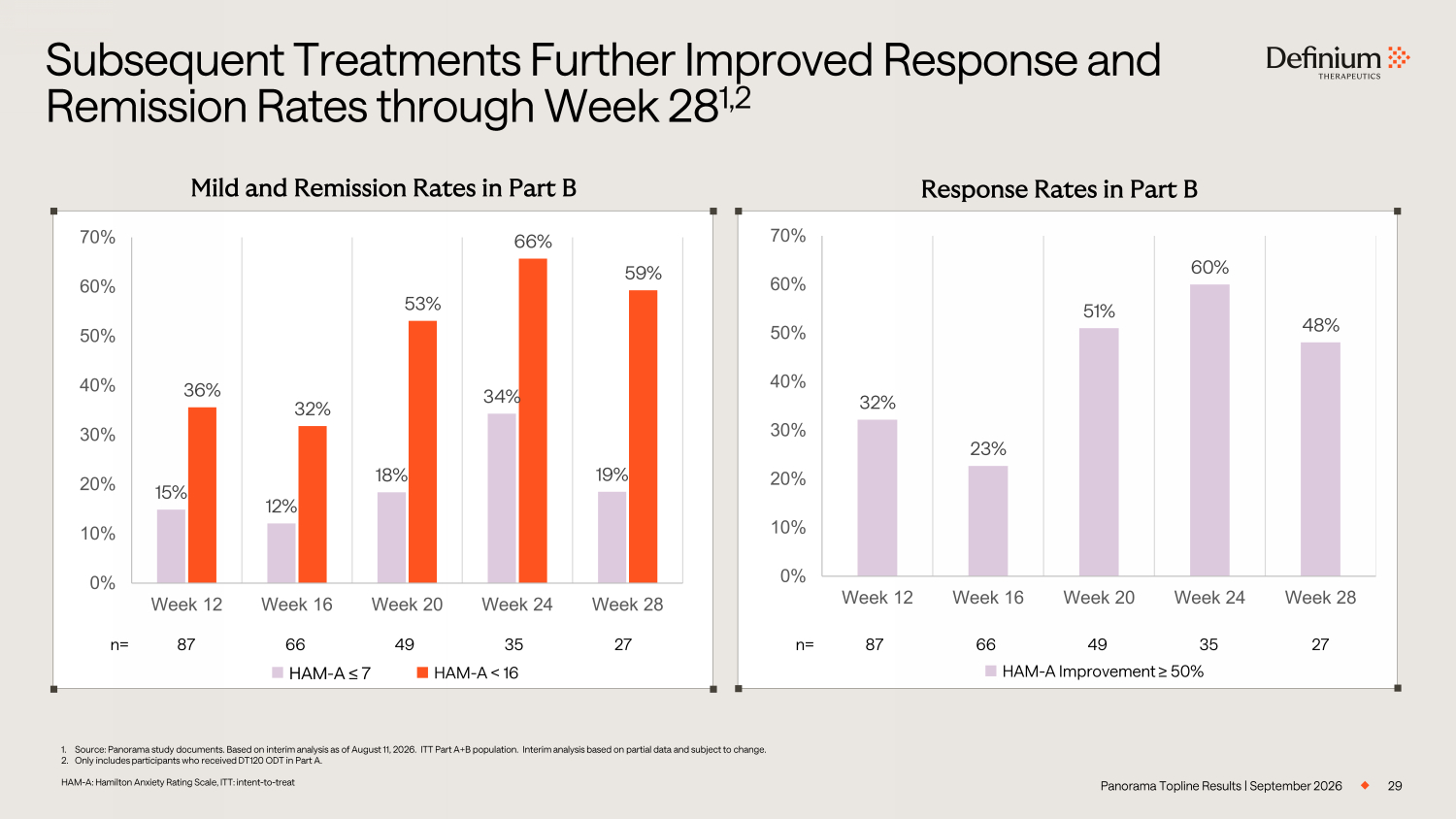
29 Subsequent Treatments Further Improved Response and Remission Rates through Week 28 1,2 Panorama Topline Results | September 2026 Mild and Remission Rates in Part B Response Rates in Part B 1. Source: Panorama study documents. Based on interim analysis as of August 11, 2026. ITT Part A+B population. Interim analysi s b ased on partial data and subject to change. 2. Only includes participants who received DT120 ODT in Part A. HAM - A: Hamilton Anxiety Rating Scale, ITT: intent - to - treat HAM - A Improvement ≥ 50% HAM - A ≤ 7 HAM - A < 16 27 35 49 66 87 n= 27 35 49 66 87 n= 15% 12% 18% 34% 19% 36% 32% 53% 66% 59% 0% 10% 20% 30% 40% 50% 60% 70% Week 12 Week 16 Week 20 Week 24 Week 28 32% 23% 51% 60% 48% 0% 10% 20% 30% 40% 50% 60% 70% Week 12 Week 16 Week 20 Week 24 Week 28 DF1 PJ2PJ3 JS4 BR5 JS6

Next Steps Rob Barrow Chief Executive Officer
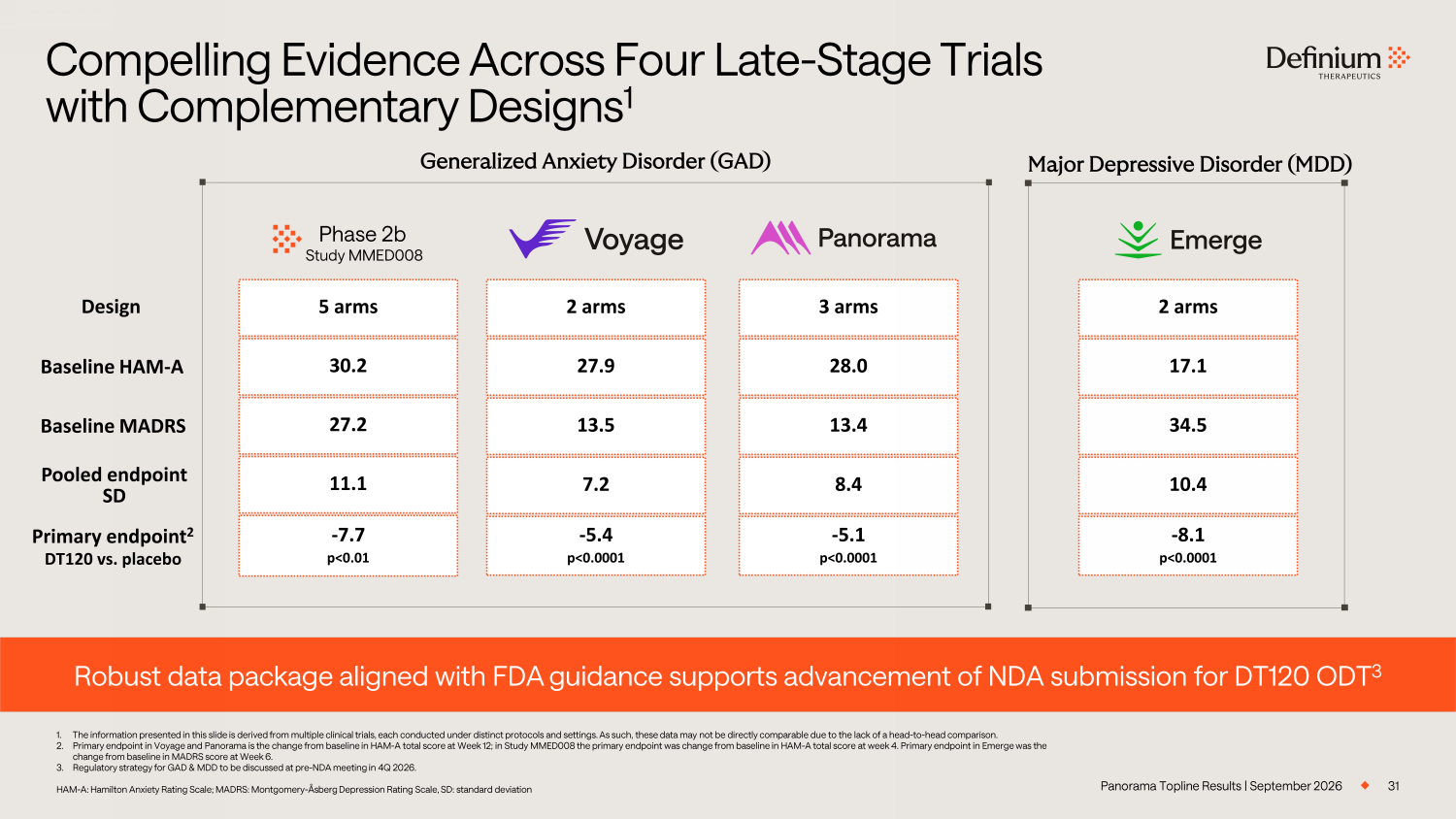
Panorama Topline Results | September 2026 31 Compelling Evidence Across Four Late - Stage Trials with Complementary Designs 1 1. The information presented in this slide is derived from multiple clinical trials, each conducted under distinct protocols and se ttings. As such, these data may not be directly comparable due to the lack of a head - to - head comparison. 2. Primary endpoint in Voyage and Panorama is the change from baseline in HAM - A total score at Week 12; in Study MMED008 the primar y endpoint was change from baseline in HAM - A total score at week 4. Primary endpoint in Emerge was the change from baseline in MADRS score at Week 6. 3. Regulatory strategy for GAD & MDD to be discussed at pre - NDA meeting in 4Q 2026. HAM - A: Hamilton Anxiety Rating Scale; MADRS: Montgomery - Åsberg Depression Rating Scale, SD: standard deviation Generalized Anxiety Disorder (GAD) Primary endpoint 2 DT120 vs. placebo Design Baseline HAM - A Baseline MADRS - 5.4 p<0.0001 2 arms 27.9 13.5 7.2 Pooled endpoint SD - 5.1 p<0.0001 3 arms 28.0 13.4 8.4 Major Depressive Disorder (MDD) - 8.1 p<0.0001 2 arms 17.1 34.5 10.4 - 7.7 p<0.01 5 arms 30.2 27.2 11.1 Phase 2b Study MMED008 Robust data package aligned with FDA g uidance supports advancement of NDA submission for DT120 ODT 3BR1PJ2RF3 JS4 JS5 RB6 RB7 RB8 BR9
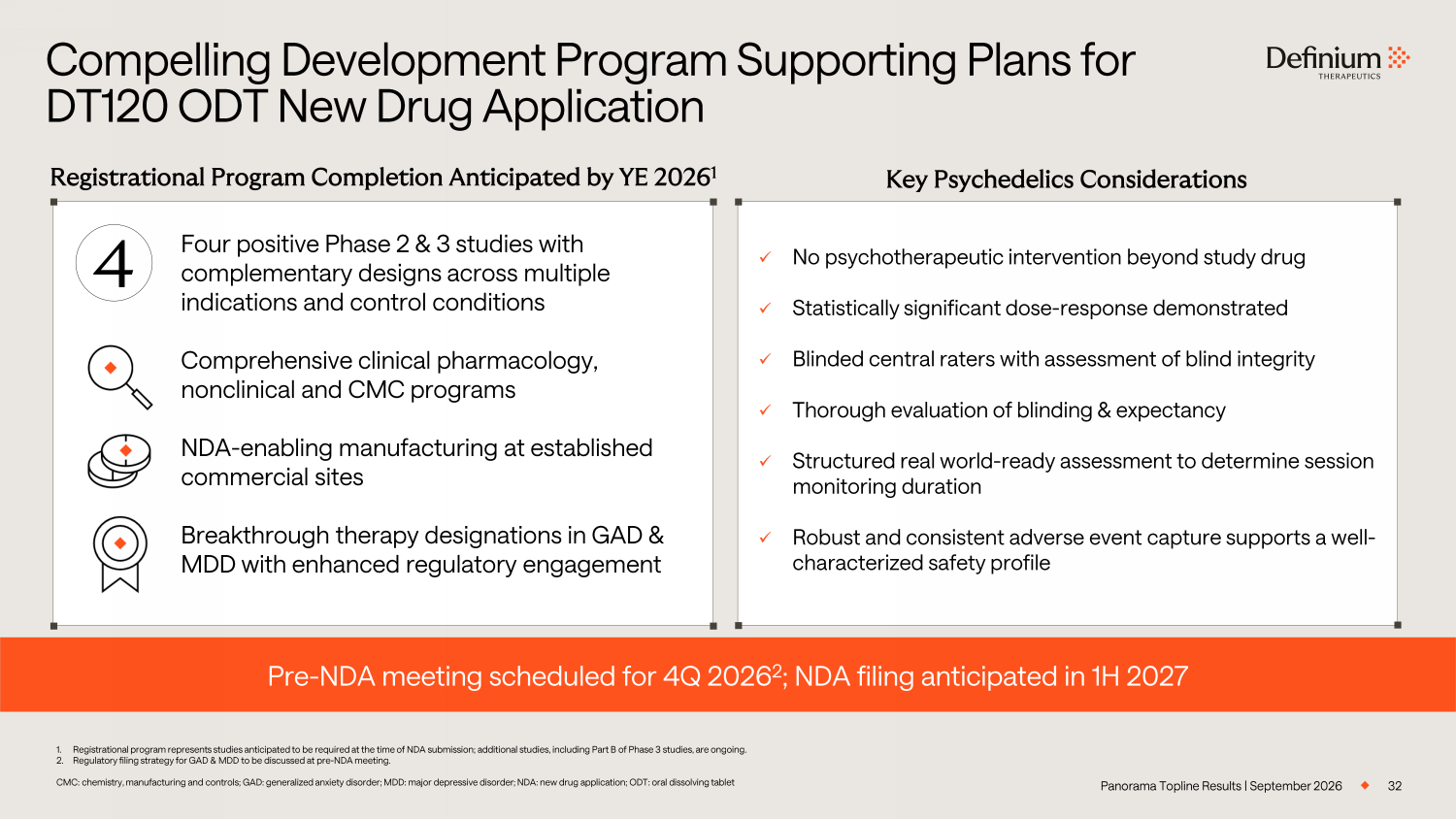
Panorama Topline Results | September 2026 32 Compelling Development Program Supporting Plans for DT120 ODT New Drug Application 1. Registrational program represents studies anticipated to be required at the time of NDA submission; additional studies, inclu din g Part B of Phase 3 studies, are ongoing. 2. Regulatory filing strategy for GAD & MDD to be discussed at pre - NDA meeting. CMC: chemistry, manufacturing and controls; GAD: generalized anxiety disorder; MDD: major depressive disorder; NDA: new drug app lication; ODT: oral dissolving tablet Registrational Program Completion Anticipated by YE 2026 1 Key Psychedelics Considerations x No psychotherapeutic intervention beyond study drug x Statistically significant dose - response demonstrated x Blinded central raters with assessment of blind integrity x Thorough evaluation of blinding & expectancy x Structured real world - ready assessment to determine session monitoring duration x Robust and consistent adverse event capture supports a well - characterized safety profile Four positive Phase 2 & 3 studies with complementary designs across multiple indications and control conditions Comprehensive clinical pharmacology, nonclinical and CMC programs NDA - enabling manufacturing at established commercial sites Breakthrough therapy designations in GAD & MDD with enhanced regulatory engagement Pre - NDA meeting scheduled for 4Q 2026 2 ; NDA filing anticipated in 1H 2027 4 MS1 JS2 RF3 JS4 JS5 JS6 JS7 JS8 BR9BR10 JS11 JS12 RB13 JS14 BR15
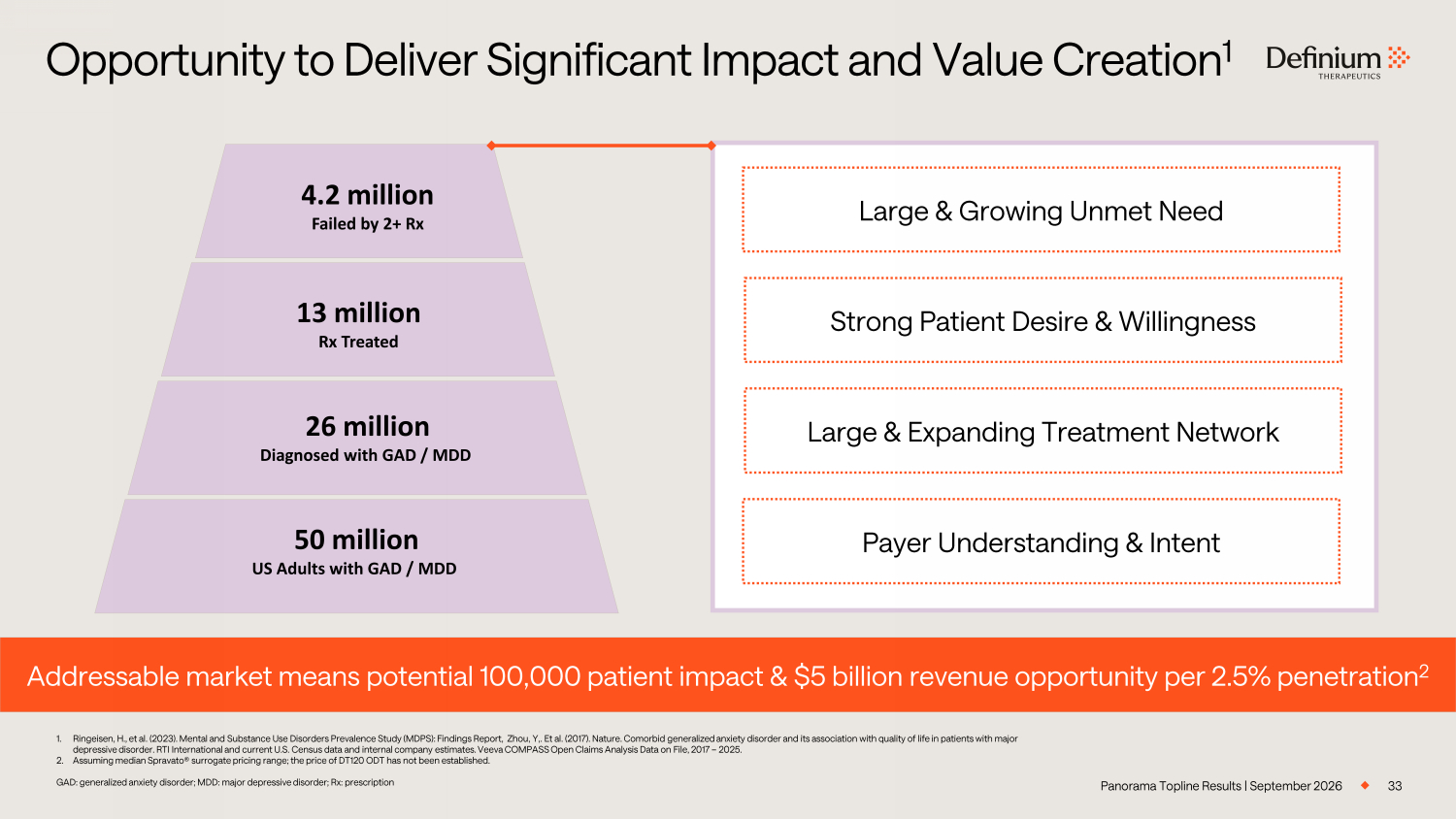
Panorama Topline Results | September 2026 33 Opportunity to Deliver Significant Impact and Value Creation 1 1. Ringeisen, H., et al. (2023). Mental and Substance Use Disorders Prevalence Study (MDPS): Findings Report, Zhou, Y,. Et al. (20 17). Nature. Comorbid generalized anxiety disorder and its association with quality of life in patients with major depressive disorder. RTI International and current U.S. Census data and internal company estimates. Veeva COMPASS Open Claims An alysis Data on File, 2017 – 2025. 2. Assuming median Spravato® surrogate pricing range; the price of DT120 ODT has not been established. GAD: generalized anxiety disorder; MDD: major depressive disorder; Rx: prescription Addressable market means potential 100,000 patient impact & $5 billion revenue opportunity per 2.5% penetration 2 50 million US Adults with GAD / MDD 26 million Diagnosed with GAD / MDD 13 million Rx Treated 4.2 million Failed by 2+ Rx Strong Patient Desire & Willingness Large & Expanding Treatment Network Payer Understanding & Intent Large & Growing Unmet Need RB1 RB2
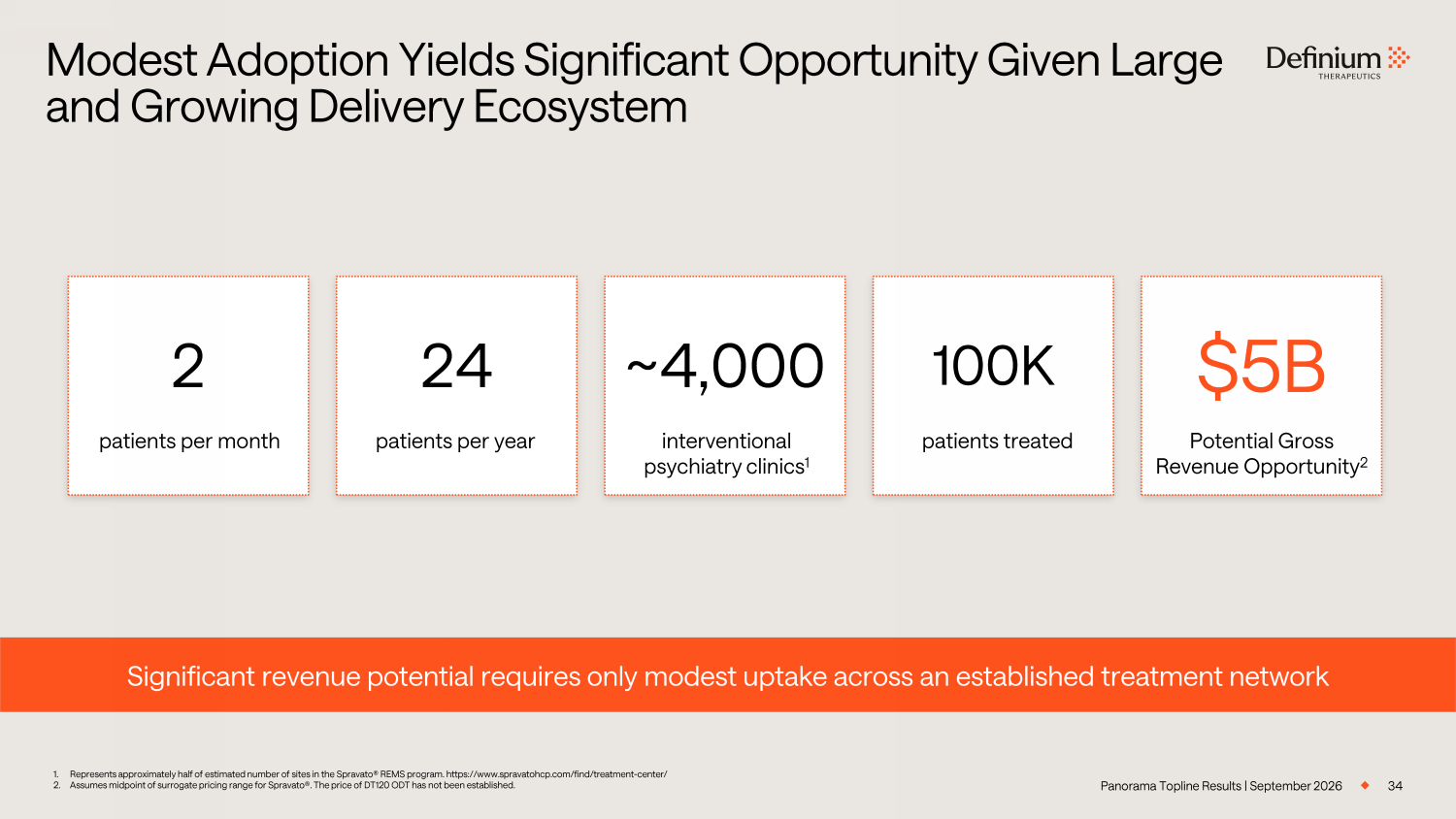
34 Modest Adoption Yields Significant Opportunity Given Large and Growing Delivery Ecosystem Panorama Topline Results | September 2026 Significant revenue potential requires only modest uptake across an established treatment network patients per month patients per year interventional psychiatry clinics 1 patients treated Potential Gross Revenue Opportunity 2 2 24 ~4,000 100K $5B 1. Represents approximately half of estimated number of sites in the Spravato® REMS program. https://www.spravatohcp.com/find/tr eat ment - center/ 2. Assumes midpoint of surrogate pricing range for Spravato®. The price of DT120 ODT has not been established. BR1
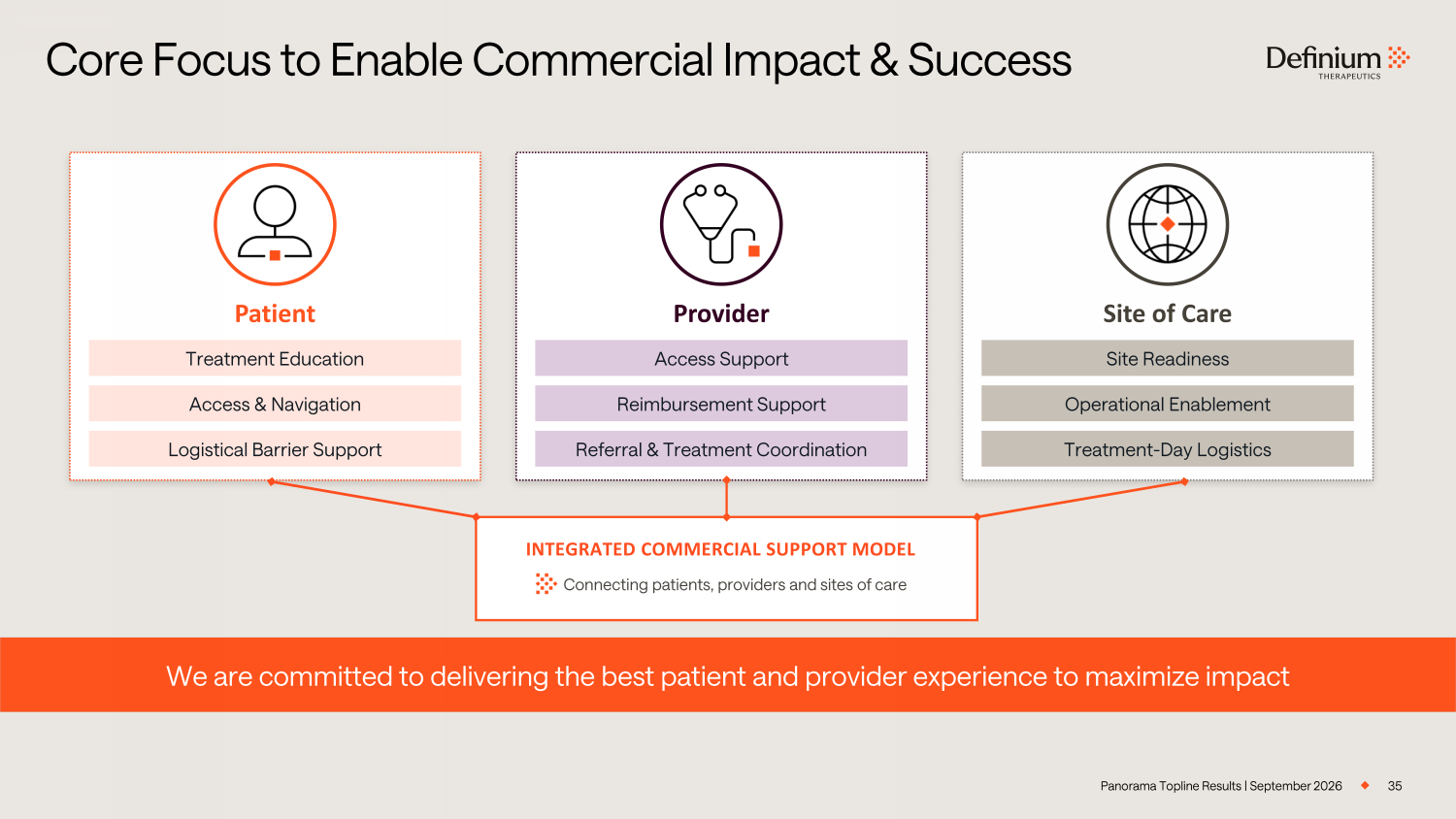
35 Core Focus to Enable Commercial Impact & Success Panorama Topline Results | September 2026 Patient Treatment Education Access & Navigation Logistical Barrier Support Provider Access Support Reimbursement Support Referral & Treatment Coordination Site of Care Site Readiness Operational Enablement Treatment - Day Logistics We are committed to delivering the best patient and provider experience to maximize impact INTEGRATED COMMERCIAL SUPPORT MODEL Connecting patients, providers and sites of care SF1 RB2 MW3 MW4
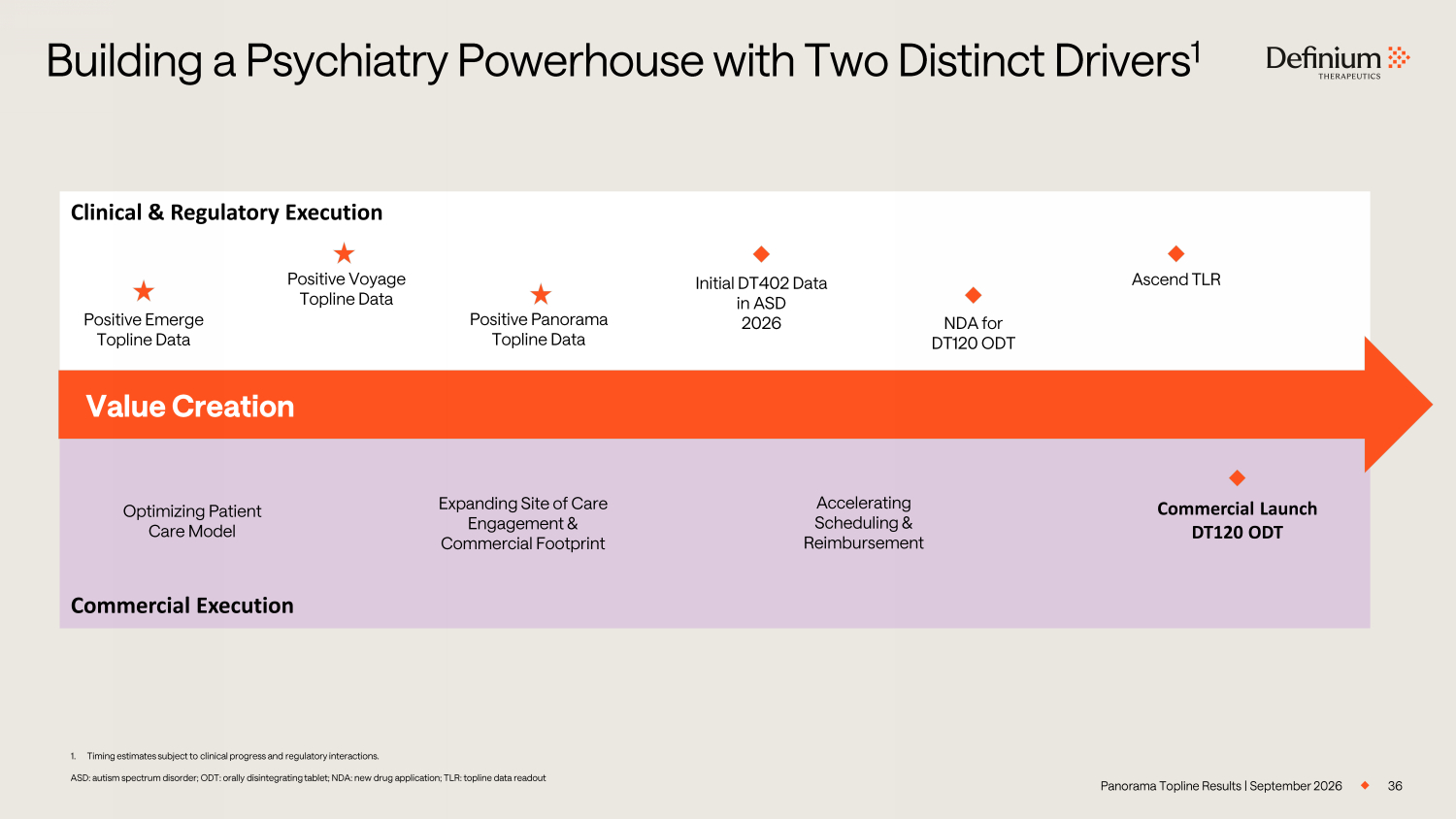
36 Building a Psychiatry Powerhouse with Two Distinct Drivers 1 1. Timing estimates subject to clinical progress and regulatory interactions. ASD: autism spectrum disorder; ODT: orally disintegrating tablet; NDA: new drug application; TLR: topline data readout Clinical & Regulatory Execution 2028 2027 2026 Commercial Execution Value Creation Expanding Site of Care Engagement & Commercial Footprint Accelerating Scheduling & Reimbursement Optimizing Patient Care Model Positive Voyage Topline Data Initial DT402 Data in ASD 2026 Positive Panorama Topline Data NDA for DT120 ODT Ascend TLR Commercial Launch DT120 ODT Panorama Topline Results | September 2026 Positive Emerge Topline Data JS1
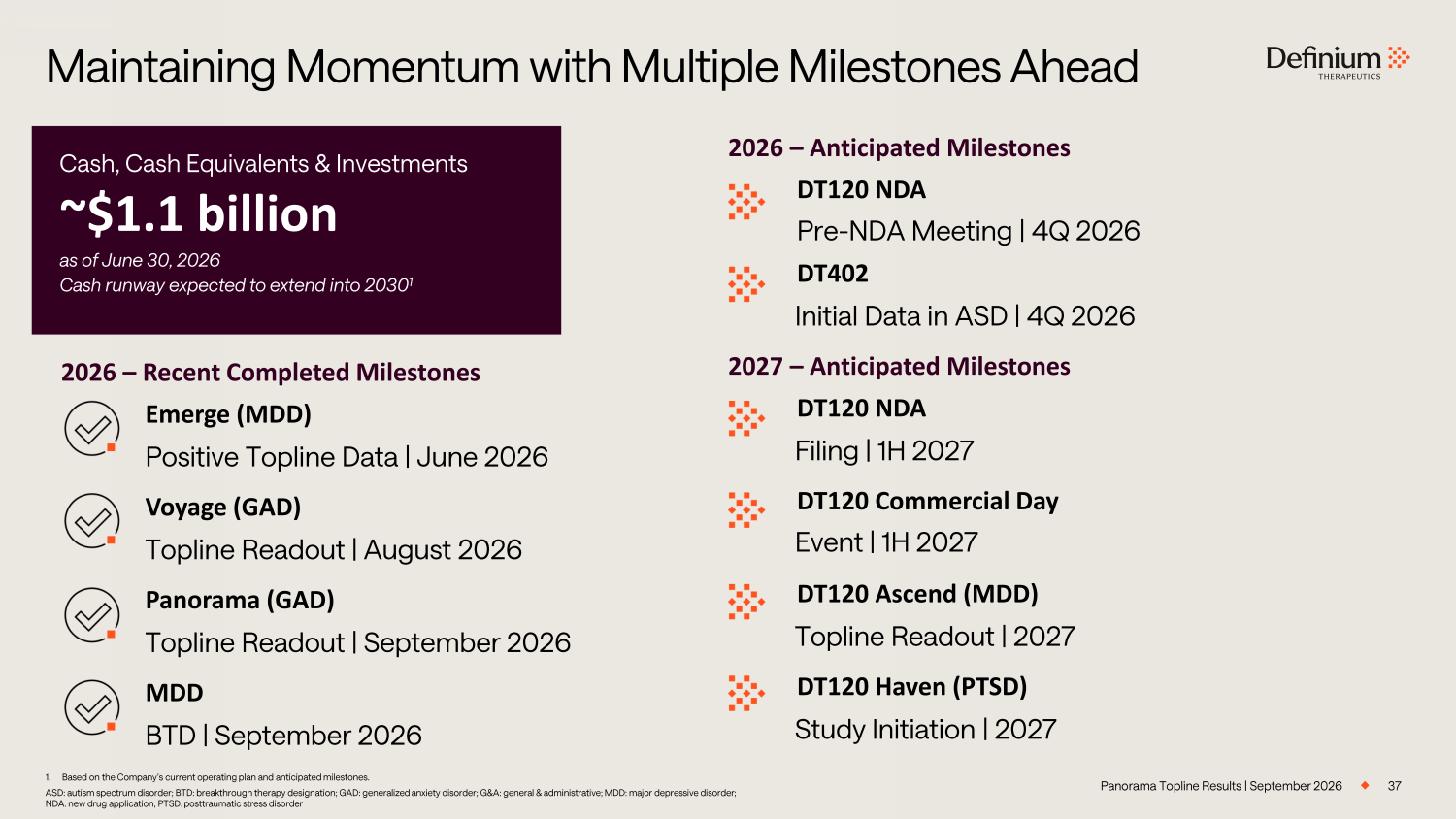
2026 – Recent Completed Milestones Emerge (MDD) Positive Topline Data | June 2026 Voyage (GAD) Topline Readout | August 2026 Panorama (GAD) Topline Readout | September 2026 MDD BTD | September 2026 2026 – Anticipated Milestones DT120 NDA Pre - NDA Meeting | 4Q 2026 DT402 Initial Data in ASD | 4Q 2026 2027 – Anticipated Milestones DT120 NDA Filing | 1H 2027 DT120 Commercial Day Event | 1H 2027 DT120 Ascend (MDD) Topline Readout | 2027 DT120 Haven (PTSD) Study Initiation | 2027 Panorama Topline Results | September 2026 37 Maintaining Momentum with Multiple Milestones Ahead 1. Based on the Company’s current operating plan and anticipated milestones. ASD: autism spectrum disorder; BTD: breakthrough therapy designation; GAD: generalized anxiety disorder; G&A: general & admin ist rative; MDD: major depressive disorder; NDA: new drug application; PTSD: posttraumatic stress disorder Cash, Cash Equivalents & Investments ~$1.1 b illion a s of June 30, 2026 Cash runway expected to extend into 2030 1 JS1 JS2 JS3 JS4 JS5 BR6 RB7 RB8 RB9


Q&A Session

Appendix
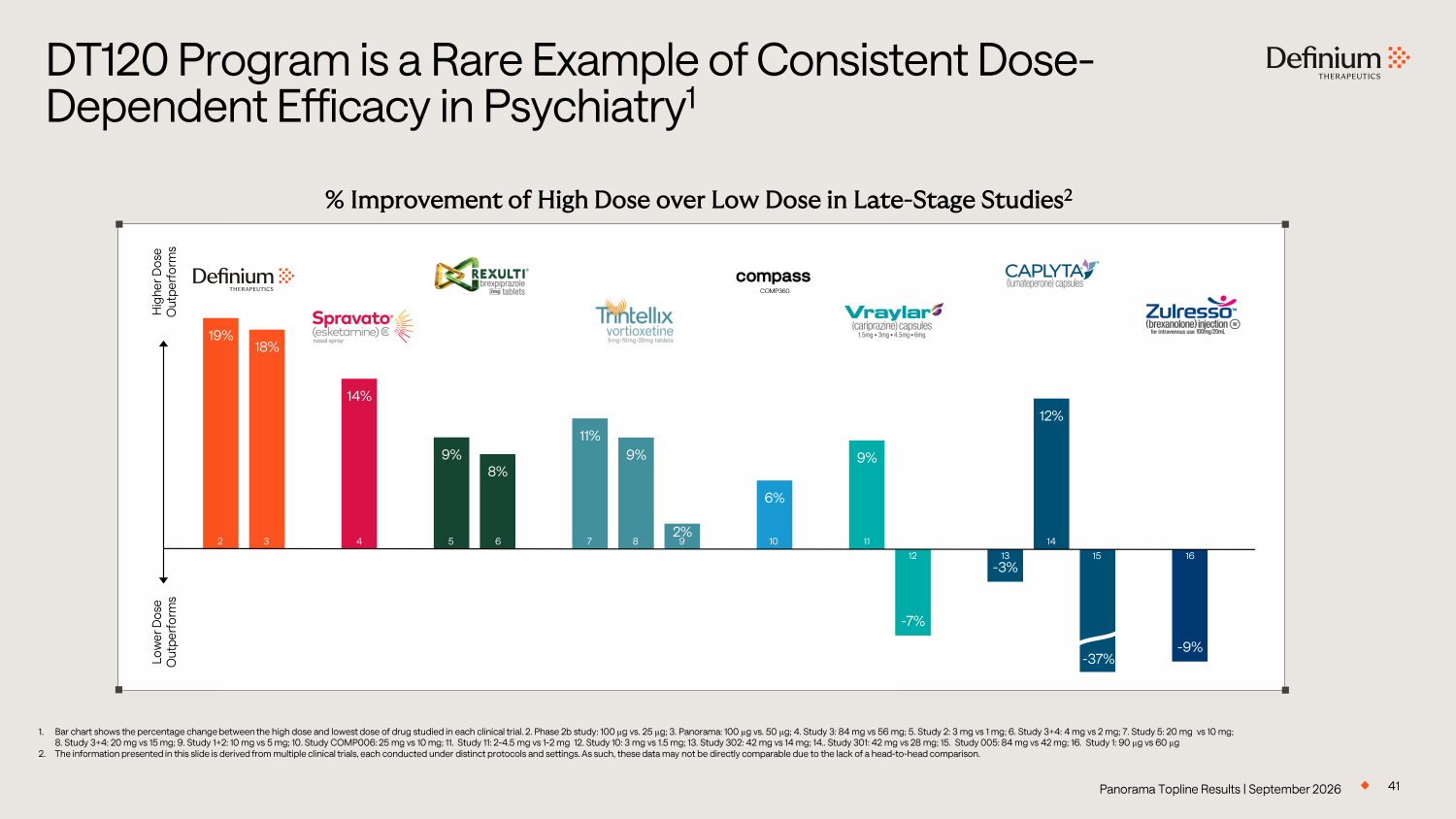
41 1. Bar chart shows the percentage change between the high dose and lowest dose of drug studied in each clinical trial. 2. Phase 2b study: 100 µ g vs. 25 µ g; 3. Panorama: 100 µ g vs. 50 µ g; 4. Study 3: 84 mg vs 56 mg; 5. Study 2: 3 mg vs 1 mg; 6. Study 3+4: 4 mg vs 2 mg; 7. Study 5: 20 mg vs 10 mg; 8. Study 3+4: 20 mg vs 15 mg; 9. Study 1+2: 10 mg vs 5 mg; 10. Study COMP006: 25 mg vs 10 mg; 11. Study 11: 2 - 4.5 mg vs 1 - 2 mg 12. Study 10: 3 mg vs 1.5 mg; 13. Study 302: 42 mg vs 14 mg; 14.. Study 301: 42 mg vs 28 mg; 15. Study 005: 84 mg vs 42 mg; 16 . Study 1: 90 µ g vs 60 µ g 2. The information presented in this slide is derived from multiple clinical trials, each conducted under distinct protocols and se ttings. As such, these data may not be directly comparable due to the lack of a head - to - head comparison. DT120 Program is a Rare Example of Consistent Dose - Dependent Efficacy in Psychiatry 1 Panorama Topline Results | September 2026 19% 18% 14% 9% 8% 11% 9% 2% 6% 9% - 7% - 3% 12% - 9% Higher Dose Outperforms 2 3 5 4 8 6 7 9 10 11 12 13 14 15 16 - 37% Lower Dose Outperforms % Improvement of High Dose over Low Dose in Late - Stage Studies 2 COMP360 RF1 JS2 JS3
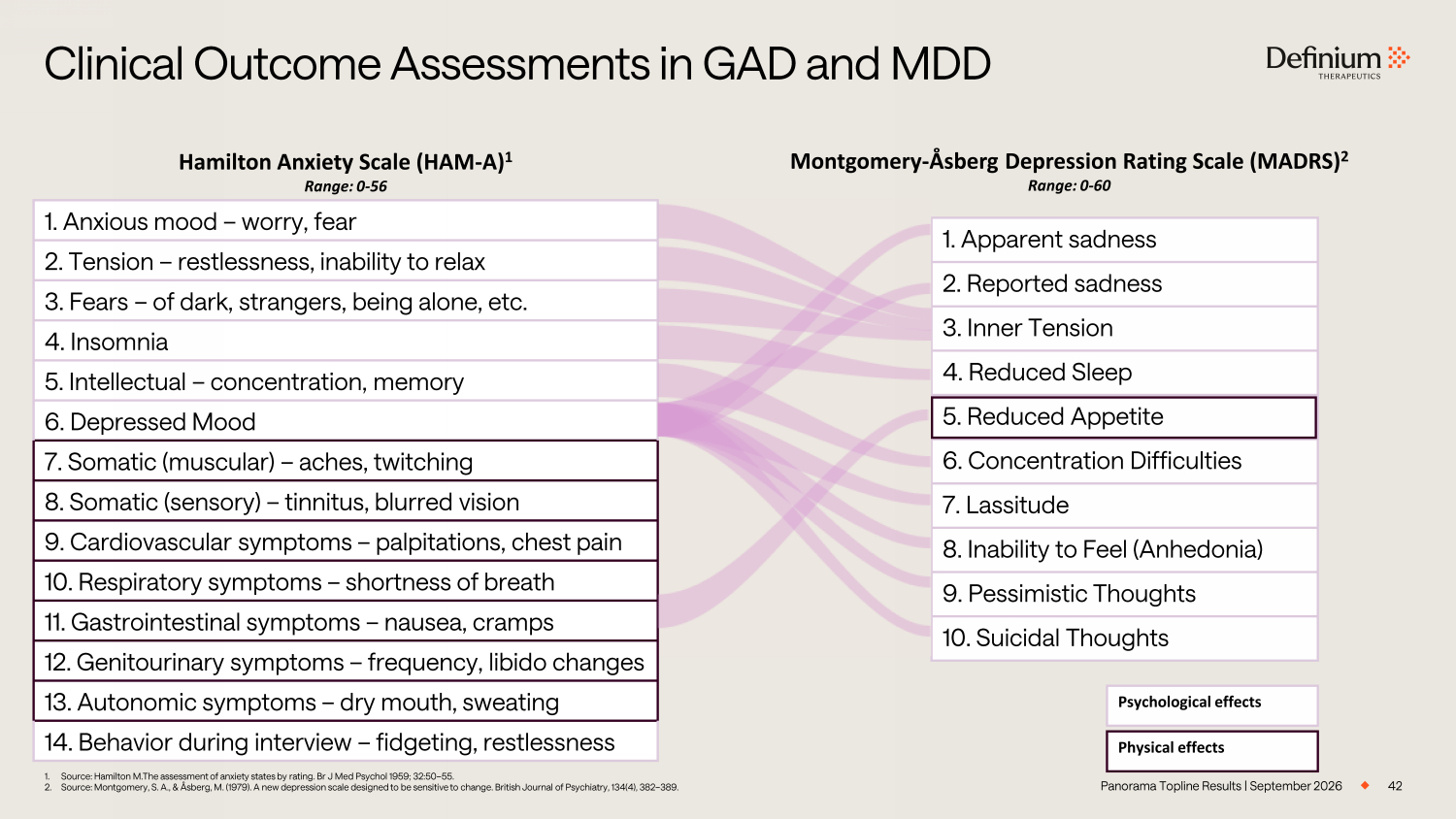
Panorama Topline Results | September 2026 42 Clinical Outcome Assessments in GAD and MDD Montgomery - Åsberg Depression Rating Scale (MADRS) 2 Range: 0 - 60 Hamilton Anxiety Scale (HAM - A) 1 Range: 0 - 56 1. Apparent sadness 2. Reported sadness 3. Inner Tension 4. Reduced Sleep 5. Reduced Appetite 6. Concentration Difficulties 7. Lassitude 8. Inability to Feel (Anhedonia) 9. Pessimistic Thoughts 10. Suicidal Thoughts 1. Anxious mood – worry, fear 2. Tension – restlessness, inability to relax 3. Fears – of dark, strangers, being alone, etc. 4. Insomnia 5. Intellectual – concentration, memory 6. Depressed Mood 7. Somatic (muscular) – aches, twitching 8. Somatic (sensory) – tinnitus, blurred vision 9. Cardiovascular symptoms – palpitations, chest pain 10. Respiratory symptoms – shortness of breath 11. Gastrointestinal symptoms – nausea, cramps 12. Genitourinary symptoms – frequency, libido changes 13. Autonomic symptoms – dry mouth, sweating 14. Behavior during interview – fidgeting, restlessness Psychological effects 1. Source: Hamilton M.The assessment of anxiety states by rating. Br J Med Psychol 1959; 32:50 – 55. 2. Source: Montgomery, S. A., & Åsberg, M. (1979). A new depression scale designed to be sensitive to change. British Journal of Ps ychiatry, 134(4), 382 – 389. Physical effects