DEF 14A: Definitive proxy statements
Published on April 27, 2026
UNITED STATES
SECURITIES AND EXCHANGE COMMISSION
Washington, D.C. 20549
(RULE 14a-101)
SCHEDULE 14A INFORMATION
Proxy Statement Pursuant to Section 14(a) of the
Securities Exchange Act of 1934
(Amendment No. )
Filed by the Registrant ☒
Filed by a Party other than the Registrant ☐
Check the appropriate box:
☐ Preliminary Proxy Statement
☐ Confidential, for Use of the Commission Only (as permitted by Rule 14a-6(e)(2))
☒ Definitive Proxy Statement
☐ Definitive Additional Materials
☐ Soliciting Material under §240.14a-12
(Name of Registrant as Specified In Its Charter)
(Name of Person(s) Filing Proxy Statement, if other than the Registrant)
Payment of Filing Fee (Check all boxes that apply):
☒ No fee required.
☐ Fee paid previously with preliminary materials.
☐ Fee computed on table in exhibit required by Item 25(b) per Exchange Act Rules 14a-6(i)(1) and 0-11.

DEFINIUM THERAPEUTICS, INC.
One World Trade Center, Suite 8500
New York, New York 10007
(212) 220-6633
NOTICE OF ANNUAL GENERAL AND SPECIAL MEETING OF SHAREHOLDERS
To be held on June 11, 2026 at 10:00 a.m. Eastern Time.
Dear Shareholder:
You are cordially invited to attend the Annual General and Special Meeting of Shareholders (the “Annual Meeting”) of Definium Therapeutics, Inc. (the “Company” or “Definium”), a British Columbia company. All shareholders are invited to attend the Annual Meeting, which will be held virtually via live webcast at www.virtualshareholdermeeting.com/DFTX2026 on June 11, 2026 at 10:00 a.m. Eastern Time. To participate, vote or submit questions during the Annual Meeting, shareholders or their proxyholders must log on to the virtual meeting platform by entering the 16-digit control number included on your proxy card, Notice of Internet Availability of Proxy Materials (“Notice”) or voting instruction form. Online access to the Annual Meeting will open approximately 15 minutes prior to the start of the virtual meeting.
The Annual Meeting and any or all adjournments or postponements thereof will be held for the following purposes:
(1) To elect Carol A. Vallone, Andreas Krebs, Dr. Suzanne Bruhn, Dr. Roger Crystal, David Gryska, Roger Adsett and Robert Barrow to the Company’s board of directors (the “Board of Directors” or the “Board”) to hold office until the 2027 annual general meeting of shareholders (“Proposal No. 1”);
(2) To appoint KPMG LLP (“KPMG”) as independent registered public accounting firm (auditor) for the Company until the 2027 annual general meeting of shareholders (“Proposal No. 2”);
(3) To consider and, if deemed advisable, approve the amendment to the Definium Therapeutics, Inc. 2025 Equity Incentive Plan (the “2025 Equity Incentive Plan”) to increase the number of common shares available for issuance under the 2025 Equity Incentive Plan (“Proposal No. 3”) by 5,000,000 common shares; and
(4) To conduct any other business properly brought before the Annual Meeting and any adjournment or postponement thereof.
These items of business are more fully described in the proxy statement accompanying this Notice of Annual General and Special Meeting of Shareholders. The Annual Meeting will be held in a virtual format to enable greater participation by shareholders. At the Annual Meeting, all shareholders, regardless of geographic location and equity ownership, will have an equal opportunity to participate. Please attend the Annual Meeting at www.virtualshareholdermeeting.com/DFTX2026. Audio can be accessed via a phone, tablet or computer.
The record date for the Annual Meeting is April 15, 2026 (the “Record Date”). Only shareholders of record as of the close of business on that date may vote at the Annual Meeting or any adjournment or postponement thereof.
You may vote by submitting your proxy via the Internet, by telephone, or by mail by following the instructions on the proxy card or Notice by June 10, 2026 at 11:59 p.m. Eastern Time. If you are a beneficial owner of shares registered in the name of a broker, bank or other nominee, you should have received a voting instruction form with these proxy materials from that organization rather than from Definium. Simply complete and mail the voting instruction form in accordance with the instructions in that form to ensure that your vote is counted. Alternatively, you may vote by telephone or over the Internet by following the instructions provided by your broker, bank or other nominee. Beneficial owners should provide their voting instructions to their broker, bank or other nominee sufficiently in advance of the Annual Meeting and in accordance with the voting instructions provided by their broker, bank or other nominee.
Although not part of the proxy statement accompanying this Notice of Annual General and Special Meeting of Shareholders, we are also making available our 2025 Annual Report on Form 10-K, which includes our financial statements prepared in accordance with U.S. GAAP for the fiscal year ended December 31, 2025 (the “Annual Report”). The proxy statement, the proxy card and the Annual Report are first being made available online to shareholders beginning on or about April 27, 2026.
Important Notice Regarding the Availability of Proxy Materials for the
Annual Meeting to be Held on June 11, 2026 at 10:00 a.m. Eastern Time:
The proxy statement, the proxy card and the Annual Report are available at: www.proxyvote.com
You may also request paper copies of materials by the following methods:
Completing a request at www.proxyvote.com; By telephone at 1-800-579-1639; or
By e-mailing sendmaterial@proxyvote.com and include 16-digit control number in the subject line.
By Order of the Board of Directors,
Robert Barrow
Chief Executive Officer
New York, New York
April 27, 2026
Your vote is very important to us. Whether or not you expect to attend the Annual Meeting, please complete, date, sign and return the enclosed proxy card or voting instruction form, or vote over the telephone or the Internet as instructed in these materials, as promptly as possible in order to ensure your representation at the Annual Meeting. Shareholders who attend the Annual Meeting should follow the instructions found at www.virtualshareholdermeeting.com/DFTX2026 to vote during the Annual Meeting. |
TABLE OF CONTENTS
PROXY STATEMENT SUMMARY
This summary highlights certain information related to topics discussed in this proxy statement (this “Proxy Statement”). This summary does not contain all of the information you should consider, and you should read this entire Proxy Statement carefully before voting.
Virtual Annual Meeting Information
Date: |
|
June 11, 2026 |
Time: |
|
10:00 a.m. Eastern Time |
Location: |
|
Online at www.virtualshareholdermeeting.com/DFTX2026 |
Record Date: |
|
April 15, 2026 |
How to Vote*
By Internet |
|
|
By Telephone |
|
By Mailing |
|
By Internet (during the |
|
|
|
|
|
|
|
|
Visit 24/7 |
|
|
Dial toll-free 24/7 |
|
Cast your ballot, sign your proxy card and send by free post |
|
Vote during the live webcast of the Annual Meeting |
Visit www.proxyvote.com and have available the 16-digit control number included on your proxy card or Notice. Your internet vote must be received by June 10, 2026 at 11:59 p.m. Eastern Time. |
|
|
Dial toll-free 1-800-690-6903 using a touch-tone phone and follow the recorded instructions. You will be asked to provide the 16-digit control number included on your proxy card or Notice. Your telephone vote must be received by June 10, 2026 at 11:59 p.m. Eastern Time. |
|
Complete, sign and date the enclosed proxy card by June 10, 2026 at 11:59 p.m. Eastern Time in the envelope provided. If you return your signed proxy card to us before such deadline, we will vote your shares as you direct. |
|
You may vote during the Annual Meeting by going to www.virtualshare |




* If you are a beneficial owner of shares registered in the name of a broker, bank, or other nominee, you should have received a voting instruction form with these proxy materials from that organization rather than from Definium. Simply complete and mail the voting instruction form in accordance with the instructions in that form to ensure that your vote is counted. Alternatively, you may vote by telephone or over the Internet by following the instructions provided by your broker, bank or other nominee. Beneficial owners should provide their voting instructions to their broker, bank or nominee sufficiently in advance of the Annual Meeting and in accordance with the voting instructions provided by their broker, bank or other nominee. You are also invited to attend the Annual Meeting by visiting www.virtualshareholdermeeting.com/DFTX2026 and entering the 16-digit control number found on your voting instruction form and voting instructions received from your broker, bank or other nominee. If you did not receive a 16-digit control number, please contact your broker, bank or other nominee as soon as possible, so that you can be provided with a control number and gain access to the Annual Meeting.
Online access to the Annual Meeting will open approximately 15 minutes prior to the start of the virtual meeting. We recommend that you visit www.virtualshareholdermeeting.com/DFTX2026 and log in with your
1
16-digit control number prior to the start time of 10:00 a.m. Eastern Time to ensure you are fully logged in when the Annual Meeting begins. If you attend the Annual Meeting, you may vote your shares electronically during the Annual Meeting even if you have previously returned your proxy card or completed your proxy by phone or on the Internet.
A summary of the information you need to participate in the Annual Meeting online is provided below.
• Any shareholder and duly appointed proxyholder as of the Record Date will be entitled to attend, participate and vote at the Annual Meeting via webcast at www.virtualshareholdermeeting.com/DFTX2026.
• To enter the Annual Meeting, please have the 16-digit control number available, which is included on your proxy card, Notice or voting instruction form. If your common shares are held of record by a broker, bank or other nominee and you did not receive a 16-digit control number, please contact your broker, bank or other nominee as soon as possible, so that you can be provided with a control number and gain access to the Annual Meeting.
• You may vote and submit questions during the Annual Meeting by following the instructions on the log-in page for the webcast at www.virtualshareholdermeeting.com/DFTX2026.
• If you encounter technical difficulties or trouble accessing the live webcast of the Annual Meeting or other technical issues during the Annual Meeting, please call the technical support number that will be posted on the log-in page for the Annual Meeting for assistance.
Cast Your Vote Right Away
Proposals |
|
More Information |
|
Board of Directors Recommendation |
Proposal 1: |
|
Page 16 |
|
FOR each nominee |
Proposal 2: |
|
Page 32 |
|
FOR |
Proposal 3: |
|
Page 34 |
|
FOR |
2
Governance Highlights
We are committed to maintaining strong corporate governance practices and continuing to build on our success and long-term shareholder value. The highlights of our corporate governance practices include the following:
• |
All of our directors are independent, other than our Chief Executive Officer, and all members of our Board committees are independent. |
|
• |
We have an independent Chair and Vice Chair of the Board. |
• |
We have adopted a Code of Conduct and Ethics, which is available on our website at https://ir.definiumtx.com/corporate-governance/governance-documents and Corporate Governance Guidelines, which are included herein as Annex A. |
|
• |
Our directors had a 97.9% attendance rate for board meetings and 100% attendance rate for committee meetings during the fiscal year ended December 31, 2025. |
• |
We proactively engage with our shareholders throughout the year. |
|
• |
We do not have a shareholder rights plan (i.e., no poison pill). |
• |
We prohibit our insiders, including our executive team, from pledging our securities or purchasing our securities on margin. |
|
• |
We conduct regular executive sessions of independent directors at meetings of our Board of Directors. |
• |
All of our directors are elected annually; we do not have a staggered or classified Board. |
|
|
|
Nominees for Director
The names of the nominees for directors and certain information about each individual as of April 27, 2026 unless noted otherwise, are set forth below:
Name |
|
Position(s) and Committee Membership on |
|
Current Position and |
|
Director |
|
Age |
|
Independent |
Carol A. Vallone |
|
Board Chair, member of Compensation Committee and Audit Committee |
|
• Chair of the board of trustees of McLean Hospital (affiliate of Harvard Medical School) |
|
2021 |
|
69 |
|
Yes |
Andreas Krebs |
|
Vice Board Chair, member of Nominating and Corporate Governance Committee and Audit Committee |
|
• Former President and Executive board member of Wyeth Corporation |
|
2021 |
|
68 |
|
Yes |
3
Dr. Suzanne Bruhn |
|
Chair of Compensation Committee and member of Nominating and Corporate Governance Committee |
|
• Chief Executive Officer of the Charcot-Marie-Tooth Association (CMTA) |
|
2022 |
|
62 |
|
Yes |
Dr. Roger Crystal |
|
Chair of Nominating and Corporate Governance Committee and member of Compensation Committee |
|
• Chief Executive Officer of FoldLogic Bio |
|
2022 |
|
49 |
|
Yes |
David Gryska |
|
Chair of Audit Committee and Audit Committee Financial Expert |
|
• Former Chief Financial Officer of Incyte Corporation and Celgene Corporation |
|
2023 |
|
70 |
|
Yes |
Roger Adsett |
|
Director |
|
• Chief Operating Officer of Insmed Inc. |
|
2026 |
|
57 |
|
Yes |
Robert Barrow |
|
Chief Executive Officer |
|
• Former Chief Development Officer of Definium |
|
2021 |
|
37 |
|
No |
As further described in “Proposal No. 1 — Election of Directors,” we believe that (i) Ms. Vallone’s financial and executive expertise, leadership and governance experience on several psychiatric services and healthcare industry boards make her qualified to serve on our Board, (ii) Mr. Krebs’ financial background, executive leadership, including his tenure as President of a major pharmaceutical corporation, and investment experience make him qualified to serve on our Board, (iii) Dr. Bruhn’s life sciences executive and public company governance experience and her industry knowledge make her qualified to serve on our Board, (iv) Dr. Crystal’s extensive experience as a pharmaceutical executive and a medical doctor makes him qualified to serve on our Board, (v) Mr. Gryska’s experience as a senior financial executive at several life sciences and biotechnology companies makes him qualified to serve on our Board, (vi) Mr. Adsett’s leadership experience launching several commercial products at biotechnology companies makes him qualified to serve on our Board and (vii) Mr. Barrow’s deep knowledge of the Company and industry experience make him qualified to serve on our Board.
4
Recent Business Highlights
• |
In February 2026, we announced full enrollment in our Phase 3 Emerge study of DT120 ODT in major depressive disorder (“MDD”). Topline data from the 12-week double-blind period is expected in late second quarter 2026. |
|
• |
In April 2026, we announced full enrollment in our Phase 3 Voyage study of DT120 ODT in generalized anxiety disorder (“GAD”). Topline data from the 12-week double-blind period is anticipated in early third quarter 2026. |
• |
In April 2026, we announced completion of the sample size re-estimation for our Phase 3 Panorama study of DT120 ODT in GAD, an updated target enrollment of 200 participants and that screening for Panorama is closed. Topline data from the 12-week double-blind period is anticipated in late third quarter 2026. |
|
• |
In February 2026, we announced initial sites have been activated in our Phase 3 Ascend study of DT120 ODT in MDD, with the first dose expected in the second quarter 2026. |
• |
In April 2026, we announced our proposed Phase 3 Haven study of DT120 ODT in posttraumatic stress disorder (“PTSD”). Haven is expected to initiate in 2027. |
|
• |
Initiated a Phase 2a trial of DT402 in autism spectrum disorder (“ASD”) in the fourth quarter of 2025. Initial data from the study is anticipated in 2026. |
• |
Enhanced our financial resources with $259 million in gross proceeds from equity financing in the fourth quarter of 2025. |
|
• |
Further strengthened leadership team with the appointments of Brandi L. Roberts as Chief Financial Officer and Matt Wiley as Chief Commercial Officer in 2025. Expanded our Board with the appointment of Roger Adsett in 2026. |
Executive Compensation Highlights
The Compensation Committee of our Board carefully considers our business strategy, our corporate achievements described above and our transformation as a company in making compensation decisions. As our business grows and transforms, our executive compensation program also continues to evolve and transform. Our Compensation Committee develops plans and arrangements that it believes are appropriate to drive results for our Company and our shareholders and makes changes to ensure that our compensation program aligns our executive officers’ compensation with our shareholders’ interests and our performance over the long-term.
Our executive compensation program is designed to align pay with our performance and accordingly, executive pay is heavily weighted toward performance-based compensation tied to our performance over the short- and long-term. For 2025, a significant portion of our chief executive officer and other named executive officer compensation was “at-risk” compensation, consisting of an annual performance bonus earned and long-term equity incentives awarded (based on such equity incentives’ grant date fair value) as reported in “Executive Compensation — 2025 Summary Compensation Table.”
Our executive compensation program adheres to the following practices, which are designed to align our executive team’s interests with shareholder interests and market best practices:
5
|
What We Do |
|
|
What We Don't Do |
• |
Emphasize “at-risk” compensation and long-term equity incentives |
|
• |
No “single trigger” change in control cash payments |
• |
Tie performance bonus-based cash opportunities to defined corporate objectives and formally cap payouts |
|
• |
No substantially enhanced benefits or perquisites that are not available to all employees |
• |
Maintain “Clawback” policy to recover incentive-based compensation erroneously received by current or former executive officers |
|
• |
No guaranteed bonuses or base salary increases |
• |
Seek and value shareholder feedback on compensation practices |
|
• |
No tax “gross-ups” on severance or change in control payments |
• |
Retain an independent compensation consultant |
|
|
|
• |
Prohibit hedging or pledging of our common shares |
|
|
|
• |
Enter into executive employment agreements and set executive compensation (including salary, bonus target and long-term incentive compensation) based on industry data from a comparable set of peer companies |
|
|
|
6

DEFINIUM THERAPEUTICS, INC.
One World Trade Center, Suite 8500
New York, New York 10007
(212) 220-6633
PROXY STATEMENT FOR THE
2026 ANNUAL GENERAL AND SPECIAL MEETING OF SHAREHOLDERS
TO BE HELD ON JUNE 11, 2026 AT 10:00 A.M. EASTERN TIME
QUESTIONS AND ANSWERS ABOUT THE ANNUAL GENERAL AND SPECIAL MEETING
Why did I receive a Notice of Internet Availability of Proxy Materials (the “Notice”) regarding the availability of proxy materials on the Internet instead of a full set of proxy materials?
Pursuant to rules adopted by the U.S. Securities and Exchange Commission (the “SEC”), and in accordance with Canadian securities regulations, we have elected to provide access to our proxy materials over the Internet. Accordingly, we have sent you the Notice because the board of directors of Definium (the “Board of Directors” or the “Board”) is soliciting your proxy to vote at the 2026 Annual General and Special Meeting of Shareholders (the “Annual Meeting”), including at any adjournments or postponements of the Annual Meeting. All shareholders will have the ability to access the proxy materials on the website referred to in the Notice or request to receive a printed set of the proxy materials. Instructions on how to access the proxy materials over the Internet or to request a printed copy may be found in the Notice.
We intend to transmit the Notice on or about April 27, 2026 to all shareholders of record entitled to vote at the Annual Meeting.
How do I attend the Annual Meeting?
The Annual Meeting will be held on June 11, 2026, at 10:00 a.m. Eastern Time, in a virtual format only, with no physical in-person meeting. The Annual Meeting will be held in a virtual format to enable greater participation by shareholders. At the Annual Meeting, all shareholders, regardless of geographic location and equity ownership, will have an equal opportunity to participate. You will be able to attend and participate in the Annual Meeting by visiting www.virtualshareholdermeeting.com/DFTX2026 and entering the 16-digit control number found on your enclosed proxy card (or included with your voting instruction form and voting instructions received from your broker, bank or other nominee if you hold your shares in “street name”) where you will be able to listen to the Annual Meeting live, submit questions and vote. If your common shares are held of record by a broker, bank or other nominee and you did not receive a 16-digit control number, please contact your broker, bank or other nominee as soon as possible, so that you can be provided with a control number and gain access to the Annual Meeting.
We believe that the ability to participate in the Annual Meeting in a meaningful way, including asking questions, is very important. It is anticipated that shareholders and proxyholders will have substantially the same opportunity to ask questions on matters of business at the Annual Meeting as if such shareholders and proxyholders were participating in the Annual Meeting in person.
Shareholders and proxyholders will have an opportunity to ask questions at the Annual Meeting in writing by sending a message to the chair of the Annual Meeting through the virtual meeting platform. We are committed to addressing questions submitted by shareholders and proxyholders during the Annual Meeting as timing and circumstances permit.
7
Questions from shareholders and proxyholders that do not relate to the formal business of the Annual Meeting will be addressed during the question and answer period following the formal business of the Annual Meeting. Questions directly related to a particular motion will be addressed once that motion has been introduced. We will only answer questions of interest to all shareholders and proxyholders during the Annual Meeting. Questions that are irrelevant to the business and affairs of Definium or the business of the Annual Meeting; related to material non-public information of Definium; related to personal grievances or in furtherance of personal interests; derogatory or otherwise in bad taste; repetitive of those made by another shareholder or proxyholder; or out of order or not otherwise appropriate, will not be accepted, all as determined by the chair of the Annual Meeting.
Online access to the Annual Meeting will open approximately 15 minutes prior to the start of the virtual meeting in order to allow time for you to ensure that you are fully logged in when the Annual Meeting begins. Information on how to vote virtually at the Annual Meeting is discussed below.
Who can vote at the Annual Meeting?
Only shareholders of record at the close of business on April 15, 2026 (the “Record Date”) will be entitled to vote at the Annual Meeting. On the Record Date, there were 109,066,783 common shares outstanding and entitled to vote.
Shareholder of Record: Shares Registered in Your Name
If on the Record Date your common shares were registered directly in your name with Definium’s transfer agent, Computershare Investor Services Inc., then you are a shareholder of record. As a shareholder of record, you may vote at the Annual Meeting by visiting www.virtualshareholdermeeting.com/DFTX2026 and entering the 16-digit control number found on your enclosed proxy card or vote by proxy. Whether or not you plan to virtually attend the Annual Meeting, we urge you to fill out and return the enclosed proxy card or vote over the telephone by dialing 1-800-690-6903 or on the Internet at www.proxyvote.com by June 10, 2026 at 11:59 p.m. Eastern Time as instructed in the response to the question “How do I vote?” below to ensure your vote is counted.
Beneficial Owner: Shares Registered in the Name of a Broker, Bank or Other Nominee
If on the Record Date your common shares were held, not in your name, but rather in an account at a broker, bank or other nominee, then you are the beneficial owner of common shares held in “street name” and these proxy materials are being forwarded to you by that organization. As a beneficial owner, you have the right to direct your broker, bank or other nominee regarding how to vote the common shares in your account. Beneficial owners should provide their voting instructions to their broker, bank or other nominee sufficiently in advance of the Annual Meeting and in accordance with the voting instructions provided by their broker, bank or other nominee. You are also invited to attend the Annual Meeting by visiting www.virtualshareholdermeeting.com/DFTX2026 and entering the 16-digit control number found on your voting instruction form and voting instructions received from your broker, bank or other nominee. If you did not receive a 16-digit control number, please contact your broker, bank or other nominee as soon as possible, so that you can be provided with a control number and gain access to the Annual Meeting.
What am I voting on?
There are three matters scheduled for a vote at the Annual Meeting:
• Proposal 1: Election of seven directors to hold office until the 2027 annual general meeting of shareholders.
• Proposal 2: Appointment of KPMG as independent registered public accounting firm (auditor) of the Company until the 2027 annual general meeting of shareholders.
• Proposal 3: To consider and, if deemed advisable, approve the amendment to the 2025 Equity Incentive Plan to increase the number of common shares available for issuance under the 2025 Equity Incentive Plan by 5,000,000 common shares.
8
What if another matter is properly brought before the Annual Meeting?
The Board knows of no other matters or amendments or variations to matters identified in the Notice of Annual General and Special Meeting that will be presented for consideration at the Annual Meeting. If any other matters or amendments or variations to matters identified in the Notice of Annual General and Special Meeting of Shareholders are properly brought before the Annual Meeting, it is the intention of the persons named on the accompanying proxy card to vote on those matters in accordance with their best judgment.
How do I appoint a proxyholder?
Your proxyholder is the person or company you appoint to cast your votes on your behalf. You can choose anyone you want to be your proxyholder; it does not have to be any of the persons we have designated in the proxy card. To do so: (i) strike out the names of the persons designated in the proxy card and insert the name of the person or company you would like to appoint as your proxyholder in the blank space provided in the proxy card, (ii) deliver the completed and executed proxy card in the envelope provided to Vote Processing, c/o Broadridge, 51 Mercedes Way, Edgewood, NY 11717 by June 10, 2026 at 11:59 p.m. Eastern Time, and (iii) advise your proxyholder of the 16-digit control number on your proxy card and Notice so that such proxyholder may participate in the Annual Meeting as your proxy and vote on your behalf. Please ensure that the person you have appointed will be attending the Annual Meeting via the virtual meeting platform and is aware that he or she will be voting your common shares. Please note that the option to appoint your own proxyholder is not available if you vote by telephone or via the Internet prior to the Annual Meeting. If you are a beneficial owner of shares registered in the name of your broker, bank, or other nominee, follow the instructions provided by your broker, bank or other nominee.
How do I vote?
You may either vote “FOR” each of the nominees to the Board of Directors in Proposal No. 1 or you may “WITHHOLD” your vote for any nominee you specify. For Proposal No. 2, you may vote “FOR” or you may “WITHHOLD” your vote. For Proposal No. 3, you may vote “FOR” or “AGAINST” or “ABSTAIN” from voting.
Please note that by casting your vote by proxy you are authorizing the individuals listed on the proxy card to vote your common shares in accordance with your instructions and in their discretion with respect to any other matter or amendments or variations to matters identified in the Notice of Annual General and Special Meeting of Shareholders that properly comes before the Annual Meeting or any adjournments or postponements thereof.
The procedures for voting are below:
Shareholder of Record: Shares Registered in Your Name
If you are a shareholder of record as of the Record Date, you may vote during the Annual Meeting via the Internet or you may vote by proxy prior to the Annual Meeting using the enclosed proxy card, over the telephone or through the Internet. Whether or not you plan to virtually attend the Annual Meeting, we urge you to vote by proxy by June 10, 2026 at 11:59 p.m. Eastern Time to ensure your vote is counted. You may still attend the Annual Meeting and vote virtually even if you have already voted by proxy.
• Vote by Internet During the Annual Meeting: Go to www.virtualshareholdermeeting.com/DFTX2026 and provide the 16-digit control number included on your enclosed proxy card or Notice that accompanied your proxy materials.
• Vote by Internet Prior to the Annual Meeting: Visit www.proxyvote.com and have available the 16-digit control number included on your proxy card or Notice that accompanied your proxy materials. Your internet vote must be received by June 10, 2026 at 11:59 p.m. Eastern Time.
• Vote by Proxy Card: Complete, sign and date the enclosed proxy card and return by June 10, 2026 at 11:59 p.m. Eastern Time, in the envelope provided. If you return your signed proxy card to us before such deadline, we will vote your shares as you direct.
9
• Vote by Telephone: Dial toll-free 1-800-690-6903 using a touch-tone phone and follow the recorded instructions. You will be asked to provide the 16-digit control number included on your proxy card. Your telephone vote must be received by June 10, 2026 at 11:59 p.m. Eastern Time.
You have the right to appoint a person or company to represent you at the Annual Meeting other than the persons we have designated in the proxy card. To do so: (i) strike out the names of the persons designated in the proxy card and insert the name of the person or company you would like to appoint as your proxyholder in the blank space provided in the proxy card, (ii) deliver the completed and executed proxy card in the envelope provided to Vote Processing, c/o Broadridge, 51 Mercedes Way, Edgewood, NY 11717 by June 10, 2026 at 11:59 p.m. Eastern Time, and (iii) advise your proxyholder of the 16-digit control number on your proxy card and Notice so that such proxyholder may participate in the Annual Meeting as your proxy and vote on your behalf.
Beneficial Owner: Shares Registered in the Name of Broker, Bank or Other Nominee
If you are a beneficial owner of shares registered in the name of your broker, bank, or other nominee, you should have received a voting instruction form with these proxy materials from that organization rather than from Definium. Simply complete and mail the voting instruction form in accordance with the instructions in that form to ensure that your vote is counted. Alternatively, you may vote by telephone or over the Internet by following the instructions provided by your broker, bank or other nominee. Beneficial owners should provide their voting instructions to their broker, bank or nominee sufficiently in advance of the Annual Meeting and in accordance with the voting instructions provided by their broker, bank or other nominee.
You will also be able to attend and participate in the Annual Meeting online by visiting www.virtualshareholdermeeting.com/DFTX2026 and entering the 16-digit control number included on your voting instruction form and voting instructions received from your broker, bank or other nominee. If you did not receive a 16-digit control number, please contact your broker, bank or other nominee as soon as possible, so that you can be provided with a control number and gain access to the Annual Meeting.
Proxy voting via the Internet will be provided to allow you to vote your shares online, with procedures designed to ensure the authenticity and correctness of your proxy voting instructions. However, please be aware that you must bear any costs associated with your Internet access, such as usage charges from Internet access providers and telephone companies. |
How many votes do I have?
On each matter to be voted upon, you have one vote for each common share you own as of the close of business on the Record Date.
What happens if I do not vote?
Shareholder of Record: Shares Registered in Your Name
If you are a shareholder of record and do not vote by completing your proxy card, by telephone, through the Internet or virtually at the Annual Meeting, your shares will not be voted.
Beneficial Owner: Shares Held in the Name of Broker, Bank or Other Nominee (Broker non-votes)
If you are a beneficial owner and do not instruct your broker, bank or other nominee how to vote your shares, the question of whether your broker, bank or other nominee will still be able to vote your shares depends on whether the New York Stock Exchange (“NYSE”) deems the particular proposal to be a “routine” matter. Brokers, banks and other nominees can use their discretion to vote “uninstructed” shares with respect to matters that are considered to be “routine,” but not with respect to “non-routine” matters. Under the rules and interpretations of the NYSE, “non-routine” matters are matters that may substantially affect the rights or privileges of shareholders, such as mergers, shareholder proposals, elections of directors (even if not contested), executive compensation and certain corporate governance proposals, even if management-supported. Accordingly, your broker, bank or other nominee may not vote your shares on Proposal No. 1 or Proposal No. 3 without your instructions, but may vote your shares on Proposal No. 2 even in the absence of your instruction.
10
What are “broker non-votes”?
As discussed above, when a beneficial owner of common shares held in “street name” does not give instructions to the broker, bank or other nominee holding the common shares as to how to vote on matters deemed to be “non-routine,” the broker, bank or other nominee cannot vote the common shares. These unvoted common shares are counted as “broker non-votes.” Therefore, we urge you to complete and mail the voting instruction form provided by your broker, bank or other nominee to ensure that your vote is counted. Alternatively, you may vote by telephone or over the Internet by following the instructions provided by your broker, bank or other nominee, or vote virtually during the Annual Meeting.
How will my common shares be voted if I give my proxy?
If you return a signed and dated proxy card, your common shares represented by the proxy card will be voted or withheld from voting in accordance with your instructions on any ballot that may be called for and, if you specify a choice with respect to any matter to be acted upon, your common shares will be voted accordingly.
What if I return a proxy card or otherwise vote but do not make specific choices?
If you return a signed and dated proxy card or otherwise vote without marking voting selections on matters on which you are entitled to cast votes, your shares will be voted, as follows: “FOR” the election of each of the nominees for director named in Proposal No. 1, “FOR” Proposal No. 2 and “FOR” Proposal No. 3. If any other matter or amendment or variation to matters identified in the Notice of Annual General and Special Meeting of Shareholders is properly presented at the Annual Meeting, your proxyholder (one of the individuals named on your proxy card or your designated third-party proxyholder) will vote your common shares using his, her or its best judgment.
Who is paying for this proxy solicitation?
This Proxy Statement is furnished in connection with the solicitation of proxies by the Board of Directors of the Company. We will pay for the entire cost of soliciting proxies. In addition to these proxy materials, our directors and employees may also solicit proxies in person, by telephone or by other means of communication. Directors and employees will not be paid any additional compensation for soliciting proxies. We may also reimburse brokers, banks and other nominees for the cost of forwarding proxy materials to beneficial owners.
What does it mean if I receive more than one set of proxy materials?
If you receive more than one set of proxy materials, your shares may be registered in more than one name or in different accounts. Please follow the voting instructions on the proxy cards in the proxy materials to ensure that all of your shares are voted.
Can I change my vote after submitting my proxy?
Shareholder of Record: Shares Registered in Your Name
Yes. You can revoke your proxy at any time before the final vote at the Annual Meeting. If you are the record holder of your shares, you may revoke your proxy in any one of the following ways:
• You may submit a new vote on the Internet or by telephone or by submitting another properly completed proxy card with a later date than your original card by June 10, 2026 at 11:59 p.m. Eastern Time.
• You may send a timely written notice that you are revoking your proxy to our registered office at 1055 Dunsmuir Street, Suite 3000, Bentall Four, Vancouver, British Columbia, V7X 1K8 to the attention of the Chief Executive Officer at any time up to and including June 10, 2026, or any time up to and including the last business day before any adjourned or postponed meeting at which the proxy is to be used.
• You may send a timely written notice at the Annual Meeting or any adjournment or postponement thereof that you are revoking your proxy to the chair of the Annual Meeting, or any adjournment or postponement thereof, before any vote in respect of which the proxy has been given has been taken.
11
Shareholders who access the Annual Meeting virtually and vote on any matter will revoke any previously submitted proxy. You are advised to review our Amended and Restated Articles (the “Articles”), which contain a description of how the revocation of proxy must be signed.
Beneficial Owner: Shares Held in the Name of Broker, Bank or Other Nominee
If your shares are held by a broker, bank or other nominee, you should follow the instructions provided by such broker, bank or other nominee regarding changing your vote.
When are shareholder proposals and director nominations due for next year’s annual general meeting of shareholders?
Shareholder Proposals
In order for a shareholder proposal to be eligible to be considered for inclusion in the proxy materials for the next annual general meeting under the Business Corporations Act (British Columbia) (“BCBCA”), your shareholder proposal must be submitted in writing by no later than March 10, 2027 to our registered office at 1055 Dunsmuir Street, Suite 3000, Bentall Four, Vancouver, British Columbia, V7X 1K8 to the attention of the Chief Executive Officer. You are also advised to ensure compliance with provisions of the BCBCA related to shareholder proposals.
In order for a shareholder proposal to be eligible to be considered for inclusion in the proxy materials for the next annual general meeting under Rule 14a-8 of the U.S. Securities Exchange Act of 1934, as amended (the “Exchange Act”), a shareholder must submit the proposal, along with proof of ownership of our common shares, no later than December 28, 2026, which is the 120th day prior to the first anniversary of the date which this Proxy Statement was first released to our shareholders in connection with this year’s Annual Meeting. If we change the date of next year’s annual general meeting by more than 30 days from the anniversary of this year’s Annual Meeting, shareholder proposals must be received a reasonable time before we begin to print and mail the proxy materials for next year’s annual general meeting in order to be considered for inclusion in the proxy materials. You are also advised to ensure compliance with provisions of Rule 14a-8 of the Exchange Act. In order for a shareholder proposal to be eligible to be considered for inclusion in the proxy materials for the next annual general meeting outside of the processes of Rule 14a-8 of the Exchange Act, and because the advanced notice provisions in our Articles do not establish a process for submitting shareholder proposals, a shareholder must submit such proposal no later than March 13, 2027, which is 45 days before the first anniversary of the date on which we first sent our proxy materials for this year’s Annual Meeting. If we change the date of next year’s annual general meeting by more than 30 days from the anniversary of this year’s Annual General Meeting, shareholder proposals must be received a reasonable time before we begin to print and mail the proxy materials for next year’s annual general meeting in order to be considered for inclusion in the proxy materials.
Director Nominations
A director nomination for the next annual general meeting must be submitted in writing to the attention of the Chief Executive Officer at either the principal executive offices of the Company at One World Trade Center, Suite 8500, New York, New York 10007 or the registered office of the Company at 1055 Dunsmuir Street, Suite 3000, Bentall Four, Vancouver, British Columbia, V7X 1K8 no later than 5:00 p.m. (Vancouver time) on the 30th day before next year’s annual general meeting; provided, however, (a) if the first public announcement made by the Company of the date of the next annual general meeting is less than 50 days before such meeting date, then no later than the close of business on the 10th day following such announcement or (b) if notice and access (as defined in National Instrument 54-101 — Communication with Beneficial Owners of Securities of a Reporting Issuer) is used for the delivery of proxy related materials in respect of the next annual general meeting and the first public announcement made by the Company in respect of such meeting is not less than 50 days before such meeting date, then no later than the close of business on the 40th day before such meeting date. You are also advised to review our Articles which contain a description of the information required to be submitted, as well as additional requirements about advance notice of director nominations.
In addition to satisfying the foregoing advance notice requirements under our Articles, to comply with the SEC’s universal proxy rules, shareholders who intend to solicit proxies in support of director nominees other than Definium nominees must provide written notice that sets forth the information required by Rule
12
14a-19 under the Exchange Act no later than April 12, 2027, which is 60 days prior to the one-year anniversary of this year’s Annual Meeting.
How are votes counted?
Votes will be counted by the inspector of election appointed for the Annual Meeting, who will separately count, for Proposal No. 1, votes “FOR,” “WITHHOLD” and, if applicable, broker non-votes; with respect to Proposal No. 2, votes “FOR,” “WITHHOLD” and, if applicable, broker non-votes; and, with respect to Proposal No. 3, votes “FOR,” “AGAINST,” “ABSTAIN” and, if applicable, broker non-votes.
How many votes are needed to approve each proposal?
The following table summarizes the minimum vote needed to approve each proposal and the effect of abstentions and broker non-votes.
Proposal Number |
|
Proposal Description |
|
Vote Required for Approval(1) |
|
Effect of Abstentions |
|
Effect of Broker Non-Votes |
1 |
|
Election of Directors to hold office until the 2027 annual general meeting of shareholders |
|
Nominees must receive “FOR” votes from a majority of votes cast by shareholders |
|
NOT APPLICABLE |
|
None |
2 |
|
Appointment of KPMG as independent public accounting firm (auditor) of the Company until the 2027 annual general meeting of shareholders |
|
“FOR” votes from a majority of votes cast by shareholders |
|
NOT APPLICABLE |
|
None(2) |
3 |
|
To approve the amendment to the 2025 Equity Incentive Plan to increase the number of common shares available for issuance under the 2025 Equity Incentive Plan by 5,000,000 common shares |
|
“FOR” votes from a majority of votes cast by shareholders |
|
NO EFFECT |
|
None |
(1) Under the BCBCA, a “WITHHOLD” vote is not deemed to be a vote cast. Therefore, “WITHOLD” votes will have no effect on Proposal 1 or Proposal 2. However, in respect of Proposal 1, the Board has adopted a “majority voting” policy, pursuant to which, if a nominee for election as director does not receive a greater number of “FOR” votes than “WITHHOLD” votes at a meeting of shareholders, such nominee shall offer his or her resignation as a director in writing to the Board immediately following such meeting of shareholders. See “Proposal 1 — Election of Directors” below for additional information.
(2) This proposal is considered to be a “routine” matter under NYSE rules. Accordingly, if you hold your common shares in street name and do not provide voting instructions to your broker, bank or other nominee that holds your common shares, your broker, bank or other nominee has discretionary authority under NYSE rules to vote your shares on this proposal.
What are the Board’s recommendations on how to vote my shares?
The Board recommends a vote:
• Proposal 1: FOR the election of each of the director nominees until the 2027 annual general meeting of shareholders;
• Proposal 2: FOR the appointment of KPMG as independent registered public accounting firm (auditor) of the Company until the 2027 annual general meeting of shareholders; and
• Proposal 3: FOR the approval of the amendment to the 2025 Equity Incentive Plan to increase the number of common shares available for issuance under the 2025 Equity Incentive Plan by 5,000,000 common shares.
13
What is the quorum requirement?
A quorum of shareholders is necessary to hold a valid meeting. A quorum will be present if at least two shareholders holding in the aggregate at least 331∕3% of the issued and outstanding common shares entitled to be voted at the Annual Meeting are present at the meeting virtually or represented by proxy, irrespective of the number of persons actually present at the Annual Meeting. On the Record Date, there were 109,066,783 common shares outstanding and entitled to vote. Thus, common shares representing 36,355,595 votes must be present virtually or represented by proxy at the Annual Meeting to have a quorum.
Your common shares will be counted towards the quorum only if you submit a valid proxy (or one is submitted on your behalf by your broker, bank or other nominee) or if you vote virtually at the Annual Meeting. Abstentions, withhold votes and broker non-votes, if any, will be counted towards the quorum requirement. If there is no quorum, the chair of the Annual Meeting, virtually or represented by proxy, may adjourn the Annual Meeting to another date.
How can I find out the results of the voting at the Annual Meeting?
Preliminary voting results will be announced at the Annual Meeting. In addition, final voting results will be published in a Current Report on Form 8-K that we expect to file with the SEC within four business days after the Annual Meeting and in a report on voting results that we will file on the System for Electronic Document Analysis and Retrieval+ (“SEDAR+”). If final voting results are not available to us in time to file a Current Report on Form 8-K within four business days after the Annual Meeting, we intend to file a Form 8-K to publish preliminary results and, within four business days after the final results are known to us, file an additional Form 8-K to publish the final results.
THIS PROXY STATEMENT, THE PROXY CARD AND THE ANNUAL REPORT TO SHAREHOLDERS ARE AVAILABLE AT WWW.PROXYVOTE.COM
14
OVERVIEW OF PROPOSALS
This Proxy Statement contains three proposals requiring shareholder action, which are as follows:
• Proposal 1, which requests the election of Carol A. Vallone, Andreas Krebs, Dr. Suzanne Bruhn, Dr. Roger Crystal, David Gryska, Roger Adsett and Robert Barrow, to the Board to hold office until the 2027 annual general meeting of shareholders;
• Proposal 2, which requests the appointment of KPMG as independent registered public accounting firm (auditor) for the Company until the 2027 annual general meeting of shareholders; and
• Proposal 3, which requests the consideration, and if deemed advisable, the approval of the amendment to the 2025 Equity Incentive Plan to increase the number of common shares available for issuance under the 2025 Equity Incentive Plan by 5,000,000 common shares.
Each of the above proposals is discussed in more detail in the pages that follow.
15
PROPOSAL NO. 1
ELECTION OF DIRECTORS
General
Definium’s Board of Directors currently consists of seven directors. The Board has set the number of directors at seven and there are seven nominees for director this year.
Each of the nominees listed below has been selected by the Board as a nominee in accordance with the recommendation of the Nominating and Corporate Governance Committee and, except for Roger Adsett, were previously elected by our shareholders at our 2025 annual general meeting of shareholders. Mr. Adsett was recommended by a third-party search firm. As previously disclosed, Mr. Adsett was appointed to the Board effective January 29, 2026. If elected at the Annual Meeting, each of these nominees will serve until the 2027 annual general meeting of shareholders or until a successor has been duly elected or appointed, or, if sooner, until the director’s death, resignation or removal, all in accordance with the BCBCA. All nominees are currently serving on our Board and have consented to being named in this Proxy Statement and to serve if elected. We do not have a formal policy regarding director or director nominee attendance at the annual meetings of shareholders. Five of our six directors attended the 2025 annual general meeting of shareholders.
Vote Required
To be elected, each director nominated must receive “FOR” votes from a majority of the votes cast by shareholders who voted in respect of this proposal. A “WITHHOLD” vote is not deemed to be a vote cast pursuant to the BCBCA. Broker non-votes and “WITHHOLD” votes will have no effect on this proposal. However, the Board has adopted a “majority voting” policy, pursuant to which, if a nominee for election as director does not receive a greater number of “FOR” votes than “WITHHOLD” votes at a meeting of shareholders, such nominee shall offer his or her resignation as a director in writing to the Board immediately following such meeting of shareholders. Upon receiving such offer of resignation, within 90 days following the meeting of shareholders, the Board will determine whether to accept the resignation. The Board shall accept that director’s resignation unless it decides that there are exceptional circumstances that prevent the Board from acceptance. The director’s resignation is conditional on, and will be effective following, its acceptance by the Board. If such director does not tender his or her resignation in accordance with the policy, the Board will not re-nominate that director at the next meeting of shareholders.
We will announce via a press release the decision of the Board with respect to whether the Board accepts such director’s resignation and file it on a Current Report on Form 8-K with the SEC and on SEDAR+. If the Board determines not to accept the resignation, the press release will state the reasons for that decision. The director who tendered such resignation will not be part of any deliberations of any Board committee (including the Audit Committee, the Compensation Committee or the Nominating and Corporate Governance Committee if such director is a member thereof) or of the Board pertaining to the resignation offer.
If the Board determines to accept the resignation, the Board may, in accordance with the BCBCA and the Articles, (a) appoint a new director to fill any vacancy created by the resignation, (b) leave a vacancy unfilled until the next annual general meeting of shareholders, or (c) call a special meeting of shareholders to consider a nominee for election as director.
The “majority voting” policy only applies in circumstances involving an uncontested election of directors. For the purposes of the policy, an “uncontested election of directors” means that the number of nominees for election as a director is not more than the number of directors proposed to be elected to the Board. Following each meeting of shareholders at which there is a vote on the election of directors at an uncontested meeting, the Company will promptly disclose by Form 8-K the detailed voting results for the election of each director. If any nominee does not receive a greater number of “FOR” votes than “WITHHOLD” votes, the Company will also disclose any offers of resignation in accordance with the policy. The “majority voting” policy is available on the Company’s website at https://ir.definiumtx.com/corporate-governance/governance-documents.
16
Nominees for Election
The Nominating and Corporate Governance Committee seeks to assemble a board that, as a whole, possesses the appropriate balance of professional and industry knowledge, financial expertise and high-level management experience necessary to oversee and direct our business. To that end, the Nominating and Corporate Governance Committee has identified and evaluated nominees in the broader context of the Board’s overall composition, with the goal of recruiting members who complement and strengthen the skills of other members and who also exhibit integrity, collegiality, sound business judgment and other qualities that the Nominating and Corporate Governance Committee views as critical to effective functioning of the Board. The brief biographies below include information, as of the date of this Proxy Statement, regarding the specific and particular experience, qualifications, attributes or skills of each director nominee that led the Board, based on the recommendation of the Nominating and Corporate Governance Committee, to nominate that nominee for continued service on the Board.
17
Name, Province or State and |
|
Age(1) |
|
Date Appointed to the Board |
|
Principal Occupation During the Past 5 Years |
Carol A. Vallone(2)(3)(5) |
|
69 |
|
September 29, 2021 |
|
• Chair of the Board of the Company |
Andreas Krebs(3)(4)(5) |
|
68 |
|
September 29, 2021 |
|
• Vice Chair of the Board of the Company |
Dr. Suzanne Bruhn(2)(4)(5) |
|
62 |
|
August 11, 2022 |
|
• Member of the Board of the Company |
Dr. Roger Crystal(2)(4)(5) |
|
49 |
|
August 11, 2022 |
|
• Member of the Board of the Company |
David Gryska(3)(5) |
|
70 |
|
June 21, 2023 |
|
• Member of the Board of the Company |
Roger Adsett |
|
57 |
|
January 29, 2026 |
|
• Member of the Board of the Company |
18
Robert Barrow(5) |
|
37 |
|
December 13, 2021 |
|
• Chief Executive Officer and member of the Board of the Company |
(1) As of April 27, 2026.
(2) Member of the Compensation Committee. Dr. Suzanne Bruhn is the Chair of the Compensation Committee.
(3) Member of the Audit Committee. David Gryska is the Chair of the Audit Committee.
(4) Member of the Nominating and Corporate Governance Committee. Dr. Roger Crystal is the Chair of the Nominating and Corporate Governance Committee.
(5) See “Security Ownership of Certain Beneficial Owners and Management” for information about the common shares beneficially owned by each of our directors.
Carol A. Vallone has served as a director of the Company since September 2021 and Chair of the Board since December 2021. Ms. Vallone has served as a Trustee at McLean Hospital, the US News & World Report #1 psychiatric hospital in the nation, and the largest psychiatric affiliate of Harvard Medical School, since June 2007 and has served as Chair of the Board of Trustees at McLean Hospital since March 2018. She also serves on the board of trustees of Mass General Brigham, an integrated healthcare system, since July 2022 and currently serves on the Strategic Capital Management Committee and the Development Committee. Additionally, Ms. Vallone has served as a board member for a Bain Capital Double Impact portfolio company, Arosa, since June 2019, and as a board member for HighTop Health since September 2023. She has been Chair of the Board of Ria Health, a SV Health Investors portfolio company since June 2022, and Chair of the Board of CrowdComfort since September 2023. In addition, Ms. Vallone served as a board member for the publicly traded medical marijuana company Cresco Labs (CSE: CL) from July 2020 until July 2024. She is an Industry Advisor for the investment firm, Berkshire Partners, an Advisory Board Member of the healthcare-focused venture growth firm, Longitude Capital, and a Senior Advisor to Oxford Medical Simulation. Ms. Vallone has served as founder and Chief Executive Officer of higher education e-learning companies that she successfully launched, scaled globally and sold; held management positions in leading enterprise technology companies; and served on the boards of a public bank and a private-equity backed e-commerce company that went public. Ms. Vallone earned her Bachelor of Science in Business Administration from the University of Delaware.
We believe that Ms. Vallone’s strategic, financial, executive and governance experience received from her service on the boards of trustees for nationally ranked psychiatric and medical hospitals; extensive experience building and selling global companies; and experience as a director and advisor to several public and private healthcare services companies make her qualified to serve on our Board.
Andreas Krebs has served as a director of the Company since September 2021 and Vice Chair of the Board since December 2021. Mr. Krebs has headed the family-owned investment company, Longfield Invest, since 2010, which focuses on growth companies in various industries as well as in the new economy. In addition, Mr. Krebs has served as a member of the board of AHW GmbH since January 2025. He has worked in seven countries across Latin America, Asia and Canada, and as President and Executive Board Member of Wyeth Corporation in the United States. Mr. Krebs served as a member of the board of directors of IDT Biopharma from July 2021 until December 2024. Mr. Krebs was Chairman of the Supervisory Board and Shareholder Council of Merz Pharma, Frankfurt am Main, Germany from 2010 to 2019 and holds other board positions at private companies across various sectors. Mr. Krebs previously served as an Industry Advisor for the investment firm Nordic Capital from August 2017 until June 2025. He also serves as Chairman of the private non-governmental organization, Förderverein Girassol eV, which supports children and young people from socially difficult backgrounds in São Paulo, Brazil. Mr. Krebs received degrees in Commercial Management/Business Administration of BSE Academy, State of Hessen/Germany and In-house Academy of Woelm Pharma, Eschwege, Germany.
We believe that Mr. Krebs’ financial background and experience as an international pharmaceutical executive and investment experience make him qualified to serve on our Board.
Suzanne Bruhn, Ph.D. has served as a director of the Company since August 2022. She is the Chief Executive Officer of the Charcot-Marie-Tooth Association (CMTA), a patient advocacy organization focused
19
on developing treatments for CMT, an inherited progressive peripheral neuropathy, a role she has held since November 2023. Prior to that she was the President and Chief Executive Officer of Tiaki Therapeutics, a private preclinical biotechnology company from May 2019 through November 2023. Prior to that, Dr. Bruhn served as President and Chief Executive Officer of Proclara Biosciences, Inc., a private, clinical-stage biotechnology company, from April 2017 until September 2018. Prior to that, Dr. Bruhn served as President and Chief Executive of Promedior, Inc., a private, clinical-stage biotechnology company, from 2012 until 2015. Dr. Bruhn previously held numerous senior leadership roles at Shire Human Genetic Therapies, Inc. (a part of Shire Plc.) including as senior vice president of global regulatory affairs. Dr. Bruhn has served on the boards of directors of Travere Therapeutics, Inc., a publicly traded pharmaceutical company (NASDAQ: TVTX), since April 2020; and Pliant Therapeutics, Inc., a publicly traded pharmaceutical company (NASDAQ: PLRX), since 2016. Dr. Bruhn previously served on the boards of directors of Vigil Neuroscience, a publicly traded microglia-focused therapeutics company (NASDAQ: VIGL), from July 2022 until it was acquired by Sanofi in August 2025; Avalo Therapeutics, Inc. (fka Cerecor Inc.), a publicly traded pharmaceutical company (NASDAQ: AVTX) from April 2020 to December 2021; Aeglea BioTherapeutics, Inc., a publicly traded biotherapeutics company (NASDAQ: AGLE), from 2017 through August 2020; Novelion Therapeutics, Inc., a biopharmaceutical company, from 2017 through January 2020; and Raptor Pharmaceuticals Corp., a former publicly traded pharmaceutical company, from 2011 until it was acquired by Horizon Pharma plc in 2016. Dr. Bruhn holds a Bachelor of Science in Chemistry from Iowa State University, a Doctor of Philosophy in Chemistry from the Massachusetts Institute of Technology and was a postdoctoral fellow in the Department of Human Genetics at Harvard Medical School.
We believe that Dr. Bruhn’s experience as chief executive officer of several biotech companies and her service as a member of the board of directors of several public companies in the life sciences industry provide her with relevant public company governance experience and industry knowledge and make her qualified to serve on our Board.
David Gryska has served as a director of the Company since June 21, 2023. Mr. Gryska previously served as Executive Vice President and Chief Financial Officer of Incyte Corporation, a publicly traded pharmaceutical company (NASDAQ: INCY), from 2014 until his retirement in December 2018. Additionally, Mr. Gryska served as Chief Operating Officer and a director of Myrexis, Inc., a publicly traded biopharmaceutical company in 2012. From 2006 to 2010, Mr. Gryska served as Senior Vice President and Chief Financial Officer of Celgene Corporation, a former publicly traded pharmaceutical company acquired by Bristol-Myers Squibb Company. From 2004 to 2006, Mr. Gryska was a principal at Strategic Consulting Group, where he provided strategic consulting to early-stage biotechnology companies. Previously, Mr. Gryska served at Scios Inc., a former publicly traded biopharmaceutical company acquired by Johnson & Johnson, as Senior Vice President and Chief Financial Officer from 2000 to 2004 and as Vice President of Finance and Chief Financial Officer from 1998 to 2000. From 1993 to 1998, Mr. Gryska served as Vice President, Finance and Chief Financial Officer at Cardiac Pathways Corporation, a former publicly traded medical device company acquired by Boston Scientific Corporation. Prior to Cardiac Pathways, Mr. Gryska served as a partner at Ernst & Young LLP in California. Mr. Gryska has served on the board of directors of Forte Biosciences, Inc., a publicly traded biopharmaceutical company (NASDAQ: FBRX) since January 2023. Mr. Gryska previously served on the boards of directors of Seagen Inc., a former publicly traded biopharmaceutical company, from 2005 through its acquisition by Pfizer in December 2023; Aerie Pharmaceuticals, a former publicly traded pharmaceutical company, from 2018 through its acquisition by Alcon in November 2022; GW Pharmaceuticals, a former publicly traded pharmaceutical company, from 2020 through its acquisition by Jazz Pharmaceuticals in May 2021; and PDL BioPharma, a former publicly traded pharmaceutical company, from 2014 to 2020. Mr. Gryska holds a Bachelor of Arts in Accounting and Finance from Loyola University and an M.B.A. from Golden Gate University.
We believe that Mr. Gryska’s experience as the chief financial officer and director at a number of public life sciences and biotechnology companies, in addition to his extensive audit and compliance experience and financial expertise, makes him qualified to serve on our Board.
Roger Crystal, M.D. has served as a director of the Company since August 2022. Dr. Crystal has served as Chief Executive Officer of FoldLogic Bio since 2025, Chief Executive Officer and Chairman of W12 Therapeutics since December 2023 and CEO of Crystal Healthcare Advisory LLC since 2023. In addition, Dr. Crystal has served as a Senior Advisor to Oaktree Capital since March of 2026. Prior to that, Dr. Crystal was the President, Chief Executive Officer and Director of Opiant Pharmaceuticals, Inc., a biopharmaceutical company, which was listed on NASDAQ. Dr. Crystal held this position from 2019 until the company was acquired by Indivior PLC in March 2023. Dr. Crystal led the development of NARCAN® Nasal Spray for
20
opioid overdose, which led to U.S. Food and Drug Administration approval and is the lead inventor on the product’s patents. Dr. Crystal previously served as the Chief Business Officer for ImaginAb, a venture capital-backed biotechnology company, from 2004 to 2016. He began his business career with roles at Goldman Sachs, A.T. Kearney, and GE Healthcare. Prior to his business career, Dr. Crystal worked for several years as a surgeon, specializing in ear, nose and throat, head and neck surgery at leading institutions including Imperial College Healthcare, London and was awarded Membership of The Royal College of Surgeons of England (MRCS). Dr. Crystal holds a Bachelor of Medical Sciences in Physiology and a Doctor of Medicine from the University of Birmingham, UK and a Master of Business Administration from the London Business School.
We believe that Dr. Crystal’s extensive experience leading a pharmaceutical company as its chief executive officer, his background and training as a medical doctor and his strong background in clinical research, product development and commercialization make him qualified to serve on our Board.
Roger Adsett has served as a director of the Company since January 2026. Mr. Adsett has served as Chief Operating Officer of Insmed Inc., a publicly traded biopharmaceutical company focused on treatments for serious and rare diseases (NASDAQ: INSM), since November 2019. Prior to his current position, Mr. Adsett served as Chief Commercial Officer of Insmed from September 2016 until his promotion in November 2019. Mr. Adsett has more than 25 years of experience in the global biotechnology and pharmaceutical industry. From January 2015 to September 2016, Mr. Adsett was Senior Vice President, Head of Gastrointestinal and Internal Medicine Business Unit at Shire Plc, a global specialty biopharmaceutical company. From August 2008 to January 2015, Mr. Adsett was Senior Vice President, Gastrointestinal Business Unit Leader at Shire. From October 2005 to August 2008, Mr. Adsett was General Manager, Oral IBD Products of the Gastroenterology Business Unit of Shire. From November 1994 to October 2005, Mr. Adsett held various marketing and commercial roles at AstraZeneca plc, a multinational pharmaceutical and biopharmaceutical company. Mr. Adsett was a senior analyst at Accenture PLC, a global professional services company, from September 1991 to November 1994. Mr. Adsett served on the board of Landos Biopharma, Inc. (NASDAQ: LABP) until its acquisition by AbbVie in 2024. Mr. Adsett holds a Master of Business Administration from The Wharton School at the University of Pennsylvania and a Bachelor of Arts in English and Economics from Bucknell University.
We believe that Mr. Adsett’s extensive experience as an executive of a biopharmaceutical company, including his experience leading the successful commercial launches of multiple products, make him qualified to serve on our Board.
Robert Barrow has served as the Chief Executive Officer of the Company since June 2021 and as a director of the Company since December 2021. Prior to his current position, he served as our Chief Development Officer and Senior Vice President of Development from January 2021 to June 2021. Mr. Barrow previously served as the founder of Jasper Biopharmaceutical Advisors from July 2020 until January 2021, where he provided consulting services to a number of pharmaceutical companies. Prior to that, Mr. Barrow served as Director of Drug Development & Discovery at the Usona Institute from January 2019 to July 2020, where he oversaw the organization’s research and development activities. Prior to joining the Usona Institute, Mr. Barrow served as Chief Operating Officer and a director of Olatec Therapeutics, LLC, a private, clinical-stage biopharmaceutical company, from 2011 to 2018. Mr. Barrow has also served as both a technical and business adviser to numerous pharmaceutical organizations ranging from startups to Fortune 500 companies. Mr. Barrow holds a Masters degree in Pharmacology from Ohio State University and a Bachelor of Science degree in Finance from Wake Forest University, where he graduated summa cum laude.
We believe that Mr. Barrow’s deep knowledge of the Company and extensive experience in clinical pharmacology and drug development programs in a variety of disease areas along with his financial expertise make him qualified to serve on our Board.
Orders, Bankruptcies and Penalties
To the knowledge of the Company, no director nominee is, at the date of this Proxy Statement, or has been, within ten years before the date of this Proxy Statement, a director, chief executive officer or chief financial officer of any company that: (i) was subject to a cease trade order or similar order, or an order that denied the relevant company access to any exemption under securities legislation, that was in effect for a period of more than 30 consecutive days, that was issued while the director nominee was acting in the capacity as director, chief executive officer or chief financial officer; or (ii) was subject to a cease trade or similar order, or an order that denied the relevant company access to any exemption under securities legislation, that was in effect for a period of more than 30 consecutive days, that was issued after the director nominee ceased
21
to be a director, chief executive officer or chief financial officer and which resulted from an event that occurred while that person was acting in the capacity as director, chief executive officer or chief financial officer.
To the knowledge of the Company, no director nominee: (i) is, as at the date of this Proxy Statement, or has been within ten years before the date of this Proxy Statement, a director or executive officer of any company that, while that person was acting in that capacity, or within a year of that person ceasing to act in that capacity, became bankrupt, made a proposal under any legislation relating to bankruptcy or insolvency or was subject to or instituted any proceedings, arrangement or compromise with creditors or had a receiver, receiver manager or trustee appointed to hold its assets; or (ii) has, within the ten years before the date hereof, become bankrupt, made a proposal under any legislation relating to bankruptcy or insolvency, or become subject to or instituted any proceedings, arrangement or compromise with creditors, or had a receiver, receiver manager or trustee appointed to hold assets of the director nominee.
To the knowledge of the Company, no director nominee, or a holding company of such director nominee, has been subject to: (i) any penalties imposed by a court relating to securities legislation or by a securities regulatory authority or has entered into a settlement agreement with a securities regulatory authority; or (ii) any other penalties or sanctions imposed by a court or regulatory body that would likely be considered important to a reasonable securityholder in deciding whether to vote for a director nominee.
THE BOARD OF DIRECTORS RECOMMENDS
A VOTE “FOR” EACH NAMED NOMINEE.
22
INFORMATION REGARDING THE BOARD OF DIRECTORS AND CORPORATE GOVERNANCE
Independence of the Board of Directors
As required under The Nasdaq Stock Market, LLC (“Nasdaq”) listing standards, a majority of the members of a listed company’s board of directors must qualify as “independent,” as affirmatively determined by such board. The Board consults with our outside counsel to ensure that its determinations are consistent with relevant securities and other laws and regulations regarding the definition of “independent,” including those set forth in relevant listing standards of Nasdaq and applicable U.S. and Canadian securities regulations.
The Board has reviewed the independence of each director. Based on information provided by each director concerning her or his background, employment and affiliations, the Board has affirmatively determined that the following six nominated directors are independent directors within the meaning of the applicable Nasdaq listing standards, National Instrument 52-110 — Audit Committees (“NI 52-110”) and under other applicable U.S. and Canadian securities regulations: Carol A. Vallone, Andreas Krebs, Dr. Suzanne Bruhn, Dr. Roger Crystal, David Gryska and Roger Adsett. In making these determinations, the Board found that none of these directors had a material or other disqualifying relationship with our company or had any relationships that would interfere with the exercise of independent judgment in carrying out the responsibilities of a director. The Board has determined that Robert Barrow is not independent by virtue of being employed by the Company.
In making the forgoing independence determinations, the Board took into account certain relationships and transactions that occurred in the ordinary course of business between us and entities with which some of our directors are or have been affiliated, including the relationships and transactions described in the section of this Proxy Statement captioned “Interest of Informed Persons in Material Transactions,” and all other facts and circumstances that the Board deemed relevant in determining their independence, including the beneficial ownership of our common shares by each director. The Board determined there are no family relationships among any of our directors or executive officers or the person nominated to become director.
Directors Serving on Other Boards
The following directors of the Company are currently serving as directors of other reporting issuers (or the equivalent in a foreign jurisdiction):
Name |
|
Name of Reporting Issuer |
|
Exchange |
Suzanne Bruhn, Ph.D. |
|
Travere Therapeutics, Inc. |
|
NASDAQ |
David Gryska |
|
Forte Biosciences, Inc. |
|
NASDAQ |
Board Leadership Structure
The Board has an independent Chair, Carol A. Vallone, who has authority, among other things, to call and preside over meetings of the Board, including meetings of the independent directors, to set meeting agendas and to determine materials to be distributed to the Board. Accordingly, the Chair has substantial ability to shape the work of the Board. We believe that separation of the positions of Board Chair and Chief Executive Officer reinforces the independence of the Board in its oversight of the business and affairs of our company. In addition, we believe that having an independent Chair creates an environment that is more conducive to objective evaluation and oversight of management’s performance, increasing management accountability and improving the ability of the Board to monitor whether management’s actions are in the best interests of our company. As a result, we believe that having an independent Chair can enhance the effectiveness of the Board as a whole.
Meetings of the Board of Directors
The Board met seven times during the last fiscal year. Each Board member attended 75% or more of the aggregate number of meetings of the Board, and of the committees on which such director served, held during the portion of the last fiscal year for which such person was a director or committee member.
23
The attendance record of each director for all Board meeting held since January 1, 2025 is set out below:
Name |
|
Board Meetings* |
|
Board Committee Meetings* |
Carol A. Vallone |
|
100% |
|
100% |
Andreas Krebs |
|
100% |
|
100% |
Suzanne Bruhn, Ph.D. |
|
100% |
|
100% |
Roger Crystal, M.D. |
|
86% |
|
100% |
David Gryska |
|
100% |
|
100% |
Roger Adsett |
|
100% |
|
— |
Robert Barrow |
|
100% |
|
— |
(1) Mr. Adsett was appointed effective January 29, 2026.
* Percentages are based on the number of meetings each director was eligible to attend.
As required under applicable Nasdaq listing standards and Canadian securities regulations, since January 1, 2025, our independent non-management directors met four times in regularly scheduled executive sessions at which only independent non-management directors were present. Executive session discussions may include any topics decided by the attendees.
Position Descriptions
The Board determines the delineation of roles and responsibilities for key management and board committee positions. The general duties of the Chair of the Board are set forth in the Company’s Corporate Governance Guidelines, included as Annex A to this Proxy Statement. The Chairs of each of the Audit Committee, the Compensation Committee and the Nominating and Corporate Governance Committee have authority, among other things, to call and preside over committee meetings, to set meeting agendas and to determine materials to be distributed to the members of such committee. The authorities of each respective committee and committee chair are further described in the committee charters, which are available on the Company’s website at https://ir.definiumtx.com/corporate-governance/governance-documents.
Role of the Board in Risk Oversight
One of the Board’s key functions is informed oversight of our risk management process. The Board does not have a standing risk management committee, but rather administers this oversight function directly through the Board as a whole as well as through various Board standing committees that address risks inherent in their respective areas of oversight. In particular, the Board is responsible for monitoring and assessing strategic risk exposure, including a determination of the nature and level of risk appropriate for our Company. The Audit Committee has the responsibility to consider and discuss our major financial risk exposures, legal compliance risk exposures (as identified by management) and risks related to data privacy, technology and information security, including cybersecurity, and the steps our management has taken to monitor and mitigate these exposures, including guidelines and policies to govern the process by which risk assessment and management is undertaken. The Audit Committee also reviews the results of management’s efforts to monitor compliance with our programs and policies designed to ensure adherence to applicable laws and rules, as well as to our Code of Business Conduct and Ethics.
Our Nominating and Corporate Governance Committee monitors the effectiveness of our Corporate Governance Guidelines, including whether they are successful in preventing illegal or improper liability-creating conduct. The Compensation Committee assesses and monitors whether any of our compensation policies and programs has the potential to encourage excessive risk-taking. Typically, the applicable Board committees meet at least annually with the employees responsible for risk management in the committees’ respective areas of oversight. Both the Board as a whole and the various standing committees receive periodic reports from management, as well as incidental reports, as matters may arise. It is the responsibility of the committee chairs to report findings regarding material risk exposures to the Board as quickly as possible.
24
Information Regarding Committees of the Board
The Board has three standing committees: the Audit Committee, the Compensation Committee and the Nominating and Corporate Governance Committee. The following table provides membership information for each of the standing committees of the Board:
Name |
|
Audit |
|
Compensation |
|
Nominating and Corporate Governance |
|||||||||
Carol A. Vallone |
|
X |
|
|
|
X |
|
|
|
|
— |
|
|
||
Andreas Krebs |
|
X |
|
|
|
|
— |
|
|
|
X |
|
|
||
Dr. Suzanne Bruhn |
|
|
— |
|
|
|
X |
|
* |
|
X |
|
|
||
Dr. Roger Crystal |
|
|
— |
|
|
|
X |
|
|
|
X |
|
* |
||
David Gryska |
|
X |
|
* |
|
|
— |
|
|
|
|
— |
|
|
|
Roger Adsett |
|
|
— |
|
|
|
|
— |
|
|
|
|
— |
|
|
Robert Barrow |
|
|
— |
|
|
|
|
— |
|
|
|
|
— |
|
|
* Committee Chair
Under Rule 5605(a)(2) of the Nasdaq Listing Rules (the “Nasdaq Rules”), a director will only qualify as an “independent director” if, in the opinion of the Board, that person does not have a relationship that would interfere with the exercise of independent judgment in carrying out the responsibilities of a director. The Board has determined that all of our directors with the exception of Mr. Barrow are independent as defined under the Nasdaq Rules. As further described below, the Board has also determined that each member of each committee meets the applicable Nasdaq Rules and regulations and NI 52-110 regarding “independence” as applicable to such committee.
Audit Committee
The Audit Committee was established by the Board in accordance with Section 3(a)(58)(A) of the Exchange Act and applicable Canadian securities regulations to oversee our corporate accounting and financial reporting processes and audits of its financial statements. For this purpose, the Audit Committee performs several functions, including:
• evaluating the performance of and assessing the qualifications of our independent registered public accounting firm;
• determining whether to retain or terminate our existing independent registered public accounting firm or to appoint and engage a new independent registered public accounting firm, and the terms of any such engagements;
• reviewing and approving the retention of our independent registered public accounting firm to perform any proposed permissible non-audit services;
• monitoring the rotation of partners of our independent registered public accounting firm on our audit engagement team as required by law;
• reviewing and approving or disapproving transactions between our company and any related persons;
• conferring with management and our independent registered public accounting firm regarding the effectiveness of internal control over financial reporting;
• establishing procedures, as required under applicable law, for the receipt, retention and treatment of complaints made regarding accounting, internal accounting controls or auditing matters and any confidential and anonymous submissions by our employees of concerns regarding questionable accounting or auditing matters; and
• meeting to review our annual audited financial statements and quarterly financial statements with management and our independent registered public accounting firm, including a review of our public disclosures under the section of such filings titled “Management’s Discussion and Analysis of Financial Condition and Results of Operations”.
The Audit Committee is currently composed of three directors: David Gryska, Andreas Krebs, and Carol A. Vallone, with David Gryska serving as Chair. The Audit Committee met six times during the fiscal year
25
ended December 31, 2025. The Board has adopted a written Audit Committee Charter that is available to shareholders on our website at https://ir.definiumtx.com/corporate-governance/governance-documents.
The Board reviews the definition of independence for Audit Committee members under Nasdaq listing standards and applicable U.S. and Canadian securities regulations on an annual basis and has determined that all members of our Audit Committee are independent (as independence is currently defined in Nasdaq Listing Rule 5605(c)(2)(A)(i) and (ii), and pursuant to Rule 10A-3(b)(1) of the Exchange Act and under NI 52-110 and financially literate under NI 52-110. The Board has also determined that David Gryska qualifies as an “audit committee financial expert,” as defined in applicable SEC rules.
Report of the Audit Committee of the Board of Directors
The material in this report is not “soliciting material,” is not deemed “filed” with the SEC and is not to be incorporated by reference in any filing by Definium under the US Securities Act of 1933, as amended (the “Securities Act”), or the Exchange Act, whether made before or after the date hereof and irrespective of any general incorporation language in any such filing.
The Audit Committee has reviewed and discussed the audited financial statements for the fiscal year ended December 31, 2025 with our management. The Audit Committee has discussed with KPMG, our independent registered public accounting firm, the matters required to be discussed by Auditing Standard No. 1301, Communications with Audit Committees, as adopted by the Public Company Accounting Oversight Board (“PCAOB”) and the SEC. The Audit Committee has also received the written disclosures and the letter from the independent registered public accounting firm required by the applicable requirements of the PCAOB regarding the independent accountants’ communications with the Audit Committee concerning independence and has discussed with the independent registered public accounting firm the accounting firm’s independence. Based on the foregoing, the Audit Committee has recommended to the Board that the audited financial statements be included in our Annual Report on Form 10-K for the fiscal year ended December 31, 2025, as filed with the SEC on February 26, 2026.
Audit Committee of the Board of Directors
David Gryska (Chair)
Andreas Krebs
Carol A. Vallone
Compensation Committee
The Compensation Committee is currently composed of three directors: Carol A. Vallone, Dr. Suzanne Bruhn and Dr. Roger Crystal, with Dr. Bruhn serving as Chair. All members of our Compensation Committee are independent (as independence is currently defined in Nasdaq Listing Rule 5605(d)(2) and under NI 52-110. The Compensation Committee met eight times during the fiscal year ended December 31, 2025. The Board has adopted a written Compensation Committee Charter that is available to shareholders on our website at https://ir.definiumtx.com/corporate-governance/governance-documents.
The Compensation Committee acts on behalf of the Board to review, adopt, recommend for adoption and oversee our compensation strategy, policies, plans and programs, including:
• reviewing and recommending to the Board for approval, annual corporate and individual performance goals and objectives, including those relevant to the compensation of our executive officers and senior management
• evaluating and approving, or recommending to the Board for approval, the Company’s performance against corporate goals and objectives;
• evaluating and approving, or recommending to the Board for approval, the compensation plans and programs advisable for the Company, as well as evaluating and approving, or recommending to the Board for approval, the modification or termination of existing compensation plans and programs;
• reviewing equity compensation arrangements with the objective of appropriately balancing the perceived value of equity compensation and the dilutive and other costs of that compensation to our company;
26
• reviewing compensation practices and trends to assess the adequacy and competitiveness of our executive compensation plans and programs among comparable companies in our industry, while also exercising independent judgment in determining the appropriate levels and types of compensation to be paid;
• reviewing and approving, or recommending to the Board for approval, the compensation and other terms of employment or service, including severance and change-in-control arrangements, of our executive officers and other senior management;
• reviewing and recommending to the Board for approval the type and amount of director compensation for Board and committee service for non-employee directors, which should be designed to be consistent with market practices of similarly situated companies; and
• administering our equity compensation plans, pension and profit-sharing plans, deferred compensation plans and other similar plans and programs.
Compensation Committee Processes and Procedures
Typically, the Compensation Committee meets quarterly, or more frequently as its members deem necessary or appropriate, but in no event less than once annually. The agenda for each meeting is usually developed by the Chair of the Compensation Committee, in consultation with the Chief Executive Officer. The Compensation Committee meets regularly in executive session. However, from time to time, various members of management and other employees as well as outside advisors or consultants may be invited by the Compensation Committee to make presentations, to provide financial or other background information or advice or to otherwise participate in Compensation Committee meetings. The Chief Executive Officer may not participate in, or be present during, any deliberations or determinations of the Compensation Committee regarding his compensation or individual performance objectives. The charter of the Compensation Committee grants the Compensation Committee full access to all of our books, records, facilities and personnel. In addition, under the charter, the Compensation Committee has the authority to obtain, at our expense, advice and assistance from compensation consultants and internal and external legal, accounting or other advisors and other external resources that the Compensation Committee considers necessary or appropriate in the performance of its duties. The Compensation Committee has direct responsibility for the oversight of the work of any consultants or advisers engaged for the purpose of advising such committee. In particular, the Compensation Committee has the sole authority to retain compensation consultants to assist in its evaluation of executive and director compensation, including the authority to approve the consultant’s reasonable fees and other retention terms. Under the charter, the Compensation Committee may select, or receive advice from, a compensation consultant, legal counsel or other adviser to the Compensation Committee, other than in-house legal counsel and certain other types of advisers, only after taking into consideration six factors, prescribed by the SEC and Nasdaq, that bear upon the adviser’s independence. As further described in the Compensation Committee’s charter, the Compensation Committee may form and delegate authority to subcommittees as appropriate, to the extent consistent with our Articles, Corporate Governance Guidelines, Nasdaq Listing Rules and other applicable laws and regulations.
During the past fiscal year, after taking into consideration the six factors prescribed by the SEC and Nasdaq, the Compensation Committee engaged Aon (Radford). (“Aon”) to provide it with information, recommendations and other advice relating to executive and director compensation on an ongoing basis. The Compensation Committee has assessed Aon’s independence and determined that Aon had no conflicts of interest in connection with its provisions of services to the Compensation Committee. In 2025, the Compensation Committee engaged Aon to provide market data, peer group analysis and conduct a compensation assessment analyzing the cash and equity compensation of our executive officers and directors against compensation for similarly situated executives and directors in our peer group. The Compensation Committee utilizes the data and analysis from Aon to evaluate and determine appropriate levels of overall compensation for our executive officers, as well as each separate element of compensation, to be consistent and competitive with our peer group.
The Compensation Committee generally determines compensation for our executive officers during the first quarter of the year, including any adjustments to annual base salaries, target bonus opportunities and approval of awards of annual performance bonuses and equity awards, as well as approval of new annual performance objectives for the coming year. In addition, at various meetings throughout the year the Compensation Committee also considers matters related to individual compensation, such as compensation for new executive hires and other strategic compensation issues, such as the efficacy of the Company’s
27
compensation strategy, potential modifications to that strategy and new trends, plans or approaches to compensation. The Compensation Committee solicits and considers evaluations and recommendations submitted by the Chief Executive Officer when determining the compensation of the other executive officers. In the case of the Chief Executive Officer, the Compensation Committee evaluates his performance, which influences any adjustments the Compensation Committee recommends to his compensation as well as equity awards to be granted. As part of its deliberations, the Compensation Committee may review and consider, as appropriate, materials that it deems appropriate, including financial reports and projections, tax and accounting information, executive and director share ownership information, company share performance data, analyses of historical executive compensation levels and current company-wide compensation levels and recommendations of its outside compensation consultant, including analyses of executive and director compensation paid at other companies identified by the consultant. For more information regarding the Compensation Committee process with respect to 2025 compensation to our named executive officers, see “Executive Compensation — How We Determine Executive Compensation.”
Nominating and Corporate Governance Committee
The Nominating and Corporate Governance Committee is responsible for:
• identifying, reviewing and evaluating candidates to serve as directors on the Board (consistent with criteria approved by the Board and in accordance with the BCBCA);
• reviewing and evaluating incumbent directors;
• making recommendations to the Board regarding the selection and approval of candidates for election to the Board;
• making recommendations to the Board regarding the membership of the committees of the Board;
• assessing the performance of the Board; and
• developing a set of corporate governance guidelines and principles for our Company.
The Nominating and Corporate Governance Committee is currently composed of three directors: Andreas Krebs, Dr. Suzanne Bruhn and Dr. Roger Crystal, with Dr. Crystal serving as Chair. All members of the Nominating and Corporate Governance Committee are independent (as independence is currently defined in Nasdaq Listing Rules 5605(a)(2) and 5605(d)(2) and under NI 52-110). The Nominating and Corporate Governance Committee meets as its members deem necessary or appropriate and met five times during the fiscal year ended December 31, 2025. The Board has adopted a written Nominating and Corporate Governance Committee Charter that is available to shareholders on our website at https://ir.definiumtx.com/corporate-governance/governance-documents.
Director Nomination Process
As described in the Company’s Corporate Governance Guidelines, a copy of which is attached as Annex A to this Proxy Statement, the Nominating and Corporate Governance Committee believes that candidates for director should have certain minimum qualifications, including having the highest personal integrity and ethics and being over 21 years of age. The Nominating and Corporate Governance Committee must also ensure that a candidate is not disqualified from acting as a director to our company pursuant to the BCBCA. The Nominating and Corporate Governance Committee also intends to consider such factors as: possessing relevant expertise to offer advice and guidance to management; having sufficient time to devote to our affairs; demonstrated excellence in his or her field; having the ability to exercise sound business judgment; and having the commitment to rigorously represent the long-term interests of our shareholders. However, the Nominating and Corporate Governance Committee retains the right to modify these qualifications from time to time, subject to the BCBCA. Candidates for director nominees are reviewed in the context of the current composition of the Board, our operating requirements, and the long-term interests of our Company, including our shareholders. In conducting this assessment, the Nominating and Corporate Governance Committee typically considers diversity of background, age, skills and such other factors as it deems appropriate, given the current needs of the Board and our company, to maintain a balance of knowledge, experience and capability.
Because our directors all serve one-year terms and stand for election at each annual meeting of shareholders, the Nominating and Corporate Governance Committee reviews each of our incumbent directors’ overall service to our Company each year, including the number of meetings attended, level of participation,
28
and quality of performance and any relationships that would interfere with the exercise of such director’s independent judgment in carrying out such director’s responsibilities as a director. The Nominating and Corporate Governance Committee also takes into account the results of the Board’s self-evaluation, conducted periodically on a group or individual basis. The Nominating and Corporate Governance Committee also determines whether the nominee is independent, which determination is based upon applicable Nasdaq listing standards, applicable U.S. and Canadian securities rules and regulations and the advice of counsel, if necessary. The Nominating and Corporate Governance Committee identifies candidates for director nominees, using search firms or other advisors as needed. The Nominating and Corporate Governance Committee conducts any appropriate and necessary inquiries into the backgrounds and qualifications of possible candidates after considering the function and needs of the Board. The Nominating and Corporate Governance Committee meets to discuss and consider the candidates’ qualifications and then selects a nominee for recommendation to the Board by majority vote. For further information on the Nominating and Corporate Governance Committee’s director selection criteria, see “— Board and Executive Officer Selection” below.
The Nominating and Corporate Governance Committee will consider director candidates recommended by shareholders. At this time, the Nominating and Corporate Governance Committee does not have a policy with regard to the consideration of director candidates recommended by shareholders, which is separate from shareholder nominations of directors made pursuant to the advance notice provisions set out in the Articles and pursuant to Section 14 of the Exchange Act. The Nominating and Corporate Governance Committee does not intend to alter the manner in which it evaluates candidates, including the minimum criteria set forth above, based on whether or not the candidate was recommended by a shareholder. See “Questions and Answers about the Annual Meeting — When are shareholder proposals and director nominations due for next year’s annual general meeting of shareholders?” for further information on the advance notice provisions by which shareholders can submit director nominees for election.
Orientation and Continuing Education
The Company has implemented an orientation process for directors that includes background material on our policies and procedures and meetings with senior management. We may also offer continuing education programs from time-to-time to assist the directors in maintaining the level of expertise necessary to perform their duties.
Assessments
As described above, the Nominating and Corporate Governance Committee will periodically review, discuss and assess the performance of the Board and the committees. The Nominating and Corporate Governance Committee shall provide the results of these evaluations to the Board for further discussion as appropriate.
Director Term Limits and Other Mechanisms of Board Renewal
The Board does not believe it should limit the number of terms for which an individual may serve as a director. Directors who have served on the Board for an extended period of time are able to provide continuity and valuable insight into our operations and prospects because of their experience and understanding of our history, policies, and objectives. The director nomination process achieves what term limits seek to accomplish.
Shareholder Communications with the Board of Directors
Shareholders may communicate with the Board, and any such communication may be directed to any of the following individuals or groups: (i) the Board; (ii) the Chair of the Board; (iii) the independent members of the Board; or (iv) any other group of directors or any other individual director. The communication must be addressed to the relevant individual or group and sent to the following address by U.S. mail, overnight courier or hand delivery: Definium Therapeutics, Inc., One World Trade Center, Suite 8500, New York, New York 10007, Attn: Corporate Secretary. The communication must prominently display the legend “BOARD COMMUNICATION”. The Corporate Secretary shall forward each such communication to the relevant individual or group to which the communication was addressed at or prior to the next meeting of the Board. The Corporate Secretary shall not be required to forward any communication determined in his or her good
29
faith belief to be frivolous, unduly hostile, threatening, illegal or similarly unsuitable, such as spam, junk mail, mass mailings, resumes, other forms of job inquiries, surveys, business solicitations or advertisements.
Ethical Business Conduct
We have adopted a Code of Business Conduct and Ethics (the “Code of Ethics”) that applies to all officers, directors and employees. The Code of Ethics is available on our website at https://ir.definiumtx.com/corporate-governance/governance-documents and has been filed on our SEDAR+ profile. If we make any amendments to the Code of Ethics or grant any waiver from a provision of the Code of Ethics, in each case requiring disclosure under Item 5.05 of Form 8-K, we will promptly disclose the nature of the amendment or waiver on the website above. The Audit Committee is responsible for periodically reviewing and assessing the Code of Ethics and providing recommendations of any changes deemed appropriate to the Board for its consideration.
The Audit Committee is responsible for reviewing the results of management’s efforts to monitor compliance with our programs and policies designed to ensure adherence to applicable laws and results as well as to the Code of Ethics. To facilitate compliance with the Code of Ethics, we have implemented a program of awareness, training and review. We have established the position of Compliance Officer to oversee this program. The Compliance Officer is a person to whom any of our directors, executive officers or employees can address any questions or concerns regarding the Code of Ethics.
No material change reports have been filed by us since January 1, 2025, that pertain to any conduct of a director or executive officer that constitutes a departure from the Code of Ethics.
Each director and executive officer of the Company is required to disclose to and seek the approval of the Audit Committee, as required by applicable laws and regulations, any material contract or transaction in respect of which that director or executive officer has a disclosable interest or any related party transactions. It is our policy that an interested director recuse himself or herself from the decision-making process pertaining to a contract or transaction in which he or she has an interest.
The Board encourages and promotes a culture of ethical business conduct through leadership by example and thereby requires each director on the Board, the Chief Executive Officer and each other executive officer to conduct himself or herself in a manner that exemplifies ethical business conduct. The Chief Executive Officer is specifically responsible for fostering a corporate culture that promotes the highest level of innovation, integrity and the highest ethical standards. The Board and each committee have the authority to hire, at the expense of the Company and subject to the Company’s conflict of interest policies, independent legal, financial or other advisors that they deem necessary, without consulting or obtaining the advanced approval of any officer.
Corporate Governance Guidelines and Board Mandate
We have Corporate Governance Guidelines to assure that the Board will have the necessary authority and practices in place to review and evaluate our business operations as needed and to make decisions that are independent of our management. The guidelines are also intended to align the interests of directors and management with those of our shareholders. The Corporate Governance Guidelines set forth the practices the Board intends to follow with respect to board composition and selection, board meetings and involvement of senior management, Chief Executive Officer performance evaluation and succession planning, and board committees and compensation. The Board and Chief Executive Officer have not developed a written position description for the Chief Executive Officer but the Board works with the Chief Executive Officer and annually reviews the performance of the Chief Executive Officer in accordance with the Corporate Governance Guidelines. The text of the Corporate Governance Guidelines is attached to this Proxy Statement as Annex A.
Anti-Hedging Policy and Anti-Pledging Policy
Our Insider Trading Policy prohibits officers, directors, and employees from engaging in short sales, transactions in put or call options, hedging transactions, margin accounts, pledges, or other inherently speculative transactions with respect to our securities at any time.
30
Insider Trading Policy
Board and Executive Officer Selection
The Company is a reporting issuer in Canada. Accordingly, pursuant to the requirements of National Instrument 58-101 — Disclosure of Corporate Governance Practices, the following disclosures are required to be included in this Proxy Statement.
At this time, we do not have a separate written policy relating to the identification and nomination of women on the Board and the Board has determined it is not necessary to have such a policy given the current diversity on and composition of the Board. The Board considers the level of representation of women as one of the factors when considering director nominees. We also have not adopted a target regarding women representation on the Board as the Nominating and Corporate Governance Committee believes all of the factors that are described under the heading “Director Nomination Process” above are relevant to ensure high functioning Board members and that establishing targets based upon only whether candidates are women may disqualify desirable director candidates.
The Board considers the level of representation of women as one of the factors in making executive officer appointments. The Board also considers the experience and skills necessary for the position. We have also not adopted a target regarding women in executive officer positions of the Company as the level of representation of women is one of the factors that the Board considers in identifying executive officers. The Company believes all of the factors that are described above are relevant to ensure appropriate executive officers are appointed and that establishing targets based upon only whether candidates are women may disqualify desirable executive officer candidates.
As of the date of this Proxy Statement, 29% of the Board (2 women) and 20% of our five executive officers are women (1 woman).
31
PROPOSAL NO. 2
APPOINTMENT OF AUDITOR
At the Annual Meeting, our shareholders will be called upon to appoint KPMG as our independent registered public accounting firm (auditor) until the 2027 annual general meeting of shareholders, with remuneration to be fixed by the Audit Committee. If the appointment of KPMG is not approved by our shareholders, KPMG will continue to serve as our independent registered public accounting firm (auditor) until a successor is appointed.
KPMG has audited the Company’s financial statements since 2022 and was appointed at our annual general and special meeting of shareholders on June 1, 2022. Representatives of KPMG are expected to be present at the Annual Meeting. They will have an opportunity to make a statement if they so desire and will be available to respond to appropriate questions.
Principal Accountant Fees and Services
The following table represents aggregate fees billed to our company by KPMG, our independent registered public accounting firm (auditor), for the fiscal years ended December 31, 2025 and 2024.
|
|
Fiscal Year Ended December 31, |
|
|||||
(in thousands) |
|
2025 |
|
|
2024 |
|
||
Audit Fees(1) |
|
$ |
960 |
|
|
$ |
1,370 |
|
Audit-Related Fees |
|
|
— |
|
|
|
— |
|
Tax Fees(2) |
|
|
144 |
|
|
|
175 |
|
All Other Fees(3) |
|
|
2 |
|
|
|
2 |
|
Total Fees |
|
$ |
1,106 |
|
|
$ |
1,547 |
|
(1) Audit Fees. This category consists of the annual audit of our consolidated financial statements and the interim reviews of the quarterly consolidated financial statements and services rendered in connection with registration statements, including comfort letters and consents.
(2) Tax Fees. This category includes all fees associated with tax compliance, tax advice and tax planning work.
(3) All Other Fees. This category includes fees billed for subscription to an online accounting research service.
Audit Committee Oversight
At no time since January 1, 2025 has a recommendation of the Audit Committee to nominate or compensate an independent registered public accounting firm (auditor) not been adopted by the Board.
Pre-Approval Policies and Procedures
Our Audit Committee charter provides that the Audit Committee will approve the fees and other compensation to be paid to our independent registered public accounting firm (auditor), and pre-approve all audit services and all non-audit services of our independent registered public accounting firm (auditor) permitted under applicable law. The charter also provides that the Audit Committee may establish other pre-approval policies and procedures for the engagement of our independent registered public accounting firm (auditor) to render services to us, including without limitation policies that would allow the delegation of pre-approval authority to one or more members of the Audit Committee, including the Chair of the Audit Committee, provided that any pre-approval decision is presented to the full Audit Committee at its next scheduled meeting. The Audit Committee has approved all audit and audit-related work covered by the audit fees, audit-related fees, tax fees and other fees disclosed above.
32
Vote Required
The affirmative vote of a majority of votes cast at the Annual Meeting will be required to appoint KPMG as our independent registered public accounting firm (auditor) until the 2027 annual general meeting of shareholders. Broker non-votes and withhold votes will have no effect on this proposal.
THE BOARD OF DIRECTORS RECOMMENDS
A VOTE “FOR” PROPOSAL 2.
33
PROPOSAL NO. 3
AMENDMENT TO THE 2025 EQUITY INCENTIVE PLAN
At the Annual Meeting, our shareholders will be called upon to consider and, if deemed advisable, approve the amendment to our 2025 Equity Incentive Plan (the “Amendment”) which will increase the number of common shares authorized and available for issuance under the 2025 Equity Incentive Plan by 5,000,000 shares to a total of 9,500,000 common shares. No other changes to the 2025 Equity Incentive Plan are proposed. A copy of the Amendment is attached to this Proxy Statement as Annex B.
The Amendment was adopted by our Board on April 6, 2026, subject to shareholder approval at the Annual Meeting. Currently, the 2025 Equity Incentive Plan provides that the maximum number of common shares available for issuance thereunder is 4,500,000 common shares. If our shareholders do not approve the Amendment, the 2025 Equity Incentive Plan will continue in effect (without giving effect to the Amendment), and we will be subject to the current share limit set forth in the 2025 Equity Incentive Plan. Because certain of our directors and executive officers are eligible to receive awards under the 2025 Equity Incentive Plan, such directors and executive officers may be considered to have an interest in this proposal.
Rationale for the Amendment
The purpose of the 2025 Equity Incentive Plan is to allow us to design and grant equity-based awards that will attract, retain, and motivate our executive officers and other employees, while aligning their interests with those of our shareholders. We currently offer equity to all of our employees as part of compensation in order to promote a culture of ownership within the Company. As of March 31, 2026, there were 2,300,845 common shares available for future grants under the 2025 Equity Incentive Plan. If our shareholders do not approve the Amendment, the Compensation Committee may not have sufficient shares available under the 2025 Equity Incentive Plan to attract, retain, and motivate employees, and the Compensation Committee will instead have to rely primarily on cash compensation to accomplish these goals. Our Compensation Committee and our Board believe that this share increase will provide a sufficient number of shares for one year, which is essential to our long-term growth and success as equity awards better align the interests of our key employees with those of our shareholders while preserving cash for our operations as we complete our pivotal clinical studies and prepare for a potential commercial launch. We believe our dilution, burn rate and grant practices are reasonable and in line relative to our industry and peer companies. In addition, a significant portion of the total compensation paid to our named executive officers in 2025 was in the form of performance-based equity, which we believe strongly aligns with the interests of our shareholders.
Grant Practices
As of March 31, 2026, we had (a) 6,194,150 common shares issuable upon the exercise of stock options outstanding under the 2025 Equity Incentive Plan, the Mind Medicine (MindMed) Inc. Stock Option Plan (the “Option Plan”) and inducement grants made outside of the 2025 Equity Incentive Plan and the Option Plan at a total weighted-average exercise price of $10.97, (b) 7,855,999 common shares underlying outstanding restricted share units (“RSUs”) and performance share units (“PSUs”) under the 2025 Equity Incentive Plan, the Mind Medicine (MindMed) Inc. Performance and Restricted Share Unit Plan (the “PR Plan” and, together with the Option Plan, the “Prior Plans”) and inducement grants made outside of the 2025 Equity Incentive Plan and the PR Plan, and (c) approximately 2,300,845 common shares available for the grant of future equity awards under the 2025 Equity Incentive Plan (plus common shares subject to awards that were outstanding under the Prior Plans as of March 14, 2025 that have been or may be terminated or forfeited after March 14, 2025 and therefore are or will become available for issuance under the 2025 Equity Incentive Plan).
In operating our 2025 Equity Incentive Plan, the Compensation Committee has monitored and managed dilution to reasonable levels. The additional 5,000,000 common shares requested to be made available under the 2025 Equity Incentive Plan, when combined with the existing 2,300,845 common shares currently available under the 2025 Equity Incentive Plan, represents a reserve pool of approximately 6.5% of our issued and outstanding common shares as of March 31, 2026, determined on a fully diluted basis (which includes warrants and pre-funded warrants).
Key Features of the 2025 Equity Incentive Plan
Key features of the 2025 Equity Incentive Plan of particular interest to our shareholders reflect best practices:
34
Material Features of the 2025 Equity Incentive Plan
Our Board originally adopted the 2025 Equity Incentive Plan for the purpose of recruiting, retaining, managing and motivating qualified clinical, scientific, technical and management personnel, in the face of significant competition for experienced personnel, and to provide eligible persons with an incentive to contribute to our success and to operate and manage our business in a manner that will provide for our long-term growth and profitability to benefit us and our shareholders. The 2025 Equity Incentive Plan provides for the grant of stock options to purchase our common shares, share appreciation rights, restricted share awards, restricted share units, performance shares or other performance-based awards, unrestricted shares, dividend equivalent rights and other share-based awards. When the 2025 Equity Incentive Plan was initially adopted, we reserved a total of 4,500,000 common shares for issuance pursuant to the 2025 Equity Incentive Plan, subject to certain adjustments set forth in the 2025 Equity Incentive Plan. If the Amendment is approved by the shareholders, the number of common shares reserved for issuance under the 2025 Equity Incentive Plan will increase by an additional 5,000,000 common shares to a total of 9,500,000 common shares (plus common shares subject to awards that were outstanding under the Prior Plans as of March 14, 2025 that have been or may be terminated or forfeited after March 14, 2025 and therefore are or will become available for issuance under the 2025 Equity Incentive Plan).
Administration. The 2025 Equity Incentive Plan is generally administered by the Compensation Committee, although the Board retains the right to appoint another of its committees to administer the 2025 Equity Incentive Plan or to administer the 2025 Equity Incentive Plan directly. Subject to the provisions of the 2025 Equity Incentive Plan, the Compensation Committee determines in its discretion the persons to whom and the times at which awards are granted, the types and sizes of awards, and all of their terms and conditions. The Compensation Committee may, subject to certain limitations on the exercise of its discretion required or otherwise provided by the 2025 Equity Incentive Plan, amend, cancel or renew any award, waive any restrictions or conditions applicable to any award, and accelerate, continue, extend or defer the vesting of any award.
The 2025 Equity Incentive Plan provides that no member of the Board or the Compensation Committee will be liable for any action or determination made in good faith with respect to the 2025 Equity Incentive Plan or any award or award agreement arising from such person’s action in administering the 2025 Equity Incentive Plan. All awards granted under the 2025 Equity Incentive Plan are evidenced by a written or digitally signed agreement between us and the participant specifying the terms and conditions of the award, consistent
35
with the requirements of the 2025 Equity Incentive Plan. The Compensation Committee interprets the 2025 Equity Incentive Plan and awards granted thereunder, and all determinations of the Compensation Committee are generally final and binding on all persons having an interest in the 2025 Equity Incentive Plan or any award.
Eligibility. Awards may be granted to our employees, directors and consultants of the Company or any present or future parent or subsidiary corporation or other affiliated entity of the Company. Incentive stock options may be granted only to employees who, as of the time of grant, are employees of the Company or any parent or subsidiary corporation or other affiliated entity of the Company. As of March 31, 2026, we had 122 employees, including seven executive officers and six non-employee directors who are eligible under the 2025 Equity Incentive Plan.
Share Authorization. Currently, the number of common shares that may be issued under the 2025 Equity Incentive Plan is 4,500,000. If the Amendment is approved by our shareholders, then this number will increase to 9,500,000 (plus common shares subject to awards that were outstanding under the Prior Plans as of March 14, 2025 that have been or may be terminated or forfeited after March 14, 2025 and therefore are or will become available for issuance under the 2025 Equity Incentive Plan). Each common share made subject to an award will reduce the number of common shares remaining available for grant under the 2025 Equity Incentive Plan by one share. If any award granted under the 2025 Equity Incentive Plan expires or otherwise terminates for any reason without having been exercised or settled in full, or if common shares subject to forfeiture are forfeited, any such common shares subject to an expired or terminated award will again become available for issuance under the 2025 Equity Incentive Plan. Common shares that are withheld or that are tendered in payment of the exercise price of an option will not be made available for new awards under the 2025 Equity Incentive Plan, and common shares withheld or reacquired by us in satisfaction of a tax withholding obligation in connection with the vesting or settlement of any full value award (RSUs or PSUs) will also reduce the number of common shares remaining available for the future grant of awards. Upon the exercise of a share appreciation right or net-exercise of an option, the number of common shares available under the 2025 Equity Incentive Plan will be reduced by the gross number of common shares for which the award is exercised.
A non-employee director may not be granted awards under the 2025 Equity Incentive Plan in any calendar year that, when combined with any cash fees or other compensation paid to such non-employee director during such calendar year, exceed $750,000 in total value, with the value of any such non-employee director awards based on the grant date fair value of such awards; provided, however, that in the calendar year in which a non-employee director first joins the board, this limit shall not exceed $1,000,000.
Adjustments for Capital Structure Changes. Appropriate and proportionate adjustments will be made to the number of common shares authorized under the 2025 Equity Incentive Plan, and to outstanding awards in the event of any change in our common shares through any recapitalization, reclassification, stock split, reverse stock split, spin-off, combination of stock, exchange of shares, stock dividend or other distribution payable in equity shares, or other increase or decrease in common shares effected without receipt of consideration by us. In such circumstances, the Compensation Committee also has the discretion under the 2025 Equity Incentive Plan to adjust other terms of outstanding awards as it deems appropriate.
Prohibition of Option and Share Appreciation Right Repricing. The 2025 Equity Incentive Plan expressly provides that, except in connection with a corporate transaction involving us (including, without limitation, any stock dividend, distribution (whether in the form of cash, common shares, other securities or other property), stock split, extraordinary cash dividend, recapitalization, change in control, reorganization, merger, amalgamation, arrangement, consolidation, split-up, spin-off, combination, repurchase or exchange of common shares or other securities or similar transaction), the Compensation Committee may not, without obtaining shareholder approval, provide for any of the following with respect to underwater options or share appreciation rights: (a) amend the terms of outstanding stock options or share appreciation rights to reduce the exercise price of such outstanding stock options or the strike price of such outstanding share appreciation rights; (b) cancel outstanding stock options or share appreciation rights in exchange for or substitution of stock options or share appreciation rights with an exercise price or strike price, as applicable, that is less than the exercise price or strike price, as applicable, of the original stock options or share appreciation rights; (c) cancel outstanding stock options or share appreciation rights with an exercise price or strike price, as applicable, above the current share price in exchange for cash or other securities; or (d) take any other action that is treated as a repricing under U.S. generally accepted accounting principles.
36
Stock Options. The Compensation Committee may grant nonstatutory stock options, incentive stock options within the meaning of Section 422 of the Internal Revenue Code of 1986, as amended (the “Code”), or any combination of these. The exercise price of each option may not be less than the fair market value of a share of our common shares on the date of grant. However, any incentive stock option granted to a person who at the time of grant owns more than 10% of the total combined voting power of all classes of outstanding voting securities of the Company and any parent or subsidiary corporation of the Company (a “10% Shareholder”) must have an exercise price equal to at least 110% of the fair market value of a common share on the date of grant. On April 24, 2026 the closing price of our common shares as reported on the Nasdaq Global Select Market was $22.48 per share.
The 2025 Equity Incentive Plan provides that the option exercise price may be paid in cash or in cash equivalents; by means of a broker-assisted cashless exercise; by such other lawful consideration as approved by the Compensation Committee; or by any combination of these. Nevertheless, the Compensation Committee may restrict the forms of payment permitted in connection with any option grant. No option may be exercised unless the participant has made adequate provision for federal, state, local and foreign taxes, if any, relating to the exercise of the option.
Options will become vested and exercisable at such times or upon such events and subject to such terms, conditions, performance criteria or restrictions as specified by the Compensation Committee. The maximum term of any option granted under the 2025 Equity Incentive Plan is ten years, provided that an incentive stock option granted to a 10% Shareholder must have a term not exceeding five years.
Options are nontransferable by the participant other than by will or by the laws of descent and distribution, and are exercisable during the participant’s lifetime only by the participant. However, an option may be assigned or transferred to certain family members or trusts for their benefit to the extent permitted by the Compensation Committee and, in the case of an incentive stock option, only to the extent that the transfer will not terminate its tax qualification.
Share Appreciation Rights. The Compensation Committee may grant share appreciation rights either in tandem with a related option (a “Tandem SAR”) or independently of any option (a “Freestanding SAR”). A Tandem SAR requires the option holder to elect between the exercise of the underlying option for common shares or the surrender of the option and the exercise of the related share appreciation right. A Tandem SAR is exercisable only at the time and only to the extent that the related stock option is exercisable, while a Freestanding SAR is exercisable at such times or upon such events and subject to such terms, conditions, performance criteria or restrictions as specified by the Compensation Committee. The strike price of each share appreciation right may not be less than the fair market value of a common share on the date of grant.
Upon the exercise of any share appreciation right, the participant is entitled to receive an amount equal to the excess of the fair market value of the underlying common shares as to which the right is exercised over the aggregate strike price for such underlying common shares. Payment of this amount upon the exercise of a Tandem SAR may be made only in common shares whose fair market value on the exercise date equals the payment amount. At the Compensation Committee’s discretion, payment of this amount upon the exercise of a Freestanding SAR may be made in cash or common shares. The maximum term of any share appreciation right granted under the 2025 Equity Incentive Plan is ten years.
Share appreciation rights are generally nontransferable by the participant other than by will or by the laws of descent and distribution, and are generally exercisable during the participant’s lifetime only by the participant. If permitted by the Compensation Committee, a Tandem SAR related to a nonstatutory stock option and a Freestanding SAR may be assigned or transferred to certain family members or trusts for their benefit to the extent permitted by the Compensation Committee. Other terms of share appreciation rights are generally similar to the terms of comparable stock options.
Restricted Share Awards. The Compensation Committee may grant restricted share awards under the 2025 Equity Incentive Plan either in the form of a restricted share purchase right, giving a participant an immediate right to purchase common shares, or in the form of a restricted share bonus, in which shares are issued in consideration for services to us rendered by the participant. The Compensation Committee determines the purchase price payable under restricted share purchase awards, which may be less than the then current fair market value of our common shares. Restricted share awards may be subject to vesting conditions based on such service or performance criteria as the Compensation Committee specifies, including the attainment of one or more performance goals similar to those described below in connection with performance awards. Shares acquired pursuant to a restricted share award may not be transferred by the
37
participant until vested. Unless otherwise provided by the Compensation Committee, a participant will forfeit any restricted shares as to which the vesting restrictions have not lapsed prior to the participant’s termination of service. Participants holding restricted shares will have the right to vote the common shares and to receive any dividends or other distributions paid in cash or common shares, which will be subject to the same restrictions as the original award.
Restricted Share Units. The Compensation Committee may grant RSUs under the 2025 Equity Incentive Plan, which represent rights to receive common shares at a future date determined in accordance with the participant’s award agreement. No monetary payment is required for receipt of RSUs or the common shares issued in settlement of such award, the consideration for which is furnished in the form of the participant’s services to us. The Compensation Committee may grant RSU awards subject to the attainment of one or more performance goals similar to those described below in connection with performance awards, or may make the awards subject to vesting conditions similar to those applicable to restricted share awards. RSUs may not be transferred by the participant. Unless otherwise provided by the Compensation Committee, a participant will forfeit any RSUs which have not vested prior to the participant’s termination of service. Participants have no voting rights or rights to receive cash dividends with respect to RSU awards until common shares are issued in settlement of such awards.
Performance Awards. The Compensation Committee may grant performance awards subject to such conditions and the attainment of such performance goals over such periods as the Compensation Committee determines in writing and sets forth in a written agreement between us and the participant. These awards may be designated as performance shares or performance units, which consist of unfunded bookkeeping entries generally having initial values equal to the fair market value determined on the grant date of a common share in the case of performance shares and a monetary value established by the Compensation Committee at the time of grant in the case of performance units. Performance awards will specify a predetermined amount of performance shares or performance units that may be earned by the participant to the extent that one or more performance goals are attained within a predetermined performance period. To the extent earned, performance awards may be settled in cash, common shares (including shares that are subject to additional vesting) or any combination of these.
Prior to the beginning of the applicable performance period, the Compensation Committee will establish one or more performance goals applicable to the award. Performance goals will be based on the attainment of specified target levels with respect to one or more measures of business or financial performance of the Company and each subsidiary corporation consolidated with the Company for financial reporting purposes, or such division or business unit of the Company as may be selected by the Compensation Committee. The Compensation Committee, in its discretion, may use such business criteria and other measures of performance as it may deem appropriate in establishing any performance conditions.
Following completion of the applicable performance period, the Compensation Committee will determine the extent to which the applicable performance goals have been attained and the resulting value to be paid to the participant. The Compensation Committee may make positive or negative adjustments to performance award payments to participants to reflect the participant’s individual job performance or other factors determined by the Compensation Committee. In its discretion, the Compensation Committee may provide for a participant awarded performance shares to receive dividend equivalent rights with respect to cash dividends paid on our common shares to the extent that the performance shares become vested. The Compensation Committee may provide for performance award payments in lump sums or installments. No performance award may be sold or transferred other than by will or the laws of descent and distribution prior to the end of the applicable performance period.
Unrestricted Share Awards. The Compensation Committee may grant awards pursuant to which the participant may receive common shares free of any restrictions in such amounts and subject to such terms and conditions as the Compensation Committee determines. Such unrestricted share awards may be granted or sold to any participant in respect of past service to us or an affiliate or other valid consideration, or in lieu of, or in addition to, any cash compensation due to such participant.
Dividend Equivalent Rights. The Compensation Committee may grant dividend equivalent rights entitling the participant to receive credits based on cash distributions that would have been paid on our common shares specified in such dividend equivalent right (or other award to which such dividend equivalent right relates) if such common shares had been issued to and held by the participant as of the record date. No dividend equivalent rights may be granted in connection with, or related to, an award of an option or SAR. Dividend equivalents credited to the holder of a dividend equivalent right may be deemed to be reinvested in
38
additional common shares, which may thereafter accrue additional dividend equivalent rights (with or without being subject to forfeiture or a repayment obligation, as determined by the Compensation Committee). Any such reinvestment will be at the fair market value thereof on the date of such reinvestment. Dividend equivalent rights may be settled in cash or common shares or a combination thereof, in a single installment or in multiple installments, all as determined in the sole discretion of the Compensation Committee. A dividend equivalent right granted as a component of another award may provide that such dividend equivalent right will be settled upon exercise, settlement, or payment of, or lapse of restrictions on, such other award, and that such dividend equivalent right will expire or be forfeited or annulled under the same conditions as such other award. A dividend equivalent right granted as a component of another award also may contain terms and conditions that are different from the terms and conditions of such other award, provided that dividend equivalent rights credited pursuant to a dividend equivalent right granted as a component of another award will not vest or become payable unless and until the award to which the dividend equivalent rights correspond becomes vested and settled.
Other Share-Based Awards. The Compensation Committee may grant other share-based awards in such amounts and subject to such terms and conditions as the Compensation Committee determines. Other share-based awards will specify a number of common shares or units based on common shares or other equity-related awards. Such awards may be subject to vesting conditions based on continued performance of service or subject to the attainment of one or more performance goals similar to those described above in connection with performance awards. Settlement of awards may be in cash or common shares, as determined by the Compensation Committee. A participant will have no voting rights with respect to any such award unless and until common shares are issued pursuant to the award. The Compensation Committee may grant dividend equivalent rights with respect to other share-based awards. The effect on such awards of the participant’s termination of service will be determined by the Compensation Committee and set forth in the participant’s award agreement.
Change in Control. The 2025 Equity Incentive Plan provides that a “Change in Control” occurs upon (a) a person or entity (with certain exceptions described in the 2025 Equity Incentive Plan) becoming the direct or indirect beneficial owner of more than 50% of the total voting power of the securities of the Company; or (b) the consummation of a merger, amalgamation, arrangement, consolidation, or similar transaction involving (directly or indirectly) the Company immediately after which the shareholders of the Company immediately prior thereto do not hold, directly or indirectly, either (i) outstanding voting securities representing more than 50% of the combined outstanding voting power of the surviving entity in such transaction or (ii) more than 50% of the combined outstanding voting power of the parent of the surviving entity in such transaction and in each case, in substantially the same proportions as their ownership of the outstanding voting securities of the Company immediately prior to such event; or (c) a change in the ownership of a substantial portion of the Company’s assets.
In the event of a Change in Control, and except as otherwise provided in the applicable award agreement or in another agreement with the participant, upon which outstanding awards are not assumed or continued: (a) such awards will vest in full, with performance-based awards vesting at the greater of target level performance and actual performance; (b) in the case of outstanding options and share appreciation rights, such awards will become exercisable during a 15 day period beginning 15 days prior to the scheduled consummation of such Change in Control; and (c) the Compensation Committee may cancel awards in exchange for cash, securities or other property, in its sole discretion. In the event of a Change in Control, except as otherwise provided in the applicable award agreement or in another agreement with the participant, upon which outstanding awards are assumed or continued in accordance with their terms: (a) each performance-based award will convert to a time-based award equal to performance based on the greater of target level performance and actual performance; and (b) all assumed or continued awards shall vest in full upon a termination of the participant without cause within 12 months following the consummation of the Change in Control. Subject to the restrictions of Section 409A of the Code, the Compensation Committee may provide for the acceleration of vesting or settlement of any or all outstanding awards upon such terms and to such extent as it determines.
Awards Subject to Section 409A of the Code. Certain awards granted under the 2025 Equity Incentive Plan may be deemed to constitute “deferred compensation” within the meaning of Section 409A of the Code, providing rules regarding the taxation of nonqualified deferred compensation plans, and the regulations and other administrative guidance issued pursuant to Section 409A. Any such awards will be required to comply with the requirements of Section 409A. Notwithstanding any provision of the 2025 Equity Incentive Plan to the contrary, the Compensation Committee is authorized, in its sole discretion and without the consent of any
39
participant, to amend the 2025 Equity Incentive Plan or any award agreement as it deems necessary or advisable to comply with Section 409A of the Code.
Amendment, Suspension or Termination. The 2025 Equity Incentive Plan will continue in effect until its termination by the Board, provided that no awards may be granted under the 2025 Equity Incentive Plan following the tenth anniversary of the 2025 Equity Incentive Plan’s effective date. The Board may amend, suspend or terminate the 2025 Equity Incentive Plan at any time, provided that no amendment may be made without shareholder approval that would increase the maximum aggregate number of common shares authorized for issuance under the 2025 Equity Incentive Plan, change the class of persons eligible to receive incentive stock options or require shareholder approval under any applicable law or the rules of any stock exchange on which our common shares are then listed. No amendment, suspension or termination of the 2025 Equity Incentive Plan may affect any outstanding award unless expressly provided by the Board, and, in any event, may not have a materially adverse effect on an outstanding award without the consent of the participant unless necessary to comply with any applicable law, regulation or rule, including, but not limited to, Section 409A of the Code.
Summary of U.S. Federal Income Tax Consequences
The following summary is intended only as a general guide to the U.S. federal income tax consequences of participation in the 2025 Equity Incentive Plan and does not attempt to describe all possible U.S. federal or other tax consequences of such participation or tax consequences based on particular circumstances.
Incentive Stock Options. A participant recognizes no taxable income for regular income tax purposes as a result of the grant or exercise of an incentive stock option qualifying under Section 422 of the Code. Participants who neither dispose of their common shares within two years following the date the option was granted nor within one year following the exercise of the option will normally recognize a capital gain or loss upon the sale of the common shares equal to the difference, if any, between the sale price and the exercise price of the common shares. If a participant satisfies such holding periods upon a sale of the common shares, we will not be entitled to any deduction for U.S. federal income tax purposes. If a participant disposes of common shares within two years after the date of grant or within one year after the date of exercise (a “disqualifying disposition”), the difference between the fair market value of the common shares on the option exercise date and the exercise price (not to exceed the gain realized on the sale if the disposition is a transaction with respect to which a loss, if sustained, would be recognized) will be taxed as ordinary income at the time of disposition. Any gain in excess of that amount will be a capital gain. If a loss is recognized, there will be no ordinary income, and such loss will be a capital loss. Any ordinary income recognized by the participant upon the disqualifying disposition of the common shares generally should be deductible by us for U.S. federal income tax purposes, except to the extent such deduction is limited by applicable provisions of the Code.
In general, the difference between the option exercise price and the fair market value of the common shares on the date of exercise of an incentive stock option is treated as an adjustment in computing the participant’s alternative minimum taxable income and may be subject to an alternative minimum tax which is paid if such tax exceeds the regular tax for the year. Special rules may apply with respect to certain subsequent sales of the common shares in a disqualifying disposition, certain basis adjustments for purposes of computing the alternative minimum taxable income on a subsequent sale of the common shares and certain tax credits which may arise with respect to participants subject to the alternative minimum tax.
Nonstatutory Stock Options. Options not designated or qualifying as incentive stock options are nonstatutory stock options having no special tax status. A participant generally recognizes no taxable income upon receipt of such an option. Upon exercising a nonstatutory stock option, the participant normally recognizes ordinary income equal to the difference between the exercise price paid and the fair market value of the common shares on the date when the option is exercised. If the participant is an employee, such ordinary income generally is subject to withholding of income and employment taxes. Upon the sale of common shares acquired by the exercise of a nonstatutory stock option, any gain or loss, based on the difference between the sale price and the fair market value of the common shares on the exercise date, will be taxed as capital gain or loss. We generally should be entitled to a tax deduction equal to the amount of ordinary income recognized by the participant as a result of the exercise of a nonstatutory stock option, except to the extent such deduction is limited by applicable provisions of the Code.
Share Appreciation Rights. A participant recognizes no taxable income upon the receipt of a share appreciation right. Upon the exercise of a share appreciation right, the participant generally will recognize ordinary income in an amount equal to the excess of the fair market value of the underlying common shares
40
on the exercise date over the exercise price. If the participant is an employee, such ordinary income generally is subject to withholding of income and employment taxes. We generally should be entitled to a deduction equal to the amount of ordinary income recognized by the participant in connection with the exercise of the share appreciation right, except to the extent such deduction is limited by applicable provisions of the Code.
Restricted Share Awards. A participant acquiring restricted shares generally will recognize ordinary income equal to the excess of the fair market value of the common shares on the “determination date” over the price paid, if any, for such common shares. The “determination date” is the date on which the participant acquires the common shares unless the common shares are subject to a substantial risk of forfeiture and are not transferable, in which case the determination date is the earlier of (i) the date on which the common shares become transferable or (ii) the date on which the common shares are no longer subject to a substantial risk of forfeiture (e.g., when they become vested). If the determination date follows the date on which the participant acquires the common shares, the participant may elect, pursuant to Section 83(b) of the Code, to designate the date of acquisition as the determination date by filing an election with the Internal Revenue Service no later than 30 days after the date on which the common shares are acquired. If the participant is an employee, such ordinary income generally is subject to withholding of income and employment taxes. Upon the sale of common shares acquired pursuant to a restricted share award, any gain or loss, based on the difference between the sale price and the fair market value of the common shares on the determination date, will be taxed as capital gain or loss. We generally should be entitled to a deduction equal to the amount of ordinary income recognized by the participant on the determination date, except to the extent such deduction is limited by applicable provisions of the Code.
Unrestricted Shares. A participant who purchases or is awarded unrestricted shares generally has ordinary income equal to the excess of the fair market value of the shares at the time of such purchase or award, as applicable, over the purchase price, if any, and a corresponding tax deduction is generally available to us in the same year that the participant recognizes ordinary income.
Restricted Share Unit, Performance and Other Share-Based Awards. A participant generally will recognize no income upon the receipt of an RSU, performance share, performance unit or other share-based award. Upon the settlement of such awards, participants normally will recognize ordinary income in the year of settlement in an amount equal to the cash received and the fair market value of any substantially vested common shares received. If the participant is an employee, such ordinary income generally is subject to withholding of income and employment taxes. If the participant receives restricted shares, the participant generally will be taxed in the same manner as described above under “Restricted Share Awards.” Upon the sale of any common shares received, any gain or loss, based on the difference between the sale price and the fair market value of the common shares on the determination date (as defined above under “Restricted Share Awards”), will be taxed as capital gain or loss. We generally should be entitled to a deduction equal to the amount of ordinary income recognized by the participant on the determination date, except to the extent such deduction is limited by applicable provisions of the Code.
Certain Change in Control Payments. Under Sections 280G and 4999 of the Code, the vesting or accelerated exercisability of stock options or the vesting and payments of other awards in connection with a change in control of a corporation may be required to be valued and taken into account in determining whether participants have received compensatory payments, contingent on the change in control, in excess of certain limits. If these limits are exceeded, a substantial portion of amounts payable to the participant, including income recognized by reason of the grant, vesting or exercise of awards may be subject to an additional 20% federal tax and may be non-deductible to us.
Section 162(m). Our ability to take any tax deduction with respect to awards under the 2025 Equity Incentive Plan is subject to deductibility limitations under Section 162(m) of the Code.
Clawback or Recoupment
Any award granted pursuant to the 2025 Equity Incentive Plan will be subject to mandatory repayment by the participants to the Company to the extent that the participants is, or in the future becomes, subject to (i) any company “clawback” or recoupment policy that is adopted to comply with the requirements of any applicable law, rule or regulation or otherwise or (ii) any law, rule or regulation that imposes mandatory recoupment, under circumstances set forth in such law, rule or regulation. For additional information, see the section entitled “Clawbacks” elsewhere in this Proxy Statement.
New Plan Benefits
41
No grants have been issued with respect to the additional common shares to be reserved for issuance under the 2025 Equity Incentive Plan pursuant to the Amendment. The number of common shares that may be granted after the date of this Proxy Statement to eligible participants under the 2025 Equity Incentive Plan, as amended by the Amendment, is not determinable at this time because future grants are subject to the discretion of the Compensation Committee, our Board or any other committee appointed by our Board for those periods in which our Board or such other committee appointed by our Board is acting administrator to which authority to grant awards is properly delegated under the 2025 Equity Incentive Plan.
Registration with the SEC
If the Amendment is approved by our shareholders, we intend to file a Registration Statement on Form S-8 relating to the additional common shares that would be available for issuance under 2025 Equity Incentive Plan with the SEC pursuant to the Securities Act of 1933, as amended.
THE BOARD OF DIRECTORS RECOMMENDS
A VOTE “FOR” PROPOSAL 3.
42
EXECUTIVE OFFICERS OF THE COMPANY
The following table sets forth information concerning our executive officers, including their ages, as of April 27, 2025.
Name |
|
Age |
|
Position |
Robert Barrow |
|
37 |
|
Chief Executive Officer |
Brandi L. Roberts |
|
52 |
|
Chief Financial Officer |
Daniel Karlin, M.D., M.A. |
|
46 |
|
Chief Medical Officer |
Mark R. Sullivan, J.D. |
|
54 |
|
Chief Legal Officer and Corporate Secretary |
Matthew T. Wiley |
|
54 |
|
Chief Commercial Officer |
Biographical information for Robert Barrow, Chief Executive Officer since June 2021 and a director since December 2021 is included in “Proposal No. 1 — Election of Directors — Nominees for Election.”
Brandi L. Roberts has served as our Chief Financial Officer since June 2025. Prior to joining our company, Ms. Roberts served as the Chief Financial Officer of Longboard Pharmaceuticals, Inc., a publicly traded biotechnology company (NASDAQ: LBPH), from January 2021 until its acquisition by H. Lundbeck A/S in December 2024. Prior to that, Ms. Roberts served as Chief Financial Officer for Lineage Cell Therapeutics, Inc., a publicly traded clinical-stage biotechnology company (NYSE: LCTX), from January 2019 to January 2021. From August 2017 to January 2019, Ms. Roberts served as Chief Financial Officer at REVA Medical, Inc., a medical device company. Subsequently, Reva filed a prepackaged voluntary Chapter 11 bankruptcy petition on January 14, 2020, and emerged from bankruptcy protection in United States effective February 26, 2020. Ms. Roberts previously served as Chief Financial Officer at Mast Therapeutics, Inc., a publicly traded biopharmaceutical company (NYSE: MSTX), from January 2013 to April 2017, having served as its Senior Vice President, Finance from March 2011 to January 2013. Previously, Ms. Roberts held senior positions at Alphatec Spine, Inc., Artes Medical, Inc., Stratagene Corporation and Pfizer, Inc. Ms. Roberts previously served on the board of TFF Pharmaceuticals, Inc., a publicly traded clinical-stage biopharmaceutical company, from March 2022 to December 2023. Ms. Roberts brings more than 25 years of public accounting and finance experience to her position. Ms. Roberts is a certified public accountant with the State of California and received her B.S. degree in business administration from the University of Arizona and her M.B.A. from the University of San Diego.
Daniel R. Karlin, M.D., M.A. has served as our Chief Medical Officer since February 2021. Dr. Karlin co-founded HealthMode in 2018 and served as its Chief Executive Officer from 2018 through its acquisition by Definium in February 2021. Prior to HealthMode. Dr. Karlin served as the Chief Medical Officer of NightWare from 2018 to December 2020 and currently serves as an advisor. From 2013 to 2018, Dr. Karlin built and led clinical, informatics and regulatory strategy for Pfizer’s (NYSE: PFE) Digital Medicine and Innovation Research Lab. He also served as Global Clinical Lead for psychiatry clinical compounds at Pfizer. Dr. Karlin previously served as founder and Chief Medical Officer at Column Health, a leading technology-enabled psychiatry and addiction practice. He is also a founding Advisor to the Digital Biomarkers Journal, co-founder and Board Chair of the Digital Medicine Society (DiMe), and was on the committee for Leadership for Digital Drug Development Tools at Critical Path Alzheimer’s Disease, MJFF and Mental Health IT at the American Psychiatric Association (“APA”). Additionally, since 2018, Dr. Karlin has held various consulting roles at companies focused on the healthcare and life sciences industries. Dr. Karlin is Board Certified in Psychiatry, Addiction Medicine and Clinical Informatics. He is a Fellow of the APA and the American Society of Addiction Medicine, an Assistant Professor of Psychiatry at Tufts University School of Medicine and is a strategic advisor to several pharmaceutical, biotech and health technology companies. Dr. Karlin graduated with a Bachelor of Arts in Neuroscience and Behavior, a Masters in Clinical Informatics from Columbia University and a Doctor of Medicine from the University of Colorado School of Medicine.
Mark R. Sullivan, J.D. has served as our Chief Legal Officer and Corporate Secretary since April 2023. Prior to joining our company, Mr. Sullivan was the General Counsel and Corporate Secretary of Sesen Bio, a biopharmaceutical company (prior to its merger with Carisma Therapeutics) (NASDAQ: CARM), from August 2019 to April 2023. From April 2018 to August 2019, he served as Acting General Counsel of Sesen Bio. From August 2012 through March 2018, he served as a private consultant to life sciences companies. Previously, he served as the General Counsel, Chief Compliance Officer and Secretary of MModal Inc. (Nasdaq: MODL), formerly MedQuist, Inc., a leading healthcare IT company, from August 2004 until July 2012 when MModal was taken private by One Equity Partners, the private investment arm of JP Morgan Chase & Co. Between March 2003 and August 2004, Mr. Sullivan served as Associate General Counsel and
43
Assistant Secretary of MModal MQ Inc. Prior to joining MModal, Mr. Sullivan was in private practice with Pepper Hamilton LLP from 2000 to 2003, and Drinker Biddle & Reath LLP from 1998 to 2000. Mr. Sullivan received a Bachelor of Arts from the University of Pennsylvania and a J.D. from the Rutgers University School of Law.
Matthew T. Wiley has served as our Chief Commercial Officer since March 2025. Prior to joining our Company, Mr. Wiley was the Senior Vice President and Chief Commercial Officer for BioXcel Therapeutics, Inc., a biopharmaceutical company focused on utilizing artificial intelligence to develop medicines in neuroscience (NASDAQ: BTAI), from January 2022 to October 2024, where he oversaw the launch of the company’s first acute treatment for agitation associated with schizophrenia and bipolar disorder. Prior to that, Mr. Wiley served as Chief Commercial Officer at VYNE Therapeutics, Inc., a therapeutics pharmaceutical company seeking to treat immuno-inflammatory conditions, from November 2018 to September 2021, where he oversaw all the commercial buildout and objectives related to the launch of the company’s first two approved dermatology products, AMZEEQ® and ZILXI®. Prior to that, he served as Vice President and Business Unit Lead for Jazz Pharmaceuticals, Inc., a global biopharmaceutical company, from 2012 to 2018 where he led the go-to-market strategy and marketing team for SUNOSI™, for narcolepsy and sleep apnea, and developed the successful growth strategy for XYREM™, for narcolepsy, which achieved $1.4 billion in net revenue during his final year. He also served as Vice President of Marketing at Azur Pharma, a specialty pharmaceutical company with a focus in central nervous system disorders, from 2007 to 2012, supporting the company from initiation of U.S. operations through its acquisition by Jazz Pharmaceuticals. Mr. Wiley holds a B.A. from Syracuse University in English.
44
SECURITY OWNERSHIP OF CERTAIN BENEFICIAL OWNERS AND MANAGEMENT
Only shareholders of record at the close of business on the Record Date of April 15, 2026 will be entitled to vote at the Annual Meeting. Each common share is entitled to one vote. On the Record Date, there were 109,066,783 common shares outstanding and entitled to vote.
The following table sets forth certain information relating to the beneficial ownership of our common shares as of April 15, 2026, by:
• each person, or group of affiliated persons, known by us to beneficially own more than 5% of our outstanding common shares;
• each of our directors;
• each of our named executive officers; and
• all of our directors and executive officers as a group.
Beneficial ownership is determined in accordance with the rules of the SEC and applicable Canadian securities regulations and includes any common shares over which a person exercises sole or shared voting or investment power. Applicable percentage ownership and total voting power are based on 109,066,783 common shares outstanding as of the Record Date. Unless otherwise indicated, the persons or entities identified in this table have sole voting and investment power with respect to all shares beneficially owned by them, subject to applicable community property laws. Common shares issuable upon vesting, exercise or conversion of outstanding options or RSUs that are exercisable, subject to vesting or convertible within 60 days after April 15, 2026, are deemed beneficially owned and such common shares are used in computing the percentage ownership of the person holding the awards, but are not deemed outstanding for the purpose of computing the percentage ownership of any other person. The information contained in the following table is not necessarily indicative of beneficial ownership for any other purpose, and the inclusion of any shares in the table does not constitute an admission of beneficial ownership of those shares.
As of April 15, 2026, to the knowledge of the executive officers and directors of the Company, no person or company beneficially owns, or controls or directs, directly or indirectly, common shares of the Company carrying 10% or more of the voting rights attached to such class.
Unless otherwise noted below, the address for persons listed in the table is c/o Definium Therapeutics, Inc., One World Trade Center, Suite 8500, New York, New York 10007.
Name of Beneficial Owner |
|
Number of Outsanding Shares Beneficially Owned |
|
|
Number of Shares Exercisable within 60 Days |
|
|
Number of Shares Beneficially Owned |
|
|
% |
|
||||
Greater than 5% Holders: |
|
|
|
|
|
|
|
|
|
|
|
|
||||
Commodore Capital LP(1) |
|
|
7,018,775 |
|
|
|
410,000 |
|
|
|
7,428,775 |
|
|
|
6.8 |
% |
Driehaus Capital Management LLC(2) |
|
|
6,537,202 |
|
|
|
— |
|
|
|
6,537,202 |
|
|
|
6.0 |
% |
BlackRock,Inc.(3) |
|
|
6,070,053 |
|
|
|
— |
|
|
|
6,070,053 |
|
|
|
5.6 |
% |
Deep Track Capital, LP(4) |
|
|
5,676,540 |
|
|
|
— |
|
|
|
5,676,540 |
|
|
|
5.2 |
% |
|
|
|
|
|
|
|
|
|
|
|
|
|
||||
Named Executive Officers and Directors: |
|
|
|
|
|
|
|
|
|
|
|
|
||||
Robert Barrow(5) |
|
|
393,446 |
|
|
|
540,333 |
|
|
|
933,779 |
|
|
* |
|
|
Brandi L. Roberts(6) |
|
|
1,468 |
|
|
|
134,375 |
|
|
|
135,843 |
|
|
* |
|
|
Dr. Daniel Karlin(7) |
|
|
301,062 |
|
|
|
211,041 |
|
|
|
512,103 |
|
|
* |
|
|
Carol A. Vallone(8) |
|
|
16,544 |
|
|
|
120,898 |
|
|
|
137,442 |
|
|
* |
|
|
Andreas Krebs(9) |
|
|
15,107 |
|
|
|
121,441 |
|
|
|
136,548 |
|
|
* |
|
|
Dr. Suzanne Bruhn(10) |
|
|
19,623 |
|
|
|
118,960 |
|
|
|
138,583 |
|
|
* |
|
|
Dr. Roger Crystal(11) |
|
|
19,623 |
|
|
|
118,960 |
|
|
|
138,583 |
|
|
* |
|
|
David Gryska(12) |
|
|
15,234 |
|
|
|
128,242 |
|
|
|
143,476 |
|
|
* |
|
|
Roger Adsett |
|
|
— |
|
|
|
— |
|
|
|
— |
|
|
* |
|
|
All current executive officers and directors as a group (11 persons)(13) |
|
|
879,774 |
|
|
|
1,725,394 |
|
|
|
2,605,168 |
|
|
|
2.4 |
% |
* Represents beneficial ownership of less than one percent (1%) of the outstanding common shares.
45
(1) Based on information contained in the Schedule 13G/A filed with the SEC on February 17, 2026, by Commodore Capital LP and Commodore Capital Master LP, which disclosed shared voting power of 7,428,775 of our common shares and shared dispositive power of 7,428,775 of our common shares. The number of shares beneficially owned includes 5,018,775 of our common shares that were previously underlying a pre-funded warrant for common shares owned by Commodore Capital LP, which was exercised in April 2026. The number of shares beneficially owned includes the remaining 410,000 common shares underlying pre-funded warrants for common shares owned by Commodore Capital LP. Under the terms of such pre-funded warrants, Commodore Capital LP may not exercise the pre-funded warrants to the extent such exercise would cause Commodore Capital LP, together with its affiliates, to beneficially own a number of common shares which would exceed 9.99% of the number of common shares outstanding following such exercise (the “Ownership Cap”). Upon 61 days’ advance written notice to us, Commodore Capital LP may from time to time increase or decrease the Ownership Cap percentage up to 19.99%. The address for Commodore Capital LP and Commodore Capital Master LP is 444 Madison Avenue, Floor 35, New York, NY 10022.
(2) Based on information contained in the Schedule 13G filed with the SEC on February 17, 2026, by Driehaus Capital Management LLC which disclosed shared voting power of 6,537,202 of our common shares and shared dispositive power of 6,537,202 of our common shares. The address for Driehaus Capital Management LLC is 25 East Erie Street, Chicago, Illinois 60611.
(3) Based on information contained in the Schedule 13G/A filed with the SEC on February 5, 2025, by BlackRock, Inc. which disclosed sole voting power of 5,992,299 of our common shares and sole dispositive power of 6,070,053 of our common shares. The address for BlackRock, Inc. is 50 Hudson Yards, New York, New York 10001.
(4) Based on information contained in the Schedule 13G/A filed with the SEC on February 13, 2026, by Deep Track Capital, LP, which disclosed shared voting power of 5,676,540 of our common shares and shared dispositive power of 5,676,540 of our common shares. The number of shares beneficially owned included 4,000,000 of our common shares that were previously underlying a pre-funded warrant for common shares owned by Deep Track Biotechnology Master Fund, Ltd (“Deep Track Master Fund”). The pre-funded warrant was exercised in full in March 2026. Deep Track Capital, LP (the “Deep Track Investment Manager”) serves as the investment manager to Deep Track Master Fund and may be deemed to beneficially own such shares. Deep Track Capital GP, LLC (the “Deep Track General Partner”) is the General Partner of the Deep Track Investment Manager. David Kroin is the Chief Investment Officer of the Deep Track Investment Manager and managing member of the Deep Track General Partner and may be deemed to beneficially own such shares. The business address of the Deep Track Master Fund, the Deep Track Investment Manager, the Deep Track General Partner and Mr. Kroin is 200 Greenwich Avenue, 3rd Floor, Greenwich, CT 06830.
(5) Includes (a) 121,333 common shares that Mr. Barrow has the right to acquire within 60 days of April 15, 2026 pursuant to the vesting of RSUs; and (b) 419,000 common shares that may be acquired pursuant to the exercise of stock options within 60 days of April 15, 2026.
(6) Includes (a) 9,375 common shares that Ms. Roberts has right to acquire within 60 days of April 15, 2026 pursuant to the vesting of RSUs; and (b) 125,000 common shares that may be acquired pursuant to the exercise of stock options within 60 days of April 15, 2026.
(7) Includes (a) 43,333 common shares that Dr. Karlin has right to acquire within 60 days of April 15, 2026 pursuant to the vesting of RSUs; and (b) 167,708 common shares that may be acquired pursuant to the exercise of stock options within 60 days of April 15, 2026.
(8) Includes 120,898 common shares subject to options held by Ms. Vallone, all of which common shares are exercisable as of April 15, 2026. In addition, within 60 days of April 15, 2026, Ms. Vallone holds 61,252 director deferred share units (“DDSUs”) pursuant to our outside directors’ deferred compensation program for non-employee directors, which are settled in cash and are not reflected in the table above. For more information see “Director Compensation — Non-Employee Director Compensation.”
(9) Includes 121,441 common shares subject to options held by Mr. Krebs, all of which common shares are exercisable as of April 15, 2026. In addition, within 60 days of April 15, 2026, Mr. Krebs holds 57,473 DDSUs pursuant to our outside directors’ deferred compensation program for non-employee directors, which will be settled in cash upon separation of service as a director and are not reflected in the table above. For more information see “Director Compensation — Non-Employee Director Compensation.”
(10) Includes 118,960 shares subject to options held by Dr. Bruhn, all of which common shares are exercisable as of April 15, 2026. In addition, within 60 days of April 15, 2026, Dr. Bruhn holds 33,585 DDSUs
46
pursuant to our outside directors’ deferred compensation program for non-employee directors, which will be settled in cash upon separation of service as a director and are not reflected in the table above. For more information see “Director Compensation — Non-Employee Director Compensation.”
(11) Includes 118,960 shares subject to options held by Dr. Crystal, all of which common shares are exercisable as of April 15, 2026. In addition, within 60 days of April 15, 2026, Dr. Crystal holds 33,585 DDSUs pursuant to our outside directors’ deferred compensation program for non-employee directors, which will be settled in cash upon separation of service as a director and are not reflected in the table above. For more information see “Director Compensation — Non-Employee Director Compensation.”
(12) Includes 128,242 common shares subject to options held by Mr. Gryska, all of which common shares are exercisable as of April 15, 2026. In addition, within 60 days of April 15, 2026, Mr. Gryska holds 10,943 DDSUs pursuant to our outside directors’ deferred compensation program for non-employee directors, which will be settled in cash upon separation of service as a director and are not reflected in the table above. For more information see “Director Compensation — Non-Employee Director Compensation”
(13) Includes all of the common shares described in notes (4) through (12) above, as well as an aggregate of 231,144 common shares held by other executive officers or right by such other executive officers to acquire common shares within 60 days of April 15, 2026 pursuant to the exercise of outstanding options and vesting of RSUs.
Delinquent Section 16(a) Reports
Section 16(a) of the Exchange Act requires our directors and executive officers, and persons who own more than ten percent of a registered class of our equity securities, to file with the SEC initial reports of ownership and reports of changes in ownership of our common shares and our other equity securities. Officers, directors and greater than ten percent shareholders are required by SEC regulation to furnish us with copies of all Section 16(a) forms they file.
To our knowledge, based on a review of the copies of such reports furnished to us and written representations that no other reports were required, during the fiscal year ended December 31, 2025, we believe all Section 16(a) filing requirements applicable to our officers, directors and greater than ten percent beneficial owners were complied with.
47
EXECUTIVE COMPENSATION
We became a U.S. domestic issuer as of January 1, 2022 and we are currently an “emerging growth company” and “smaller reporting company” under applicable U.S. federal securities laws. As an emerging growth company, we provide in this Proxy Statement the scaled disclosure permitted under the Jumpstart Our Business Startups Act of 2012. Accordingly, the following disclosure is intended to comply with the scaled disclosure requirements applicable to us. Although the rules allow us to provide less detail about our executive compensation program, our Compensation Committee is committed to providing additional information to help our shareholders understand our executive compensation-related decisions. Accordingly, this section includes supplemental narratives that describe our 2025 executive compensation program.
This section discusses our executive compensation decisions for the fiscal year ended December 31, 2025 for the individuals who served as our principal executive officer, and our two other most highly compensated executive officers as of December 31, 2025 (each referred to hereinafter as our “named executive officers” or “NEOs” for 2025). Our NEOs for 2025 are the following:
Name |
|
Title |
Robert Barrow |
|
Chief Executive Officer ("CEO") |
Brandi L. Roberts |
|
Chief Financial Officer ("CFO") |
Daniel Karlin, M.D. |
|
Chief Medical Officer ("CMO") |
Executive Summary
Company Overview
We are a late-stage clinical biopharmaceutical company developing novel product candidates to treat brain health disorders. Our mission is to forge a new era of psychiatry by applying scientific rigor to psychedelics, with the goal of developing accessible treatments that unlock healing at scale. We are developing a pipeline of innovative product candidates targeting neurotransmitter pathways that play key roles in brain health disorders. This specifically includes pharmaceutically optimized product candidates derived from the psychedelic and empathogen drug classes including DT120 (previously referred to as MM120), and DT402 (previously referred to as MM402), our lead product candidates.
Our first lead product candidate, DT120 ODT, is a proprietary, pharmaceutically optimized formulation of lysergide D-tartrate that we are developing for the treatment of adults with generalized anxiety disorder, major depressive disorder and posttraumatic stress disorder. In December 2023, we announced positive topline results from our Phase 2b clinical trial of DT120 for the treatment of GAD. The trial met its primary endpoint, with DT120 demonstrating statistically significant and clinically meaningful dose-dependent improvements on the Hamilton Anxiety Rating Scale (“HAM-A”) compared to placebo at Week 4. In March 2024, we announced that the U.S. Food and Drug Administration (“FDA”) granted breakthrough designation to our DT120 program for the treatment of GAD. We also announced in March 2024 that our Phase 2b clinical trial of DT120 in GAD met its key secondary endpoint, and 12-week topline data demonstrated clinically and statistically significant durability of activity observed through Week 12. In September 2025, we announced that the full results from our Phase 2b clinical trial of DT120 in GAD had been published in the Journal of the American Medical Association.
In June 2024, we announced the completion of our End-of-Phase 2 meeting with the FDA, supporting the advancement of DT120 into pivotal trials for the treatment of adults with GAD. Our Phase 3 clinical program for DT120 ODT is expected to consist of two clinical trials: the Voyage study (DT120-300) and the Panorama study (DT120-301). Both trials are comprised of two parts: Part A, which is a 12-week, randomized, double-blind, placebo-controlled, parallel-group trial assessing the efficacy and safety of DT120 ODT versus placebo; and Part B, which is a 40-week extension period during which participants will be eligible for open-label treatment with DT120 ODT, subject to certain conditions for treatment eligibility. Both trials use an adaptive trial design with a blinded interim sample size re-estimation (“SSRE”), allowing for an increase in sample size by up to 50% in each trial or, in the case of Panorama, a decrease in sample size, depending on the observed values for certain nuisance parameters. In February 2026, we announced that the SSRE for Voyage has been completed and it was determined that no increase in the sample size of the trial is required. In April 2026, we announced that Voyage was fully enrolled with 214 participants randomized 1:1 to receive DT120 ODT 100 µg or placebo. Also in April 2026, we announced that the SSRE for Panorama has been completed and it was determined that the sample size of the trial would be updated to a target of 200
48
participants randomized 2:1:2 to receive DT120 ODT 100 µg, DT120 ODT 50 µg or placebo. We also announced that enrollment in Panorama exceeded the 200 participant target and that screening for Panorama is now closed. The primary endpoint for each trial is the change from baseline in HAM-A score at Week 12 between DT120 ODT 100 µg and placebo. We anticipate a topline readout (Part A results) for Voyage in early third quarter 2026 and a topline readout (Part A results) for Panorama in late third quarter 2026.
We are also developing DT120 ODT for the treatment of adults with MDD. In the first quarter of 2024, we held a pre-IND meeting with FDA to discuss the initiation of our Phase 3 clinical program for DT120 ODT in MDD and the trial design for the Emerge study (DT120-310), which like our pivotal trials in GAD, we anticipate will be comprised of two parts: Part A, which is a 12-week, randomized, double-blind, placebo-controlled, parallel group trial assessing the efficacy and safety of DT120 ODT versus placebo; and Part B, which is a 40-week extension period during which participants will be eligible for open-label treatment with DT120 ODT, subject to certain conditions for treatment eligibility. Emerge is fully enrolled with 149 participants randomized 1:1 to receive DT120 ODT 100 µg or placebo. The primary endpoint is the change from baseline in Montgomery Åsberg Depression Rating Scale (“MADRS”) score at Week 6 between DT120 ODT 100 µg and placebo. We anticipate a topline readout (Part A results) for Emerge in late second quarter 2026.
We activated initial sites in our second Phase 3 clinical trial of DT120 ODT in MDD, Ascend (DT120-311), in the first quarter of 2026 and we expect to dose our first patient in this trial by early second quarter 2026. Ascend has a similar design to Emerge, with a 12-week, randomized, double-blind, placebo-controlled, parallel group design assessing the efficacy and safety of DT120 ODT versus placebo (Part A); and Part B, which includes a 40-week extension period during which participants will be eligible for open-label treatment with DT120 ODT. Ascend is anticipated to enroll approximately 175 participants (randomized 2:1:2 to receive DT120 ODT 100 µg, DT120 ODT 50 µg or placebo). The primary endpoint is the change from baseline in MADRS score at Week 6 between DT120 ODT 100 µg and placebo. We anticipate dosing for Ascend to begin in the second quarter of 2026.
In April 2026, we announced the expansion of our DT120 ODT program with the planned Phase 3 Haven study for the treatment of PTSD. The Haven study is anticipated to be comprised of two parts: Part A, which is a 12-week, randomized, double-blind, placebo-controlled, parallel group trial assessing the efficacy and safety of DT120 ODT versus placebo; and Part B, which is a 40-week extension period during which participants will be eligible for open-label treatment with DT120 ODT, subject to certain conditions for treatment eligibility. Haven is anticipated to enroll approximately 200 participants randomized 1:1 to receive DT120 ODT 100 µg or placebo. The primary endpoint is anticipated to be the change from baseline in Clinician-Administered PTSD Scale for DSM-5 (CAPS-5) at Week 8 between DT120 ODT 100 µg and placebo. Haven is expected to initiate in 2027.
Our second lead product candidate, DT402 (previously referred to as MM402), also referred to as R(-)-MDMA, is our proprietary form of the R-enantiomer of 3,4-methylenedioxymethamphetamine (“MDMA”), which we are developing for the treatment of adults with ASD. MDMA is a synthetic molecule that is often referred to as an empathogen because it is reported to increase feelings of connectedness and compassion. Preclinical studies of R(-)-MDMA demonstrated its acute pro-social and empathogenic effects, while its diminished dopaminergic activity suggests that it has the potential to exhibit less stimulant activity, neurotoxicity, hyperthermia and abuse liability compared to racemic MDMA or the S(+)-enantiomer. In October 2024, we completed our first clinical trial of DT402, a single-ascending dose trial in adult healthy volunteers. The data from this Phase 1 clinical trial helped to characterize the tolerability, pharmacokinetics and pharmacodynamics of DT402.
We initiated a Phase 2a trial of DT402 in ASD in the fourth quarter of 2025. This study is a single-dose, open-label study to assess early signals of efficacy of DT402 in treating core socialization and communication symptoms in adults with ASD. This study is anticipated to enroll up to 20 participants. The objectives and endpoints of the study are designed to characterize the pharmacodynamics and clinical effects of DT402 in adults with ASD, including on multiple functional biomarkers. We anticipate initial data from our Phase 2a study in 2026.
Beyond our clinical stage product candidates, we are exploring additional programs, including through external collaborations, which we seek to expand our drug development pipeline and broaden the potential applications of our lead product candidates. These research and development programs include nonclinical, preclinical and human clinical trials of current and new product candidates and research compounds with our collaborators.
49
Our business is premised on a growing body of research supporting the use of novel psychoactive compounds to treat a myriad of brain health disorders. For all product candidates, we intend to proceed through research and development, and with marketing of the product candidates that may ultimately be approved pursuant to the regulations of the FDA and the regulations in other jurisdictions. This entails, among other things, conducting clinical trials with research scientists, using internal and external clinical drug development teams, producing and supplying product candidates according to current Good Manufacturing Practices (“cGMP”), and conducting all trials and development in accordance with the regulations of the FDA, and other regulations in other jurisdictions.
On January 9, 2026, we changed our corporate name from Mind Medicine (MindMed) Inc. to Definium Therapeutics, Inc. In connection with our rebrand, we began trading on Nasdaq under the symbol “DFTX” on January 15, 2026.
Corporate Performance Highlights
Business
• In the fourth quarter of 2025 we completed an equity financing totaling approximately $259 million in gross proceeds, extending our cash runway into 2028.
• We published full study results in the Journal of the American Medical Association from our randomized, placebo-controlled Phase 2b trial evaluating a single dose of DT120 across four dose levels in patients with moderate to severe GAD).
• We further strengthened our leadership team with the appointments of Brandi L. Roberts as Chief Financial Officer and Matthew Wiley as Chief Commercial Officer in 2026.
• We expanded our Board of Directors with the appointment of Roger Adsett in January 2026.
DT120 ODT
• DT120 ODT, our proprietary, pharmaceutically optimized form of lysergide D-tartrate, is being developed for the treatment of GAD, MDD and PTSD.
• In February 2026, we announced full enrollment in our Phase 3 Emerge study of DT120 ODT with MDD. Topline data from the 12-week double-blind period expected in late second quarter 2026.
• In February 2026, we announced that sites have been activated in our Phase 3 Ascend study of DT120 ODT in MDD. We anticipate dosing to begin in the second quarter of 2026.
• In April 2026, we announced full enrollment in our Phase 3 Voyage study of DT120 ODT in GAD. Topline data from the 12-week double-blind period is anticipated in early third quarter 2026.
• In April 2026, we announced that screening for our Phase 3 Panorama study of DT120 ODT in GAD is closed and that target enrollment for the Panorama study was updated to 200 participants following the SSRE . Topline data from the 12-week double-blind period is anticipated in late third quarter 2026.
• In April 2026, we announced our planned Phase 3 Haven study of DT120 ODT in PTSD. We anticipate initiating the Haven study in 2027.
DT402
• DT402, our proprietary form of the R-enantiomer of MDMA, is being developed for the treatment of core symptoms of ASD.
• We initiated a Phase 2a trial of DT402 in ASD in the fourth quarter of 2025. Initial data from the study is anticipated in 2026.
Our Executive Compensation Practices
Our executive compensation program adheres to the following policies and practices designed to align our executive team’s interests with shareholder interests and market best practices:
50
|
What We Do |
|
|
What We Don't Do |
• |
Emphasize “at-risk” compensation and long-term equity incentives |
|
• |
No “single trigger” change in control cash payments |
• |
Tie performance bonus-based cash opportunities to defined corporate objectives and formally cap payouts |
|
• |
No substantially enhanced benefits or perquisites that are not available to all employees |
• |
Maintain “Clawback” policy to recover incentive-based compensation erroneously received by current or former executive officers |
|
• |
No guaranteed bonuses or base salary increases |
• |
Seek and value shareholder feedback on compensation practices |
|
• |
No tax “gross-ups” on severance or change in control payments |
• |
Retain an independent compensation consultant |
|
|
|
• |
Prohibit hedging or pledging of our common shares |
|
|
|
• |
Enter into executive employment agreements and set executive compensation (including salary, bonus target and long-term incentive compensation) based on industry data from a comparable set of peer companies |
|
|
|
2025 Executive Compensation Actions
• We structured a significant portion of CEO and other NEO compensation as “at-risk”, including certain performance-based compensation. The charts below show the 2025 total reported pay mix of our CEO and our other NEOs and the portion of each individual’s aggregate reported pay that is tied directly to performance, consisting of annual performance bonus earned, performance stock units, and other “at-risk” compensation, consisting of other equity incentives awarded (based on such equity incentives’ grant date fair value as reported in the “2025 Summary Compensation Table”).
• We structured annual performance bonus opportunities to be dependent on achievement of corporate objectives and we paid annual performance bonuses for 2025 performance at 105% of target based on 105% achievement of these objectives.
• We introduced PSUs as a significant part of the 2025 total compensation to reward achievement of long-term milestones that drive shareholder value creation.
• We granted equity awards in the form of PSUs, RSUs and, for new hires, stock options.
• We increased base salaries for our CEO, Mr. Barrow, and our CMO, Dr. Karlin, in order to position their respective 2025 base salaries at approximately the 50th percentile of competitive market data.
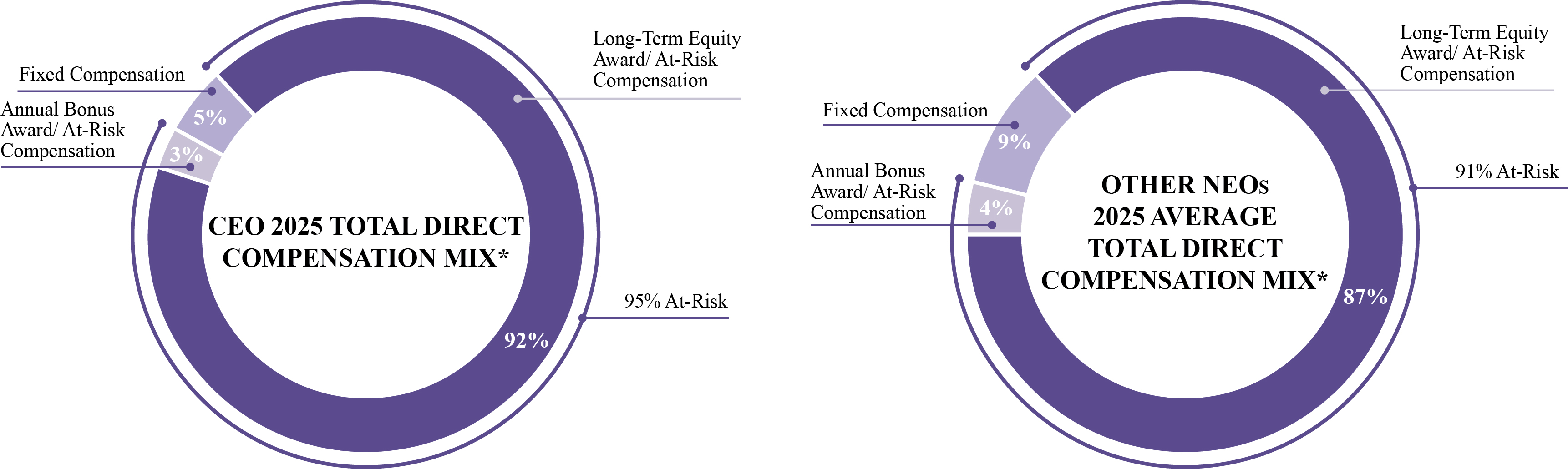
* Reflects 2025 cash compensation, consisting of annual base salaries and performance bonus earned, and 2025 equity awards granted, based on such equity incentives’ grant date fair value as reported in the “2025 Summary Compensation Table,” for each of our named executive officers.
51
Overview of Our Executive Compensation Program
The Compensation Committee oversees our executive compensation program and policies. Our executive compensation philosophy is based on the following objectives:
• providing equitable and highly competitive compensation to attract, motivate and retain top talent;
• directly and substantially linking short-term compensation to measurable corporate goals to promote a high-performance culture; and
• providing a highly competitive long-term incentive structure based on creating and aligning compensation with shareholder and broader stakeholder value.
The following table summarizes the three principal components of our executive compensation program, their objectives and key features. In addition to these three principal components, we also provide our executive officers with severance and change-in-control payments and benefits, as well as other benefits generally available to all our employees, including retirement benefits under the Company’s 401(k) plan and participation in employee benefit plans, which are more fully described in the section entitled “Other Features of Our Compensation Program” below.
52
Element of Compensation |
|
Objectives |
|
Key Features |
Base Salary (fixed cash) |
|
Provides financial stability and security through a fixed amount of cash for performing job responsibilities. |
|
Base salaries are reviewed and determined based on a number of factors, including internal equity, retention, expected cost of living increases and the overall performance of our company, and by reference to competitive market data provided by the Compensation Committee’s compensation consultant. |
Annual Performance Bonus (at-risk cash) |
|
Motivates and rewards for attaining rigorous annual corporate performance goals that relate to our key business objectives. |
|
Target annual performance bonus opportunities, expressed as a percentage of base salary, are reviewed annually and determined based upon positions that have similar impact on the organization and competitive bonus opportunities in our market. Actual bonus payments are based upon achievement of corporate objectives determined by the Compensation Committee. |
Long-Term Incentive (at-risk equity) |
|
Motivates and rewards for long-term company performance; aligns executives’ interests with shareholder interests and changes in shareholder value. |
|
Annual equity awards are reviewed and determined at the beginning of each year or as appropriate during the year for new hires, promotions or rewards for significant achievement. |
We do not currently have formal policies for allocating compensation among base salary, annual performance bonuses and equity awards. Instead, the Compensation Committee uses its judgment to establish a target total direct compensation opportunity for each named executive officer that is a mix of current, short- and long-term incentive compensation, and cash and non-cash compensation, that it believes is appropriate to achieve the goals of our executive compensation program and our corporate objectives. We believe our compensation program reflects a "pay-for-performance" philosophy that aligns the interests of our executive officers with our shareholders. A significant portion of our named executive officers’ target total direct compensation opportunity is comprised of “at-risk” compensation in the form of an annual performance bonus opportunity and equity awards tied to shareholder returns in order to align the named executive officers’ incentives with the interests of our shareholders and our corporate goals.
How We Determine Executive Compensation
The Compensation Committee reviews and approves, or recommends for approval by our Board, the compensation of our named executive officers. The Compensation Committee uses the services of an independent compensation consultant who is retained by, and reports directly to, the Compensation Committee to provide the Compensation Committee with an additional external perspective with respect to
53
its evaluation of relevant market and industry practices. For fiscal year 2025, our Compensation Committee retained Aon to provide executive compensation consulting services to the Compensation Committee and assist it in reviewing our executive compensation program, making compensation decisions for each of our executive officers and designing our compensation program to remain competitive in attracting and retaining talented executives. As part of its services to the Compensation Committee, Aon recommended and the Compensation Committee approved a peer group of companies to provide relevant data from comparable companies for the Compensation Committee to consider in making executive compensation decisions. The peer group of companies used by the Compensation Committee in making 2025 compensation decisions was comprised of the following companies. These companies were selected in August 2024 as appropriate peers due to industry and stage of development (pharmaceutical and biotechnology companies in Phase 2 or 3 development, with a pipeline similar to ours focused on central nervous system and/or psychiatric conditions, who had recently gone public), location (headquartered in competitive markets for talent) and size (market capitalizations primarily ranging from 0.25 to four times our market capitalization and primarily pre-revenue).
54
Peer Group Companies 2025
Arvinas, Inc. |
|
Humacyte, Inc. |
|
Neumora Therapeutics, Inc. |
Alector, Inc. |
|
Kalvista Pharmaceuticals, Inc. |
|
Praxis Precision Medicines, Inc. |
Anavex Life Sciences Corp |
|
Larimar Therapeutics, Inc. |
|
Relmada Therapeutics, Inc. |
Annexon, Inc. |
|
LeonaBio, Inc. (f/k/a Athira Pharma) |
|
Solid Biosciences Inc. |
AtaiBeckley Inc. |
|
Lineage Cell Therapeutics, Inc. |
|
Stoke Therapeutics, Inc. |
Compass Pathways plc |
|
MeiraGTx Holdings plc |
|
Trevi Therapeutics, Inc. |
Fulcrum Therapeutics, Inc. |
|
|
|
|
The Compensation Committee’s general aim is for compensation to remain competitive with the market, falling above or below the median of the market data as appropriate based on corporate and individual executive performance, and other factors deemed to be appropriate by the Compensation Committee. We have not developed a specific market positioning or “benchmark” that we consistently aim for in setting compensation levels; instead the Compensation Committee determines each element of compensation, and total target cash and direct compensation, for each named executive officer based on various facts and circumstances appropriate for our company in any given year.
The Compensation Committee sets the compensation of our named executive officers at levels the Compensation Committee determines to be competitive and appropriate for each named executive officer, using the Compensation Committee’s professional experience and judgment. Compensation decisions are not made by use of a formulaic approach; the Compensation Committee believes that these decisions require consideration of a multitude of relevant factors that may vary from year to year. In making executive compensation decisions, the Compensation Committee generally takes into consideration the following factors:
• our corporate performance and business needs;
• each named executive officer’s individual performance, experience, job function, change in position or responsibilities, and expected future contributions to our company;
• internal pay equity among our named executive officers and positions;
• the need to attract new talent to our executive team and retain existing talent in a highly competitive industry;
• a range of competitive market data reference points from the peer group described above;
• the total compensation cost, burn rate and shareholder dilution from executive compensation actions;
• trends and compensation paid to similarly situated executives within our market;
• its compensation consultant’s recommendations;
• a review of each named executive officer’s total targeted and historical compensation and equity ownership; and
• our CEO’s recommendations on executive officers (other than the CEO), based on the CEO’s direct knowledge of the performance of each named executive officer and the CEO’s review of competitive market data.
55
2025 Summary Compensation Table
The following table sets forth the information as to compensation awarded to, paid to or earned by our named executive officers during the fiscal years ended December 31, 2025 and December 31, 2024.
Name and Principal Position |
Year |
Salary |
|
Bonus |
|
Stock Awards |
|
Option Awards |
|
Non-Equity Incentive Plan Compensation |
|
|
All Other Compensation |
|
|
Total |
|
|||||||
Robert Barrow(3) |
2025 |
|
655,000 |
|
|
— |
|
|
11,719,750 |
|
|
— |
|
|
378,263 |
|
(4) |
|
14,429 |
|
(6) |
|
12,767,442 |
|
Chief Executive Officer |
2024 |
|
623,500 |
|
|
— |
|
|
— |
|
|
1,672,000 |
|
|
359,216 |
|
(5) |
|
14,294 |
|
(7) |
|
2,669,010 |
|
Brandi L. Roberts(10) |
2025 |
|
288,750 |
|
|
— |
|
|
1,815,000 |
|
|
2,890,889 |
|
|
121,322 |
|
(4) |
|
401 |
|
(11) |
|
5,116,362 |
|
Chief Financial Officer |
|
|
|
|
|
|
|
|
|
|
|
|
|
|
|
|
|
|||||||
Daniel Karlin, M.D. |
2025 |
|
510,000 |
|
|
— |
|
|
3,262,525 |
|
|
— |
|
|
214,200 |
|
(4) |
|
14,533 |
|
(8) |
|
4,001,258 |
|
Chief Medical Officer |
2024 |
|
485,500 |
|
|
— |
|
|
— |
|
|
627,000 |
|
|
203,424 |
|
(5) |
|
14,395 |
|
(9) |
|
1,330,319 |
|
(1) The amounts disclosed in this column represent the aggregate grant date fair value of RSUs and PSUs as calculated in accordance with Financial Accounting Standard Board Accounting Standards Codification (“ASC”) Topic 718. Assumptions used in the calculation of these amounts are included in “Note 2 — Basis of Presentation and Summary of Significant Accounting Policies — Stock-based compensation” to our consolidated financial statements included in our Annual Report on Form 10-K for the fiscal year ended December 31, 2025. There were no RSUs awards granted in the fiscal year ended December 31, 2024. The grant date fair value of the PSUs assumed a maximum of 200% of the target. These amounts do not reflect the actual economic value that will be realized by the named executive officers upon vesting of the RSUs or PSUs, or the sale of the common shares underlying such RSUs or PSUs.
(2) The amounts disclosed in this column represent the aggregate grant date fair value of option awards as calculated in accordance with ASC Topic 718. Assumptions used in the calculation of the amounts for the fiscal year ended December 31, 2025, are included in “Note 2 — Basis of Presentation and Summary of Significant Accounting Policies — Stock-based compensation” to our consolidated financial statements included in our Annual Report on Form 10-K for the fiscal year ended December 31, 2025. Assumptions used in the calculation of the amounts for the fiscal year ended December 31, 2024, are included in “Note 2 — Basis of Presentation and Summary of Significant Accounting Policies — Stock-based compensation” to our consolidated financial statements included in our Annual Report on Form 10-K for the fiscal year ended December 31, 2024. These amounts do not correspond to the actual economic value that may be realized by the named executive officers upon the exercise of such stock options.
(3) Mr. Barrow is also a member of our Board, but did not receive any additional compensation in his capacity as a director.
(4) Earned with respect to 2025 performance and paid in 2026.
(5) Earned with respect to 2024 performance and paid in 2025.
(6) Consists of $13,989 in 401(k) matching contributions, $162 in life insurance premiums and $278 in perquisites.
(7) Consists of $13,800 in 401(k) matching contributions, $162 in life insurance premiums and $332 in perquisites.
(8) Consists of $13,989 in 401(k) matching contributions, $270 in life insurance premiums and $274 in perquisites.
(9) Consists of $13,800 in 401(k) matching contributions, $270 in life insurance premiums and $325 in perquisites.
(10) Ms. Roberts joined our company as our CFO on June 2, 2025. All information regarding compensation and awards in this section reflects the compensation of Ms. Roberts as CFO from and after June 2, 2025.
(11) Consists of $241 in life insurance premiums and $160 in perquisites.
56
Narrative to 2025 Summary Compensation Table
Annual Base Salary
Each of the named executive officer’s 2025 annual base salaries are listed in the table below:
Name |
|
2025 |
|
|
Robert Barrow |
|
|
655,000 |
|
Brandi L. Roberts |
|
|
495,000 |
|
Daniel Karlin, M.D. |
|
|
510,000 |
|
The 2025 base salaries approved for Mr. Barrow and Dr. Karlin represent increases of approximately 4%, from their base salaries in place as of the end of 2024. The increased base salary rates were effective on January 1, 2025. Ms. Roberts commenced employment on June 2, 2025 and was paid a prorated portion of her annual base salary in 2025.
Performance Bonus Compensation
The annual performance-based bonus that each named executive officer is eligible to receive is generally based on the extent to which we achieve the corporate goals that the Board or our Compensation Committee establishes each year. Based on achieving these corporate goals, Mr. Barrow, Dr. Karlin and Ms. Roberts each have the opportunity to earn a target annual performance bonus equal to 55%, 40% and 40% of annual base salary, respectively. For 2025, our named executive officer performance bonuses were dependent upon meeting strategic goals related to: the advancement and acceleration of our R&D product pipeline; the advancement of our commercial affairs strategy through awareness and engagement; the advancement of our pre-commercial strategy related to DT120; delivering on our financial ambitions to support value creation and continue to strengthen our compliance; and our advancement as a patient-focused, high impact company. Our performance targets were designed to be achieved in a range from 0% (achievement at less than threshold) to 200% (achievement at maximum or above) of target based upon our performance. After assessing our 2025 performance, the Compensation Committee determined that our overall level of achievement of all goals was 105% and accordingly, each of our named executive officers received a performance bonus equal to 105% of such named executive officer’s target bonus. Ms. Roberts performance bonus was prorated based on her start date of June 2, 2025. A summary of the corporate goals, relative weightings and level of achievement is set forth in the table below:
2025 Corporate Goals |
|
Weighting |
|
|
Actual Performance |
|
||
Advance & Accelerate Our R&D Product Pipeline |
|
|
60 |
% |
|
|
100 |
% |
Drive Awareness and Engagement through Advancement of Commercial Affairs Strategy |
|
|
10 |
% |
|
|
105 |
% |
Drive Launch Readiness through Advancement of Pre-Commercial Strategy |
|
|
10 |
% |
|
|
105 |
% |
Deliver on Financial Ambitions to Support Value Creation & Continue to Strengthen Compliance |
|
|
10 |
% |
|
|
125 |
% |
Advance our Patient-Focused High Impact Company |
|
|
10 |
% |
|
|
110 |
% |
Total 2025 Achievement |
|
|
100 |
% |
|
|
105 |
% |
The 2025 amounts reflected in the “Non-Equity Incentive Plan Compensation” column of the 2025 Summary Compensation Table above reflect the amount earned in respect of 2025 performance bonuses.
Equity Incentive Compensation
The Compensation Committee, in consultation with Aon, evaluated the appropriate form of equity compensation and determined that our long-term incentive compensation program for our named executive officers for 2025 should consist of stock options, RSUs and PSUs. The Compensation Committee believed this award mix delivered the most appropriate, balanced incentives in 2025 to our named executive officers.
57
The Compensation Committee felt that it was appropriate to introduce PSUs as a part of our compensation program to better align the interests of executive officers with the interests of our shareholders. PSUs only reward executive officers if the preset goals are achieved, which the Compensation Committee believes will motivate our executive officers to deliver sustained long-term value to our shareholders. In addition, PSUs reinforce the pay-for-performance nature of the long-term incentive grants and our overall executive compensation program. For Mr. Barrow, approximately 68% of his 2025 equity grant consisted of PSUs. For Dr. Karlin, approximately 63% of his 2025 equity grant consisted of PSUs.
The vesting of the PSUs is tied to our achievement of certain key clinical and regulatory milestones. The PSUs will vest on the third anniversary of the grant date, subject to continued service through the vesting date. Actual earned PSUs can range from 0%-200% of the target number of PSUs and will be based on the achievement of certain performance metrics as measured at the end of the three-year performance period.
In determining the size of the 2025 equity grants, the Compensation Committee considered a number of factors, including (but not limited to) the equity award value, the ownership percentage of the Company represented for each executive officer, the equity award as a portion of direct compensation, the retentive value of each executive officer's existing unvested and total equity incentive holdings, equity compensation in relation to the general practices of our 2025 Peer Group and total and cumulative dilution associated with the current and prior equity awards.
We made an annual grant consisting of time-vesting RSUs and PSUs to each of Mr. Barrow and Dr. Karlin in March 2025. The grant date value of equity awards we granted to Mr. Barrow and Dr. Karlin in 2025 fell well above the median of the competitive market data, which was provided by Aon and reviewed by the Compensation Committee. The Compensation Committee believes that the 2025 equity grants provide strong retentive value and bring the overall equity compensation of Mr. Barrow and Dr. Karlin in line with the general practices of our 2025 Peer Group.
We made an initial grant consisting of time-vesting stock options and PSUs to Ms. Roberts on her start date in June 2025. The grant date value of the initial equity awards we granted to Ms. Roberts in 2025 fell above the median of the competitive market data, which was provided by Aon and reviewed by the Compensation Committee.
The 2025 equity awards granted to our named executive officers are reflected in the table below. These stock options were granted under and subject to the terms of the Option Plan, in the case of Mr. Barrow and Mr. Karlin, and were granted as inducement grants outside our equity plans, in the case of Ms. Roberts.
Name |
|
Stock Options |
|
|
RSUs |
|
|
PSUs |
|
|||
Robert Barrow |
|
|
— |
|
|
|
350,000 |
|
|
|
750,000 |
|
Brandi L. Roberts |
|
|
500,000 |
|
|
|
— |
|
|
|
125,000 |
|
Daniel Karlin, M.D. |
|
|
— |
|
|
|
115,000 |
|
|
|
200,000 |
|
Other Features of Our Compensation Program
Employment Agreements with our Named Executive Officers
On May 27, 2025, we entered into an employment agreement with Ms. Roberts in connection with her appointment as our CFO. Based on consultations between our Compensation Committee and our outside legal counsel, in July 2025, we entered into new employment agreements with each of Mr. Barrow and Dr. Karlin on substantially similar terms to the employment agreement with Ms. Roberts. Each employment agreement provides for “at-will” employment and provides, among other things, the terms of compensation of each such named executive officer. Each of those agreements sets forth such named executive officer’s annual base salary and target annual cash bonus opportunity, which amounts may be adjusted from time to time (which amounts for 2025 are described above in “— Annual Base Salary” and “— Performance Bonus Compensation”). In addition, such employment agreements provide for certain severance and change of control benefits, the terms of which are described below under “— Severance and Change in Control Benefits.”
58
Severance and Change in Control Benefits
Under the terms of their employment agreements, each of our named executive officers is eligible for severance benefits upon certain involuntary termination events. The Compensation Committee reviewed, and our Board approved, these severance benefits, after a review of competitive market data provided by Aon, to ensure that the benefits are market-based, appropriately structured and at reasonable levels. The Board and Compensation Committee believe that these severance protection benefits are necessary to attract and retain top talent, provide stability among our named executive officers, serve to focus our named executive officers on our business operations and avoid distractions in connection with a potential change in control transaction or period of uncertainty.
All change of control payments are structured to be on a “double-trigger” basis, requiring an involuntary termination in connection with the change in control transaction. Enhanced severance benefits are provided for a qualifying termination that occurs in connection with a change of control because the severance benefits are also intended to mitigate any reluctance of our named executive officers to diligently consider and pursue potential change in control transactions that may be in the best interests of our company. We do not maintain any agreements with our named executive officers providing for tax “gross-ups” in connection with severance or change in control transactions.
Pursuant to their employment agreements, each of our named executive officers is eligible to receive benefits if the named executive officer’s employment is terminated by us without cause or by the named executive officer for good reason (in either case, referred to as an “Involuntary Termination”). The amount of such benefits is greater if such Involuntary Termination occurs on or within the 12 months following a change in control transaction (a “CIC Termination”). Upon such an Involuntary Termination or a CIC Termination, in addition to any accrued but unpaid salary through the date of termination, unreimbursed business expenses payable in accordance with our standard expense reimbursement policies and any benefits owed under any qualified retirement plan or health and welfare benefit plan, the named executive officer is eligible to receive the following severance benefits, subject to signing and delivering to us a separation agreement containing a general release of claims in favor of our company:
• continued payment of his or her then-current base salary for 12 months (CEO) and nine months (other NEOs), or, in the case of a CIC Termination, 24 months (CEO) and 12 months (other NEOs) (such applicable period of time, the “Severance Period”);
• payment or reimbursement of continued health coverage for the named officer and his or her dependents under COBRA for up to the length of the Severance Period;
• if the Involuntary Termination occurs after the completion of our fiscal year, but before any bonuses are paid for such fiscal year, the named executive officer will be eligible for a bonus for the completed fiscal year, dependent upon the actual achievement of the applicable corporate performance goals, as determined by the Board in its reasonable discretion, or in the case of a CIC Termination that occurs after the completion of our fiscal year, but before any bonuses are paid for such fiscal year, an amount equal to 100% of target bonus for the year in which the termination occurs and an amount equal to the named executive officer’s target bonus prorated for the portion of the year in which the named executive officer is employed; and
• only in the case of a CIC Termination, the vesting and exercisability of all outstanding equity awards that are subject to time-based vesting requirements (if any) will be accelerated in full.
The terms “cause” and resignation for “good reason” are defined in the employment agreements, and a “change in control” has the definition set forth in the Option Plan.
Additionally, each of our named executive officers holds stock options, RSUs and PSUs granted under and subject to the terms of the Option Plan, PR Plan and the 2025 Equity Incentive Plan. A description of the termination and change in control provisions in such equity plans are provided below.
Option Plan. Unless otherwise determined by the Option Plan administrator and set forth in the relevant option award agreement, upon the occurrence of an Event of Termination (as defined in the Option Plan), the options granted to a named executive officers may be exercised in accordance with the following:
• if the named executive officer’s service with us terminates by reason of the death of the named executive officer, all outstanding options shall become vested and immediately exercisable and any option held by the named executive officer may thereafter be exercised for a period ending 12 months following the date of death (or, if sooner, on the last day of the stated term of such option);
59
• if the named executive officer’s service with us is terminated for Cause (as defined the Option Plan): (i) any option held by the named executive officer will immediately and automatically expire as of the date of such termination, and (ii) any common shares for which we have not yet delivered share certificates or other evidence of ownership will be immediately and automatically forfeited and we will refund to the named executive officer the option exercise price paid for such common shares, if any; or
• if a the named executive officer’s service with us terminates for any reason other than death or Cause, any option held by such named executive officer may thereafter be exercised by the named executive officer, to the extent it was exercisable at the time of such termination, for a period ending 90 days following the date of such termination (or, if sooner, on the last day of the stated term of such option); provided that any such exercise of an option shall only be in respect of common shares which were available for purchase at the date of the Event of Termination.
Notwithstanding anything to the contrary set forth in the Option Plan, upon or in anticipation of any Change in Control (as defined in the Option Plan), the Option Plan administrators may, in their sole and absolute discretion and without the need for the consent of any Option Plan participant, take one or more of the following actions contingent upon the occurrence of that Change in Control: (a) cause any or all outstanding Options to become vested and immediately exercisable, in whole or in part; and/or (b) cause any outstanding Option to become fully vested and immediately exercisable for a reasonable period in advance of the Change in Control and, to the extent not exercised prior to that Change in Control, cancel that Option upon closing of the Change in Control.
PR Plan. Except as otherwise provided in the relevant RSU or PSU award agreement or the named executive officer’s employment agreement, in the event that, prior to a vesting date with respect to RSUs or PSUs, (i) the named executive officer’s employment is terminated by us for any reason, or (ii) a named executive officer voluntarily terminates his or her employment with us, including due to retirement, no portion of the RSUs or PSUs that would otherwise vest on such vesting date shall vest and the named executive officer shall receive no payment or other compensation in respect of such RSUs or PSUs; provided that any vested RSUs or PSUs will be settled in accordance with the payment of cash or shares sections of the PR Plan.
Subject to the terms of the relevant RSU or PSU award agreement or the named executive officer’s employment agreement, in the event of a Change in Control (as defined in the PR Plan), all RSUs and PSUs credited to the account of the named executive officer as at the time of Change in Control, will become vested RSUs or PSUs on a one-for-one basis as at the time of Change in Control, unless otherwise determined by the Board. As soon as practical following the Change in Control, the named executive officer, at the discretion of the Board, will receive a payment in cash or in common shares (or a combination thereof) equal to the number of such vested RSUs and PSUs multiplied by the price at which the common shares are valued for the purposes of the transactions giving rise to the Change in Control.
2025 Equity Incentive Plan. Except as otherwise provided in the relevant RSU or PSU award agreement or the named executive officer’s employment agreement, in the event that, prior to a vesting date with respect to RSUs or PSUs, (i) the named executive officer’s employment is terminated by us for any reason, or (ii) a named executive officer voluntarily terminates his or her employment with us, including due to retirement, no portion of the RSUs or PSUs that would otherwise vest on such vesting date shall vest and the named executive officer shall receive no payment or other compensation in respect of such RSUs or PSUs; provided that any vested RSUs or PSUs will be settled in accordance with the payment of cash or shares as described in the 2025 Equity Incentive Plan.
Subject to the terms of the relevant RSU or PSU award agreement or the named executive officer’s employment agreement, in the event of a Change in Control (as defined in the 2025 Equity Incentive Plan), all RSUs and PSUs credited to the account of the named executive officer as at the time of Change in Control, will become vested RSUs or vested PSUs (based on the greater of target level of performance or, if measurable, actual performance as of a date reasonably proximal to the date of consummation of the Change in Control) on a one-for-one basis as at the time of Change in Control, unless otherwise determined by the Board. As soon as practical following the Change in Control, the named executive officer, at the discretion of the Board, will receive a payment in cash or in common shares (or a combination thereof) equal to the number of such vested RSUs and PSUs multiplied by the price at which the common shares are valued for the purposes of the transactions giving rise to the Change in Control.
60
Perquisites, Health, Welfare and Retirement Benefits
Our named executive officers were eligible to participate in our employee benefit plans, including health insurance and group life insurance benefits, on the same basis as our other employees. We also maintain a 401(k) plan, which is a defined contribution employee retirement plan intended to qualify as a tax-qualified plan under Section 401(k) of the Code. Our named executive officers are eligible to participate in the 401(k) plan on the same basis as our other employees. The 401(k) plan provides that each participant may contribute up to the lesser of 100% of his or her compensation or the statutory limit, which was $23,500 for employees under the age of 50 for calendar year 2025. For 2025, we made non-elective contributions totaling up to 4% of an eligible employee’s gross salary, subject to any applicable statutory limits imposed by the Internal Revenue Service. Mr. Barrow, Dr. Karlin and Ms. Roberts received $13,989, $13,989, and $0, respectively, in 401(k) plan matching contributions in 2025.
We generally do not provide other material perquisites or personal benefits to our named executive officers, except in certain limited circumstances. None of our named executive officers participate in non-qualified deferred compensation plans sponsored by our company. The Board may elect to adopt qualified or non-qualified deferred compensation or pension plans in the future if it determines that doing so is in our company’s best interests.
Clawbacks
As a public company, if we are required to restate our financial results due to our material noncompliance with any financial reporting requirements under the federal securities laws as a result of misconduct, the CEO and CFO may be legally required to reimburse our company for any bonus or other incentive-based or equity-based compensation they receive in accordance with the provisions of section 304 of the Sarbanes-Oxley Act of 2002. Additionally, on November 20, 2023 we adopted a clawback policy, which was subsequently amended on April 11, 2025 (the “Clawback Policy”), to provide for recovery of certain incentive compensation in the event of an Accounting Restatement (as defined in the Clawback Policy). The Clawback Policy is intended to meet the requirements of the SEC and the Nasdaq listing standards, which implement the Rule 10D-1 of the Exchange Act. Under the Clawback Policy, in the event we are required to prepare an Accounting Restatement, except as otherwise provided in the Clawback Policy, we are required to recover the excess incentive compensation received by any of the Covered Officer (as defined in the Clawback Policy). The excess incentive compensation is the amount that exceeds what would have been received if the determination of the incentive compensation had been based on the restated amounts in the accounting restatement. The Clawback Policy applies to all incentive compensation, whether it is cash or equity compensation, that is awarded to executives on achievement of Financial Reporting Measures (as defined in the Clawback Policy). The Clawback Policy is available on the Company’s website at https://ir.definiumtx.com/corporate-governance/governance-documents.
Outstanding Equity Awards at Fiscal Year End
The following table sets forth certain information about equity awards granted to our named executive officers that were outstanding as of December 31, 2025:
61
Name |
|
Option or Stock Award Grant Date |
|
Number of Securities Underlying Unexercised Options (#) Exercisable |
|
|
Number of Securities Underlying Unexercised Options (#) Unexercisable |
|
|
Option Exercise Price(1) |
|
|
Option Expiration Date |
|
|
Number of |
|
|
Market Value |
|
||||||
Robert Barrow |
|
3/12/2025 |
|
|
— |
|
|
|
— |
|
|
|
— |
|
|
|
— |
|
|
|
375,000 |
|
(7) |
$ |
5,021,250 |
|
|
|
3/12/2025 |
|
|
— |
|
|
|
— |
|
|
|
— |
|
|
|
— |
|
|
|
284,375 |
|
(8) |
$ |
3,807,781 |
|
|
|
2/27/2024 |
|
|
183,333 |
|
|
|
216,667 |
|
(4) |
$ |
4.98 |
|
|
2/26/2034 |
|
|
|
— |
|
|
|
— |
|
|
|
|
3/14/2023 |
|
|
— |
|
|
|
— |
|
|
|
— |
|
|
|
— |
|
|
|
125,000 |
|
(9) |
$ |
1,673,750 |
|
|
|
3/24/2022 |
|
|
181,875 |
|
|
|
12,125 |
|
(5) |
$ |
17.72 |
|
|
3/24/2027 |
|
|
|
— |
|
|
|
— |
|
|
|
|
3/24/2022 |
|
|
— |
|
|
|
— |
|
|
|
— |
|
|
|
— |
|
|
|
7,583 |
|
(10) |
$ |
101,536 |
|
|
|
4/21/2021 |
|
|
167,700 |
|
|
|
— |
|
|
$ |
32.76 |
|
|
4/21/2026 |
|
|
|
— |
|
|
|
— |
|
|
|
|
1/15/2021 |
|
|
66,666 |
|
|
|
— |
|
|
$ |
46.28 |
|
|
1/15/2026 |
|
|
|
— |
|
|
|
— |
|
|
Brandi L. Roberts |
|
6/2/2025 |
|
|
— |
|
|
|
500,000 |
|
(6) |
$ |
7.26 |
|
|
6/1/2035 |
|
|
|
— |
|
|
|
— |
|
|
|
|
6/2/2025 |
|
|
— |
|
|
|
— |
|
|
|
— |
|
|
|
— |
|
|
|
62,500 |
|
(7) |
$ |
836,875 |
|
Daniel Karlin, M.D. |
|
3/12/2025 |
|
|
— |
|
|
|
— |
|
|
|
— |
|
|
|
— |
|
|
|
100,000 |
|
(7) |
$ |
1,339,000 |
|
|
|
3/12/2025 |
|
|
— |
|
|
|
— |
|
|
|
— |
|
|
|
— |
|
|
|
93,438 |
|
(8) |
$ |
1,251,135 |
|
|
|
2/27/2024 |
|
|
68,750 |
|
|
|
81,250 |
|
(4) |
$ |
4.98 |
|
|
2/26/2034 |
|
|
|
— |
|
|
|
— |
|
|
|
|
3/14/2023 |
|
|
— |
|
|
|
— |
|
|
|
— |
|
|
|
— |
|
|
|
39,063 |
|
(9) |
$ |
523,054 |
|
|
|
3/24/2022 |
|
|
78,125 |
|
|
|
5,208 |
|
(5) |
$ |
17.72 |
|
|
3/24/2027 |
|
|
|
— |
|
|
|
— |
|
|
|
|
3/24/2022 |
|
|
— |
|
|
|
— |
|
|
|
— |
|
|
|
— |
|
|
|
3,958 |
|
(10) |
$ |
52,998 |
|
|
|
4/21/2021 |
|
|
97,933 |
|
|
|
— |
|
|
$ |
32.76 |
|
|
4/21/2026 |
|
|
|
— |
|
|
|
— |
|
|
(1) All of the option awards listed in the table were granted with an exercise price equal to the closing price of our common shares on Nasdaq on the trading day prior to the date of grant.
(2) Represents shares underlying RSUs or PSUs. Each RSU and PSU represents a contingent right to receive one of our common shares and vests subject to the named executive officer providing continuous service to us on each vesting date.
(3) This column reflects the market value of RSUs or PSUs as of December 31, 2025, based on the closing price of our common shares on Nasdaq as of that date. These amounts do not reflect the actual economic value that will be realized by the named executive officers upon vesting of the RSUs or PSUs, or the sale of our common shares underlying such RSUs or PSUs.
(4) The common shares subject to the option vest and become exercisable with 1/48th of the total common shares vesting monthly over 48 months from the vesting commencement date, March 27, 2024, subject to the named executive officer providing continuous service to us as of each such vesting date.
(5) The common shares subject to the option vest and become exercisable with 1/48th of the total common shares vesting monthly over 48 months from the vesting commencement date, March 24, 2022, subject to the named executive officer providing continuous service to us as of each such vesting date.
(6) 25% of the common shares underlying the option vest and become exercisable on June 2, 2026; the remaining common shares underlying the option shall vest and become exercisable in 36 equal monthly installments thereafter, subject to Ms. Roberts providing continuous service to us on each such vesting date.
(7) Amounts listed are for PSUs at threshold performance (50%). The PSUs will vest on the third anniversary of the grant date, subject to continued service through the vesting date. Actual earned PSUs can range from 0%-200% of the target number of PSUs and will be based on the achievement of certain performance metrics as measured at the end of the three-year performance period.
(8) RSUs vest in 16 equal quarterly installments beginning on June 1, 2025, subject to the named executive officer providing continuous service to us on each such vesting date.
(9) The RSUs vest quarterly over 48 months from the vesting commencement date, March 14, 2023, subject to the named executive officer providing continuous service to us on each such vesting date.
(10) The RSUs vest in 48 equal monthly installments from the vesting commencement date, March 24, 2022, subject to the named executive officer providing continuous service to us on each vesting date.
62
Policies and Practices Related to the Grant of Certain Equity Awards Close in Time to the Release of Material Nonpublic Information
Although we do not have a formal policy, program or plan that requires us to award equity or equity-based compensation on specific dates, we generally issue equity awards to our employees, including our executive officers, annually in the first quarter, and such awards are approved by our Compensation Committee during the first quarter. In certain circumstances, including the hiring of an employee, the Compensation Committee may approve grants to be effective at other times.
During the fiscal year ended December 31, 2025, we did not issue any options to our named executive officers during any period beginning four business days before the (i) filing of a periodic report on Form 10-Q or Form 10-K or (ii) the filing or furnishing a current report on Form 8-K that disclosed material nonpublic information, and ending one business day after the filing or furnishing of such report with the SEC.
63
DIRECTOR COMPENSATION
Director Compensation Table
The following table sets forth information concerning the compensation earned for service on our Board of Directors during the year ended December 31, 2025. Mr. Barrow’s compensation as an executive officer is set forth under “Executive Compensation — 2025 Summary Compensation Table.” Mr. Barrow did not receive any compensation for service as a director. Mr. Adsett was appointed to the Board on January 29, 2026 and, therefore, did not earn any compensation for service to the Board in 2025. None of our directors earned any compensation other than cash fees, options under the 2025 Equity Incentive Plan and DDSUs under the Directors Deferred Share Unit Plan (“DDSU Plan”), respectively, during the fiscal year ended December 31, 2025, and accordingly, we have omitted all other columns from the table below.
Name |
|
Fees Earned or Paid in Cash |
|
|
Option Awards(1) |
|
|
Stock Awards(2) |
|
|
Total |
|
||||
Carol A. Vallone |
|
$ |
97,000 |
|
|
$ |
399,827 |
|
|
|
— |
|
|
$ |
496,827 |
|
Andreas Krebs |
|
$ |
85,000 |
|
|
$ |
399,827 |
|
|
|
— |
|
|
$ |
484,827 |
|
Dr. Suzanne Bruhn |
|
$ |
58,000 |
|
|
$ |
399,827 |
|
|
|
— |
|
|
$ |
457,827 |
|
Dr. Roger Crystal |
|
$ |
57,000 |
|
|
$ |
399,827 |
|
|
|
— |
|
|
$ |
456,827 |
|
David Gryska |
|
$ |
59,000 |
|
|
$ |
399,827 |
|
|
|
— |
|
|
$ |
458,827 |
|
(1) All of the option awards listed in the table were granted with a per share exercise price equal to the closing price of our common shares on Nasdaq on the date of the grant. The amounts shown in this column represent the grant date fair value of the option awards in accordance with ASC Topic 718. These amounts do not reflect the actual economic value that will be realized by such director. For the assumptions used in valuing the options, see “Note 2 — Basis of Presentation and Summary of Significant Accounting Policies — Stock-based compensation” to our consolidated financial statements in our Annual Report on Form 10-K for the fiscal year ended December 31, 2025. As of December 31, 2025, each director had the outstanding stock options shown in the table below:
Name |
|
Outstanding Stock Options |
|
|
Carol A. Vallone |
|
|
120,898 |
|
Andreas Krebs |
|
|
121,441 |
|
Dr. Suzanne Bruhn |
|
|
118,960 |
|
Dr. Roger Crystal |
|
|
118,960 |
|
David Gryska |
|
|
129,287 |
|
(2) As of December 31, 2025, each director had the number of unvested RSUs and DDSUs shown in the table below:
Name |
|
Unvested |
|
|
Unvested RSUs |
|
||
Carol A. Vallone |
|
|
— |
|
|
|
— |
|
Andreas Krebs |
|
|
— |
|
|
|
— |
|
Dr. Suzanne Bruhn |
|
|
— |
|
|
|
— |
|
Dr. Roger Crystal |
|
|
— |
|
|
|
— |
|
David Gryska |
|
|
2,189 |
|
|
|
4,617 |
|
Non-Employee Director Compensation Policy
Our Board amended our Non-Employee Director Compensation Policy (the “Policy”) effective as of May 8, 2025, and subsequently amended the Policy further on January 28, 2026 and April 15, 2026 (collectively, the “Amended Policy”). Under the Amended Policy, each of our non-employee directors is eligible to receive compensation for service on our Board and committees of our Board. Non-employee directors also receive reimbursement for necessary and reasonable out-of-pocket travel expenses to cover in-person attendance at and participation in Board and committee meetings.
64
The Amended Policy provides our non-employee directors with the following cash compensation for their services:
• $40,000 per year for each non-employee director (“Base Retainer”);
• $40,000 per year for the Chair of the Board (if applicable) in addition to the Base Retainer;
• $30,000 per year for the Vice Chair of the Board (if applicable) in addition to the Base Retainer;
• $20,000 per year for the Chair of the Audit Committee or $10,000 per year for each other member of the Audit Committee;
• $15,000 per year for the Chair of the Compensation Committee or $7,500 per year for each other member of the Compensation Committee; and
• $10,000 per year for the Chair of the Nominating and Corporate Governance Committee or $5,000 per year for each other member of the Nominating and Corporate Governance Committee.
The cash compensation above is payable to our eligible non-employee directors in equal quarterly installments, prorated for any partial quarter of service. All annual cash fees are vested upon payment. Each non-employee director may decline all or any portion of his or her compensation by giving notice to the Company prior to the date cash payment is made.
Each non-employee director who joins our Board, upon the date of his or her initial election or appointment to be a non-employee director, is granted an equity award with a fair market value of up to $800,000 as measured on the date of the grant, with the type of equity to be determined by the Compensation Committee (the “Initial Grant”). The Initial Grant shall be made pursuant and subject to the 2025 Equity Incentive Plan and shall vest with respect to 1/3 of the Initial Grant on the one-year anniversary of the grant date, with the remaining portion of the Initial Grant vesting in equal monthly installments thereafter, subject to such non-employee director’s continued service through the applicable vesting date.
On the date of each annual shareholder meeting of the Company, each non-employee director who continues to serve as a non-employee director following such annual shareholder meeting (excluding any non-employee director who is first appointed or elected by the Board at such annual shareholder meeting) will be granted an annual equity award with a fair market value of up to $450,000 as measured on the date of the grant, with the type of equity to be determined by the Compensation Committee (the “Annual Grant”). The Annual Grant vests in twelve equal monthly installments over a one-year period measured from the grant date, or in any event no later than the date immediately prior to the next annual shareholder meeting, subject in any case to the eligible director’s continuous service as a member of the Board through such vesting date. For 2026, the Compensation Committee has determined that Annual Grant shall consist of 75% stock options and 25% RSUs.
All options granted in an Initial Grant or Annual Grant are nonstatutory stock options, with an exercise price per share equal to 100% of the Fair Market Value (as defined in the 2025 Equity Incentive Plan) of the underlying common shares on the grant date, and a term of ten years from the grant date (subject to earlier termination in connection with a termination of service, as provided in the 2025 Equity Incentive Plan and applicable stock option grant notice and award agreement).
All DDSUs granted are to be settled in cash upon the termination of the directorship (with each DDSU representing the right to receive the cash equivalent of the fair market value of one ordinary share). The fair market value of an ordinary share is equal to the volume weighted average trading price of an ordinary share on Nasdaq for the five business days immediately preceding the DDSUs vesting date. The DDSUs granted will expire no later than 90 days after the director’s termination date or such other reasonable time as may be determined by the administrators of the Directors Deferred Share Unit Plan.
With respect to grants made under the Option Plan, PR Plan or DDSU Plan, as applicable, each Initial Grant and Annual Grant vest as follows upon a Change in Control or Change of Control (as defined in each of the Option Plan, PR Plan or DDSU Plan, as applicable), subject, in each case, to the non-employee director’s continuous service as a member of the Board through the date of such Change in Control or Change of Control (as applicable): (a) with respect to any non-employee director who has less than one (1) year of continuous service as a member of the Board on the date of such Change in Control or Change of Control, the portion of each Initial Grant and/or Annual Grant held by such non-employee director will vest as would have vested through the one (1) year anniversary of the applicable grant date, had the non-employee director provided continuous service as a member of the Board through such date; and (b) with respect to any
65
non-employee director who has one (1) or more years of continuous service as a member of the Board on the date of such Change in Control or Change of Control, each Initial Grant and/or Annual Grant held by such Eligible Director will vest in full.
With respect to grants made under the 2025 Equity Incentive Plan, upon a Change in Control (as defined in 2025 Equity Incentive Plan), each Initial Grant and Annual Grant shall vest as set forth in the 2025 Equity Incentive Plan. For more information, please refer to - Proposal No. 3 Amendment to 2025 Equity Incentive Plan - Change in Control.
66
SECURITIES AUTHORIZED FOR ISSUANCE UNDER EQUITY COMPENSATION PLANS
The following table provides certain information with respect to all of our equity compensation plans under which our equity securities are authorized for issuance in effect as of December 31, 2025.
Equity Compensation Plan Information
Plan Category |
|
Number of Securities to be Issued upon Exercise of Outstanding Options, Warrants and Rights |
|
|
Weighted-Average Exercise Price of Outstanding Options, Warrants and Rights |
|
|
Number of Securities Remaining Available for Future Issuance under Equity Compensation Plans |
|
|
|||
Equity compensation plans approved by shareholders |
|
|
|
|
|
|
|
|
|
|
|||
Mind Medicine (MindMed) Inc. Stock Option Plan |
|
|
2,804,024 |
|
|
$ |
14.14 |
|
|
|
|
|
|
Mind Medicine (MindMed), Inc. Performance & Restricted Share Unit Plan |
|
|
5,112,720 |
|
|
|
|
|
|
|
|
||
Definium Therapeutics, Inc. 2025 Equity Incentive Plan |
|
|
375,935 |
|
|
$ |
7.30 |
|
|
|
4,778,811 |
|
(1) |
Definium Therapeutics, Inc. Employee Share Purchase Plan (“ESPP”) |
|
|
|
|
|
|
|
|
646,465 |
|
(2) |
||
Equity compensation plans not approved by shareholders |
|
|
|
|
|
|
|
|
|
|
|||
Stock Options |
|
|
2,926,800 |
|
(3) |
$ |
8.35 |
|
|
|
|
|
|
Restricted Stock Units |
|
|
60,000 |
|
(4) |
|
|
|
|
|
|
||
Performance Stock Units |
|
|
284,500 |
|
(5) |
|
|
|
|
|
|
||
Total |
|
|
11,563,979 |
|
|
|
|
|
|
5,425,276 |
|
|
|
(1) Represents the aggregate number of common shares reserved for future issuance under our 2025 Equity Incentive Plan as of December 31, 2025. On March 14, 2025, we retired our Option Plan and PR Plan such that no additional awards will be issued from the Option Plan or PR Plan.
(2) Represents the aggregate of 612,678 common shares remaining available under our ESPP and 33,787 common shares subject to purchase during the then-existing purchase period as of December 31, 2025.
(3) Represents an aggregate of 2,926,800 common shares issuable upon the exercise of outstanding stock options made outside the Option Plan and 2025 Equity Incentive Plan as an inducement material to certain employees entering into employment with us pursuant to Nasdaq Stock Market LLC Listing Rule 5635(c)(4). The shares underlying the stock options shall vest and become exercisable over a four-year period with 25% vesting on the first anniversary of the date of the grant and the remaining 75% vesting in 36 equal monthly installments thereafter.
(4) Represents an aggregate of 60,000 common shares issuable upon the vesting of RSUs made outside of the PR Plan and 2025 Equity Incentive Plan as an inducement material to certain employees entering into employment with us pursuant to Nasdaq Stock Market LLC Listing Rule 5635(c)(4). The RSUs vest 25% on the first anniversary of the date of grant and the remaining 75% vesting in 12 equal quarterly installments thereafter.
(5) Represents an aggregate of 284,500 common shares issuable upon the vesting of PSUs made outside of the PR Plan and 2025 Equity Incentive Plan as an inducement material to certain employees entering into employment with us pursuant to Nasdaq Stock Market LLC Listing Rule 5635(c)(4). The PSUs will vest on the third anniversary of the grant date, subject to continued service through the vesting date. Actual earned PSUs can range from 0%-200% of the target number of PSUs and will be based on the achievement of certain performance metrics as measured at the end of the three-year performance period.
INDEBTEDNESS OF DIRECTORS AND EXECUTIVE OFFICERS
None of our directors, executive officers, employees, former directors, former executive officers or former employees, and none of their associates, is indebted to us or another entity whose indebtedness is the subject of a guarantee, support agreement, letter of credit or other similar agreement or understanding provided by us.
67
INTEREST OF INFORMED PERSONS IN MATERIAL TRANSACTIONS
Other than compensation arrangements for our directors and executive officers, which are described above under the headings “Executive Compensation” and “Director Compensation” and as set forth below, there have been no transactions since January 1, 2024 to which we were a party or will be a party, in which:
• the amounts involved exceeded or will exceed the lesser of (a) $120,000 or (b) 1% of the average of our total assets for the fiscal years ended December 31, 2025 or 2024; and
• any of our directors, executive officers or holders of more than 5% of our share capital, or any member of the immediate family of, or person sharing the household with, the foregoing persons, had or will have a direct or indirect material interest.
Indemnification Agreements
Our Articles provide that we must indemnify each of our directors and officers to the extent permitted under the BCBCA. We may also indemnify any of our employees, agents or representatives subject to any restrictions under the BCBCA.
Indemnification is prohibited under the BCBCA unless the individual:
• acted honestly and in good faith with a view to the best interests of our company or its subsidiary, as applicable; or
• in the case of a proceeding other than a civil proceeding, the individual had reasonable grounds for believing that his or her conduct was lawful.
We have entered into an indemnification agreement with each of our directors and executive officers. As provided by our Articles, these agreements, among other things, require us to indemnify each director and executive officer to the extent permitted under the BCBCA. These agreements provide our directors and executive officers with contractual rights to indemnification and, in some cases, expense advancement in any action or proceeding arising out of their services as one of our directors or executive officers or as a director or executive officer of any other company or enterprise to which the person provides services at our request.
Related-Party Transaction Policy
In January 2022, we adopted a written related person transaction policy, which was subsequently amended in April 2025. The policy sets forth our procedures for the identification, review, consideration and approval or ratification of related person transactions. For the purposes of our policy only, a related person transaction will be a transaction, arrangement or relationship (including any indebtedness or guarantee of indebtedness), or any series of similar transactions, arrangements or relationships, in which we were or are a participant and the amount involved exceeds $120,000, and a related party had or will have a direct or indirect material interest. A related person means (i) any person who is, or at any time since the beginning of the Company’s fiscal year preceding its last fiscal year, was, a director or executive officer of the Company or a nominee to become a director of the Company and (ii) any security holder known by the Company to be the beneficial owner of more than 5% of any class of the Company’s voting securities, including any immediate family members of such persons identified in (i) and (ii).
Under the policy, if a transaction has been identified as a related person transaction, including any transaction that was not a related person transaction when originally consummated or any transaction that was not initially identified as a related person transaction prior to consummation, our management must present information regarding the related person transaction to our Audit Committee, or, if Audit Committee approval would be inappropriate, to another independent body of our Board, for review, consideration and approval or ratification. The presentation must include a description of, among other things, the material facts, the interests, direct and indirect, of the related persons, the benefits to us of the transaction and whether the transaction is on terms that are comparable to the terms available to or from, as the case may be, an unrelated third party or to or from employees generally. Under the policy, we will collect information that we deem reasonably necessary from each director, executive officer and, to the extent feasible, significant shareholder to enable us to identify any existing or potential related-person transactions and to effectuate the terms of the policy. In addition, under our Code of Ethics, our employees and directors have an affirmative responsibility to disclose any transaction or relationship that reasonably could be expected to give rise to a conflict of interest. In considering related person transactions, our Audit Committee, or other independent body of our Board of Directors, takes into account the available facts and circumstances including:
68
• the parties thereto and the basis on which a party is a related person;
• the interests, direct or indirect, of any related person in the transaction in sufficient detail so as enable a full assessment of such interest;
• a description of the purpose of the related person transaction;
• all of the material terms of the proposed transaction, including the proposed aggregate value of such transaction, or, in the case of indebtedness, the amount of principal, the term and interest rate that would be involved;
• the benefits to the Company of the proposed transaction;
• if applicable, the availability of other sources of comparable products or services;
• an assessment of whether the proposed transition is on terms that are comparable to the terms available to or from, as the case may be, an unrelated third party or to employees generally;
• management’s recommendation with respect to the proposed transaction; and
• any other facts or circumstances deemed relevant by the person providing the presentation.
The policy requires that, in determining whether to approve, ratify or reject a related person transaction, our Audit Committee, or other independent body of our Board, must consider, in light of the foregoing, (i) whether the transaction is in, or is not inconsistent with, our best interests, (ii) whether the transaction is not in violation of such policy and any other policy or procedures of the Company, in each case, as our Audit Committee, or other independent body of our Board, determines in the good faith exercise of its discretion. Under the policy, any director who has a direct or indirect material interest in the proposed related person transaction should not participate in the decision of the Audit Committee or other independent body of the Board of Directors regarding whether to approve, ratify or reject the proposed transaction and must not be present during any deliberations concerning the proposed transaction unless as permitted by the policy.
Although we have not always had a written policy for the review and approval of transactions with related persons, our Board has historically reviewed and approved any transaction where a director or officer had a financial interest, including the transactions described above. Prior to approving such a transaction, the material facts as to a director’s or officer’s relationship or interest in the agreement or transaction were disclosed to our Board. Our Board took this information into account when evaluating the transaction and in determining whether such transaction was fair to us and in the best interest of all our shareholders.
To the knowledge of the Company, no informed person of the Company, nor any proposed director, nor any associate or affiliate of any informed person or proposed director, has any material interest, direct or indirect, in any transaction since the commencement of the Company’s last financial year or in any proposed transaction which has materially affected or would materially affect the Company or any of its subsidiaries and that, directly or indirectly, involves remuneration for services.
69
INTEREST OF CERTAIN PERSONS OR COMPANIES IN MATTERS TO BE ACTED UPON
To the knowledge of the Company, there is no substantial interest, direct or indirect, by way of beneficial ownership of securities or otherwise, of each person who has been a director or executive officer of the Company at any time since January 1, 2025, each proposed nominee for election as a director of the Company or each associate or affiliate of the aforementioned persons in any matter to be acted upon in the Annual Meeting other than the election of directors except as otherwise disclosed in this Proxy Statement.
HOUSEHOLDING OF PROXY MATERIALS
The SEC has adopted rules that permit companies and intermediaries (e.g., brokers) to satisfy the delivery requirements for annual general meeting materials with respect to two or more shareholders sharing the same address by delivering a single set of annual general meeting materials addressed to those shareholders. This process, which is commonly referred to as “householding,” potentially means extra convenience for shareholders and cost savings for companies.
This year, a number of brokers with account holders who are shareholders will be “householding” our proxy materials. A single copy of the Notice and, if you requested printed versions by mail, this Proxy Statement and our Annual Report on Form 10-K for the fiscal year ended December 31, 2025 will be delivered to multiple shareholders sharing an address unless contrary instructions have been received from the affected shareholders. Once you have received notice from your broker that they will be “householding” communications to your address, “householding” will continue until you are notified otherwise or until you revoke your consent. If, at any time, you no longer wish to participate in “householding” and would prefer to receive a separate set of annual general meeting materials, please notify your broker or us. Direct your written request to Definium Therapeutics, Inc., Chief Executive Officer, One World Trade Center, Suite 8500, New York, New York 10007 or (212) 220-6633 and we will deliver promptly a separate copy of the Notice and, if you requested printed versions by mail, this Proxy Statement and our Annual Report on Form 10-K for the fiscal year ended December 31, 2025 to any shareholder that elects not to participate in householding. Shareholders who currently receive multiple copies of the annual general meeting materials at their addresses and would like to request “householding” of their communications should contact their brokers.
ADDITIONAL INFORMATION
Additional information relating to the Company may be found on SEDAR+ at www.sedarplus.ca and in the Company’s filings with the SEC at www.sec.gov. Additional financial information is provided in our audited consolidated financial statements and management’s discussion and analysis for our most recently completed financial year. A copy of our financial statements and management’s discussion and analysis is available upon written request to our registered office at 1055 Dunsmuir Street, Suite 3000, Bentall Four, Vancouver, BC, V7X 1K8.
OTHER MATTERS
The Board knows of no other matters that will be presented for consideration at the Annual Meeting. If any other matters are properly brought before the meeting, it is the intention of the persons named in the accompanying proxy to vote on such matters in accordance with their best judgment.
By Order of the Board of Directors
Robert Barrow Chief Executive Officer
70
Annex A — Corporate Governance Guidelines
DEFINIUM THERAPEUTICS, INC.
CORPORATE GOVERNANCE GUIDELINES
The Board of Directors of Definium Therapeutics, Inc. (the “Company”) has established the following Corporate Governance Guidelines (the “Guidelines”) for the Board’s conduct and operation. These Guidelines are designed to give directors and management a flexible framework for effectively pursuing the Company’s objectives for the benefit of its shareholders. That is why these Guidelines should be interpreted in the context of all applicable laws, the Company’s Amended and Restated Articles (the “Articles”), and other policies.
As required by and in accordance with the applicable listing standards of Nasdaq and applicable Canadian securities regulators and based on information provided by Board members and advice of counsel, the Board will affirmatively determine director independence. In accordance therewith, the Board will confirm that each director determined to be independent has no relationships to the Company that would interfere with the exercise of such director’s independent judgment in carrying out the responsibilities of a director. A director will be asked to recuse themselves from a Board meeting if the Board is considering a transaction in which such director (or another organization in which the director is a director or officer) has a financial or other interest.
The Audit Committee shall review and approve any proposed related-party transactions in compliance with the Company’s policies and applicable Exchange Act rules, listing standards of Nasdaq and applicable Canadian laws and regulations.
The name of the chair or lead independent director will be listed in the Company’s proxy statement. The independent chair or lead independent director will be responsible for coordinating the activities of the independent directors. In addition to the duties of all Board members, the specific responsibilities of the independent chair or lead independent director are to:
E. Selection of Directors. The Board will be responsible for nominating candidates for election to the Board by the Company’s shareholders. The Board may fill any casual vacancy occurring in the Board. If the Company has no directors or fewer directors in office than the number set pursuant to the Articles as the quorum of directors, the shareholders may elect or appoint directors to fill any vacancies on the Board. The Nominating and Corporate Governance Committee is responsible for identifying, reviewing, evaluating, and recommending candidates to serve as directors of the Company, in accordance with its charter and consistent with the criteria listed below.
For nominations of potential candidates made other than by the Board, the shareholder or other person making such nomination must comply with the Company’s Articles, including without limitation, submission of the information or other materials required with respect to proposed nominees. Each potential candidate must provide a list of references and agree (i) to be interviewed by members of the Nominating and Corporate Governance Committee or other directors in the discretion of the Nominating and Corporate Governance Committee (ii) to a background check or other review of the qualifications of a proposed nominee by the Company, and (iii) meet with other members of the Board, either in person or telephonically. Upon request, any candidate nominated will agree in writing to comply with these Guidelines and all other policies and procedures of the Company applicable to the Board.
F. Board Membership Criteria. The Board will determine the appropriate characteristics, skills, and experience for the Board as a whole and for its individual members. The Board considers recommendations for nominees from the Nominating and Corporate Governance Committee and shareholders, provided that all nominees are nominated in accordance with the Articles. The Board believes that candidates for
director must have certain minimum qualifications, including the highest personal integrity and ethics and being older than 21, and may add any specific additional criteria with respect to specific searches to identify new candidates and for re-nominating existing directors to serve on the Board. The Board must also ensure that a candidate is not disqualified from acting as a director to the Company pursuant to the Business Corporations Act (British Columbia).
In considering candidates recommended by the Nominating and Corporate Governance Committee, the Board intends to consider other factors, such as:
The Board reviews candidates for director nomination in the context of the current composition of the Board, the Company’s operating requirements, and the long-term interests of the Company’s shareholders. In conducting this assessment, the Board considers diversity of background, age, skills, and other factors that it deems appropriate to maintain a balance of knowledge, experience, and capability on the Board. For each incumbent director, the Board reviews such director’s overall service to the Company during such director’s term, including the number of meetings attended, level of participation, and quality of performance.
G. Changes in Board Membership Criteria. From time to time, the Board, in its discretion, may change the criteria for Board membership. When this occurs, the Board will evaluate existing members according to the new criteria. The Board may ask a director who no longer meets the criteria for board membership to adjust his or her committee assignments or resign from the Board.
H. Term Limits. The Board does not believe it should limit the number of terms for which an individual may serve as a director. Directors who have served on the Board for an extended period of time are able to provide continuity and valuable insight into the Company’s operations and prospects because of their experience and understanding of the Company’s history, policies, and objectives. The director nomination process achieves what term limits seek to accomplish.
I. Limits on Board Memberships. Directors must inform the chair of the Nominating and Corporate Governance Committee before accepting an invitation to serve on the board or committee of another company and the chair of the Nominating and Corporate Governance Committee must inform the chair of the Board before accepting an invitation to serve on the board or committee of another company. If the director is not employed as a CEO or Named Executive Officer of another public company, the director may sit on no more than five public boards, inclusive of The Company’s Board. If the director is a CEO or Named Executive Officer of the Company or another public company, the director may sit on no more than three public boards, inclusive of the Company’s Board. The Board recognizes that a director’s ability to fulfill his or her responsibilities as a director can be impaired if he
or she serves on multiple other boards or board committees. Service on boards and board committees of other companies should be consistent with the Company’s conflict-of-interest policies.
J. Retirement Age. The Board believes that it is inappropriate to have a retirement age for directors.
K. Directors Who Change Their Job Responsibility. A director who retires or materially changes his or her present job (other than an ordinary course promotion) must notify the chair of the Board and the chair of the Nominating and Corporate Governance Committee. While the Board does not believe any director who retires or materially changes his or her present job should necessarily leave the Board, there should be an opportunity for the Nominating and Corporate Governance Committee to review such director’s qualifications.
II. ROLE OF THE BOARD OF DIRECTORS
Shareholders select directors to provide oversight and strategic guidance to senior management. A director’s responsibility is to fulfill his or her fiduciary duties of care and loyalty, and otherwise to exercise his or her business judgment in the best interests of the Company. Board service requires significant time and attention. More specifically, the Board has responsibilities to review, approve, and monitor fundamental financial and business strategies, assess the Company’s major risks, and consider ways to address those risks, select and oversee management, and establish and oversee processes to maintain the Company’s integrity. To fulfill their duties, directors must prepare for meetings and discussions with management, participate in Board meetings, review relevant materials, and serve on committees. The Company expects directors to maintain an attitude of constructive involvement and oversight, ask relevant and incisive questions, and demand honest and accurate answers. Directors must act with integrity and demonstrate a commitment to the Company, the Company’s values, business, and long-term shareholder value.
III. DIRECTOR ORIENTATION AND EDUCATION
The Nominating and Corporate Governance Committee may implement an orientation process for directors that includes background material on the Company’s policies and procedures and meetings with senior management. The Company may also offer continuing education programs to assist the directors in maintaining the level of expertise necessary to perform their duties.
The Compensation Committee will review and recommend to the Board the type and amount of director compensation for Board and committee service for non-employee directors in accordance with applicable legal and regulatory guidelines. Compensation for non-employee directors and committee members should be designed to be consistent with market practices of similarly situated companies. In determining compensation, the Board will consider the impact of such compensation on each non-employee director’s independence and objectivity.
A. Number of Meetings. The Board expects to have at least four regular Board meetings each year. Directors are invited to attend the Company’s annual meeting of shareholders.
B. Attendance and Preparation. The Company expects its Board members to prepare for, attend and participate in all meetings of the Board and committees on which they serve. Directors should notify the Company’s Secretary when he or she will be absent
from a meeting. The Company will provide directors with appropriate materials before the meeting, except in unusual or exigent circumstances.
C. Agenda. The Chief Executive Officer and chair or lead independent director of the Board will create a schedule of topics to be discussed during the year and an agenda for each Board meeting. Each Board member is encouraged to suggest topics for the agenda at any time, and each Board member is free to raise subjects that are not on the agenda.
D. Executive Session. The independent non-employee directors of the Board will meet periodically in executive session but no less than two times per year or the minimum set by applicable listing standards of Nasdaq. Executive session discussions may include any topics decided by the attendees.
E. Committee Reports. At each regular Board meeting, if requested by the Board, each committee will present a brief summary of the principal subjects discussed, any conclusions reached, and the final actions of the committee. The chair of each committee will present the report. Minutes of committee meetings will be available to any director.
VI. BOARD COMMITTEES
A. Number of Committees; Independence of Members. The Board will constitute and maintain an Audit Committee, a Compensation Committee, and a Nominating and Corporate Governance Committee. Only independent directors may serve on the Audit Committee, the Compensation Committee, and the Nominating and Corporate Governance Committee. The Board may form, merge, or dissolve additional committees, as it deems appropriate.
B. Committee Functions and Charters. All standing committees will have a written charter that describes the committee’s responsibilities. Unless otherwise directed by the Board, any new committee formed by the Board will develop a written charter delineating its responsibilities. Each committee will annually review its charter and recommend any proposed charter changes to the Board.
C. Board Committee Membership. The Nominating and Corporate Governance Committee oversees the Board’s committee structure and operations, including authority to delegate to subcommittees and committee reporting to the Board. The Nominating and Corporate Governance Committee will annually recommend to the Board each committee’s chair and membership. In making those recommendations, the Nominating and Corporate Governance Committee will consider the interests, independence, and experience of the directors and the independence and experience requirements of Nasdaq, the rules and regulations of the U.S. Securities and Exchange Commission, applicable Canadian securities regulators, and any other applicable law.
D. Committee Meetings and Agenda. Each committee chair, in consultation with that committee’s members, will determine the processes frequency, length, and agenda for each committee meeting and the appropriate attendees in light of that committee’s charter, the authority delegated by the Board to that committee, and the legal, regulatory, accounting and governance principles applicable to that committee’s functions.
VII. BOARD ACCESS TO MANAGEMENT; USE OF OUTSIDE ADVISORS
Board members will have access to Company management, subject to such processes as deemed appropriate by the Nominating and Corporate Governance Committee. Board
members are expected to use their judgment to ensure that this contact is not distracting to the Company’s operations or to management’s duties and responsibilities.
The Board and each committee will have the power to hire, at the expense of the Company, subject to the Company’s conflict-of-interest policies, independent legal, financial, or other advisors that they may deem necessary, without consulting or obtaining the advanced approval of any officer.
The Board, based on recommendations from the Compensation Committee, will annually review the Chief Executive Officer’s performance. The Board will evaluate performance based on objective criteria, including how well the business achieves long-term strategic plans and how well the business conducts itself in a manner to enhance shareholder value. The Compensation Committee and Board will use this evaluation when considering the compensation of the Chief Executive Officer.
The Nominating and Corporate Governance Committee should develop and periodically review with the Chief Executive Officer a plan with respect to executive officers’ succession and recommend to the Board appropriate individuals who might fill those positions. The Chief Executive Officer should also recommend and evaluate potential successors. The Chief Executive Officer will also review any development plans for those potential successors.
The Nominating and Corporate Governance Committee will periodically review, discuss, and assess the performance of the Board and the committees. The Nominating and Corporate Governance Committee will also consider and assess the independence of directors. The Nominating and Corporate Governance Committee should provide the results of these evaluations to the Board for further discussion as appropriate.
A director should discharge his or her duties, including duties as a member of any committee on which he or she serves, in good faith and in a manner the director reasonably believes to be in the best interests of the Company. Board members will comply with applicable laws and requirements of Nasdaq and other applicable regulatory agencies and with all policies and guidelines of the Company, including without limitation, the Company’s Code of Business Conduct and Ethics.
Each director is expected to disclose promptly to the Board and respond promptly and accurately to periodic questionnaires or other inquiries from the Company regarding any existing or proposed relationships with the Company, including compensation and share ownership, which could affect the independence of the director. Each director will also promptly inform the Board of any change in such information, to the extent not already known by the Board.
Board members are expected to devote sufficient time and attention to prepare for, attend and participate in Board meetings and meetings of committees on which they serve, including advance review of meeting materials that may be circulated prior to each meeting. Directors have an obligation to protect and keep confidential all of the Company’s non-public information unless the Company has authorized public disclosure or unless otherwise required by applicable law. Confidential information includes all non-public information entrusted to or
obtained by a director by reason of his or her position on the Board. This includes information regarding the Company’s strategy, business, finances, and operations, and will include minutes, reports, and materials of the Board and committees, and other documents identified as confidential by the Company. The obligations described above continue even after service on the Board has ended.
Directors may not use such confidential information for personal benefit or to benefit other persons or entities other than the Company. Unless authorized by the Company or applicable law, directors will refrain from disclosing confidential information to anyone outside the Company, including anyone affiliated with any entity or person that employs the director or has nominated the director for election to the Board. These obligations continue even after service on the Board has ended. Any questions or concerns about potential disclosures should be directed to the Company’s Chief Executive Officer, Chief Financial Officer or Chief Legal Officer, who then may communicate with the Chief Executive Officer or the Nominating and Corporate Governance Committee regarding the potential disclosures.
Notwithstanding the foregoing, nothing in these Guidelines, including the confidentiality restrictions, or in any other Company policy or agreement between the Company (or its affiliates) and any officer, director or employee shall be construed to restrict or prohibit any officer, director or employee from providing information to any federal, state, provincial or local government agency responsible for the enforcement of laws or regulations applicable to the Company, or reporting any possible violations of law or regulation to any federal, state or local government agency.
The Nominating and Corporate Governance Committee will periodically review and assess the adequacy of these Guidelines and recommend any proposed changes to the Board for approval.
Approvals April 11, 2025
Annex B — Amendment No. 1 to Definium Therapeutics, Inc. 2025 Equity Incentive Plan
DEFINIUM THERAPEUTICS, INC.
AMENDMENT NO. 1 TO THE 2025 Equity Incentive PLAN
WHEREAS, Definium Therapeutics, Inc. (the “Company”) maintains the Definium Therapeutics, Inc., 2025 Equity Incentive Plan, effective as of June 12, 2025 (as may be amended and restated from time to time, the “Plan”);
WHEREAS, pursuant to Section 5.3 of the Plan, the Board of Directors of the Company (the “Board”) may amend the Plan at any time; provided that, the effectiveness of any amendment to the Plan will be contingent on the approval of such amendment by the Company’s shareholders to the extent provided by the Board or required by Applicable Laws (including the rules of any Stock Exchange on which the Common Shares are listed (“Shareholder Approval”) subject to certain exceptions;
WHEREAS, the Board has determined that it is advisable and in the best interests of the Company and its shareholders to increase the number of Common Shares available for issuance under the Plan by 5,000,000 Common Shares (the “Share Increase”);
WHEREAS, pursuant to Section 5.3 of the Plan, in order to effect the Share Increase, Shareholder Approval must be obtained;
WHEREAS, the Board desires to amend the Plan to provide for the Share Increase as set forth in this amendment to the Plan (this “Amendment”), effective upon receipt of the Shareholder Approval; and
WHEREAS, capitalized terms used in this Amendment but not defined herein shall have the meaning given to them in the Plan.
NOW, THEREFORE, the Board hereby amends the Plan, effective upon receipt of the Shareholder Approval, as follows:
4.1 Number of Common Shares Available for Awards.
Subject to such additional Common Shares as will be available for issuance under the Plan pursuant to Section 4.2, and subject to adjustment pursuant to Section 16, the maximum number of Common Shares available for issuance under the Plan will be equal to 9,500,000 Common Shares plus any Common Shares that would otherwise have become available for grant under the Prior Plans after March 14, 2025 as a result of the termination or forfeiture of awards under the Prior Plans. Such Common Shares may be authorized and unissued Common Shares as may be determined from time to time by the Board or by the Committee. Any of the Common Shares available for issuance under the Plan may be used for any type of Award under the Plan, and any or all of the Common Shares available for issuance under the Plan will be available for issuance pursuant to Incentive Stock Options.
Effective Date: _______________
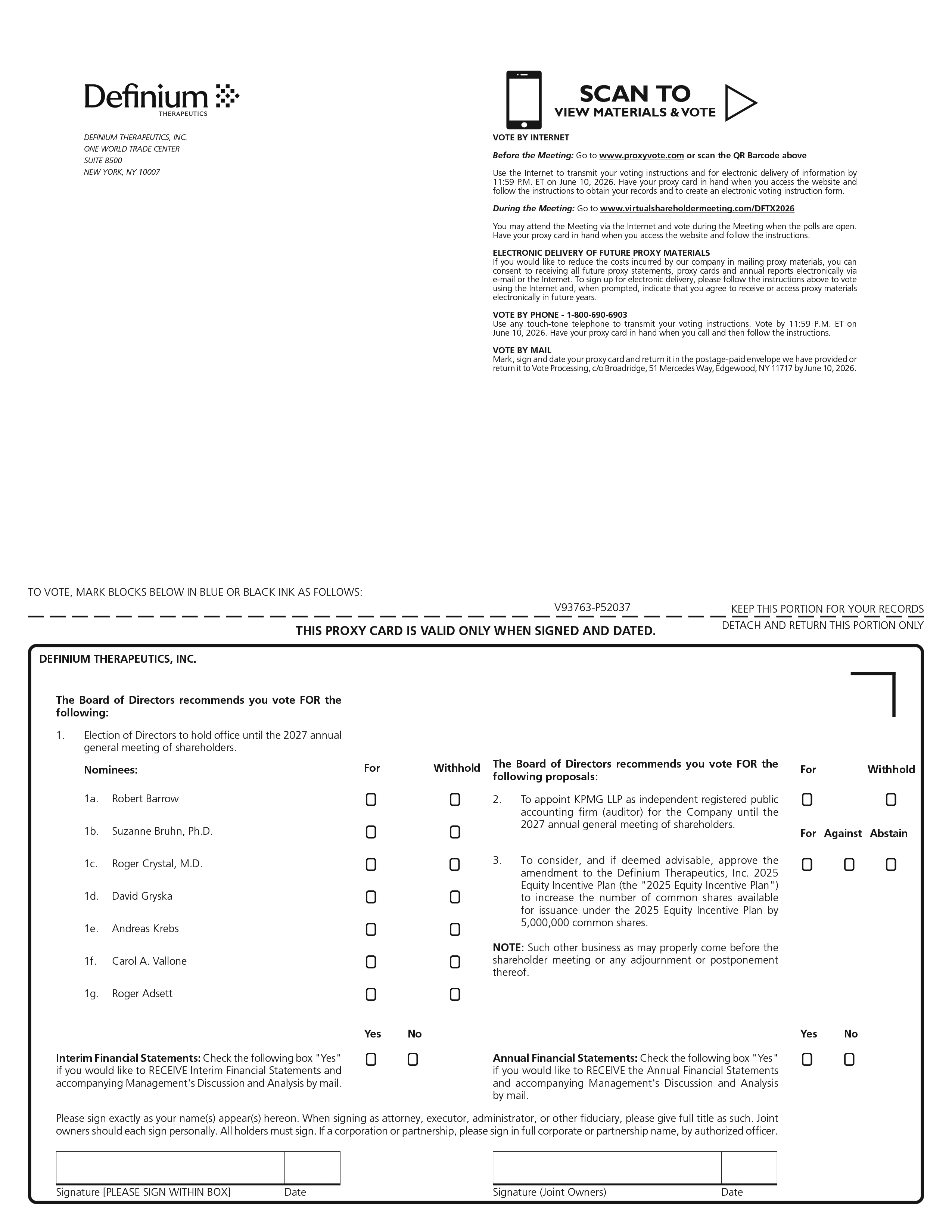
DEFINIUM THERAPEUTICS, INC. ONE WORLD TRADE CENTER SUITE 8500 NEW YORK, NY 10007 VOTE BY INTERNET Before the Meeting: Go to www.proxyvote.com or scan the QR Barcode above Use the Internet to transmit your voting instructions and for electronic delivery of information by 11:59 P.M. ET on June 10, 2026. Have your proxy card in hand when you access the website and follow the instructions to obtain your records and to create an electronic voting instruction form. During the Meeting: Go to www.virtualshareholdermeeting.com/DFTX2026 You may attend the Meeting via the Internet and vote during the Meeting when the polls are open. Have your proxy card in hand when you access the website and follow the instructions. ELECTRONIC DELIVERY OF FUTURE PROXY MATERIALS If you would like to reduce the costs incurred by our company in mailing proxy materials, you can consent to receiving all future proxy statements, proxy cards and annual reports electronically via e-mail or the Internet. To sign up for electronic delivery, please follow the instructions above to vote using the Internet and, when prompted, indicate that you agree to receive or access proxy materials electronically in future years. VOTE BY PHONE - 1-800-690-6903 Use any touch-tone telephone to transmit your voting instructions. Vote by 11:59 P.M. ET on June 10, 2026. Have your proxy card in hand when you call and then follow the instructions. VOTE BY MAIL Mark, sign and date your proxy card and return it in the postage-paid envelope we have provided or return it to Vote Processing, c/o Broadridge, 51 Mercedes Way, Edgewood, NY 11717 by June 10, 2026. DEFINIUM THERAPEUTICS, INC. The Board of Directors recommends you vote FOR the following: 1. Election of Directors to hold office until the 2027 annual general meeting of shareholders. Nominees: For 1a. Robert Barrow ! 1b. Suzanne Bruhn, Ph.D. ! 1c. Roger Crystal, M.D. ! 1d. David Gryska ! 1e. Andreas Krebs ! 1f. Carol A. Vallone ! 1g. Roger Adsett ! Yes Interim Financial Statements: Check the following box "Yes" ! if you would like to RECEIVE Interim Financial Statements and accompanying Management's Discussion and Analysis by mail. Withhold ! ! ! ! ! ! ! No ! V93763-P52037 The Board of Directors recommends you vote FOR the following proposals: 2. To appoint KPMG LLP as independent registered public accounting firm (auditor) for the Company until the 2027 annual general meeting of shareholders. 3. To consider, and if deemed advisable, approve the amendment to the Definium Therapeutics, Inc. 2025 Equity Incentive Plan (the "2025 Equity Incentive Plan") to increase the number of common shares available for issuance under the 2025 Equity Incentive Plan by 5,000,000 common shares. NOTE: Such other business as may properly come before the shareholder meeting or any adjournment or postponement thereof. Annual Financial Statements: Check the following box "Yes" if you would like to RECEIVE the Annual Financial Statements and accompanying Management's Discussion and Analysis by mail. For Withhold !! For Against Abstain !!! Yes No !! Please sign exactly as your name(s) appear(s) hereon. When signing as attorney, executor, administrator, or other fiduciary, please give full title as such. Joint owners should each sign personally. All holders must sign. If a corporation or partnership, please sign in full corporate or partnership name, by authorized officer.
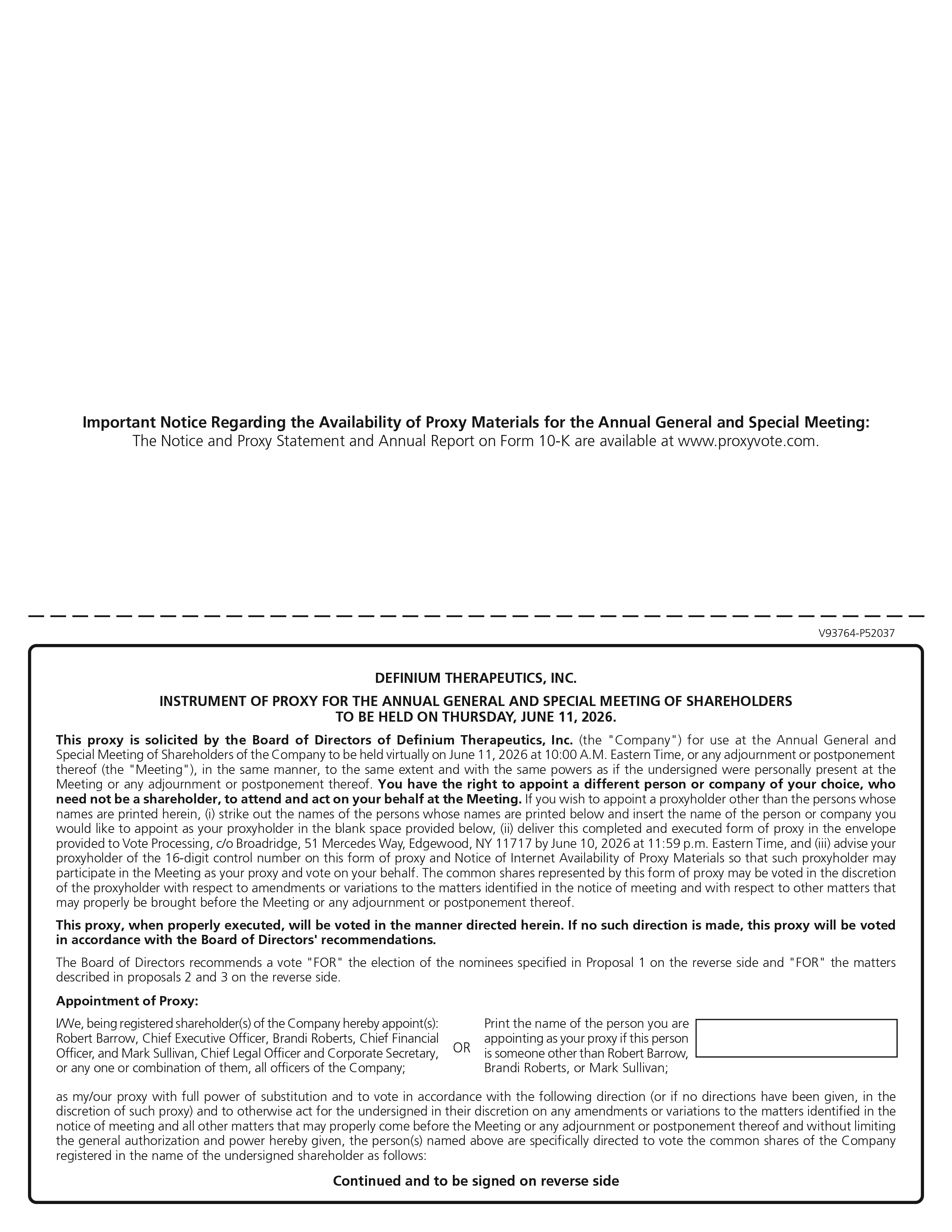
Important Notice Regarding the Availability of Proxy Materials for the Annual General and Special Meeting: The Notice and Proxy Statement and Annual Report on Form 10-K are available at www.proxyvote.com. V93764-P52037 DEFINIUM THERAPEUTICS, INC. INSTRUMENT OF PROXY FOR THE ANNUAL GENERAL AND SPECIAL MEETING OF SHAREHOLDERS TO BE HELD ON THURSDAY, JUNE 11, 2026. This proxy is solicited by the Board of Directors of Definium Therapeutics, Inc. (the "Company") for use at the Annual General and Special Meeting of Shareholders of the Company to be held virtually on June 11, 2026 at 10:00 A.M. Eastern Time, or any adjournment or postponement thereof (the "Meeting"), in the same manner, to the same extent and with the same powers as if the undersigned were personally present at the Meeting or any adjournment or postponement thereof. You have the right to appoint a different person or company of your choice, who need not be a shareholder, to attend and act on your behalf at the Meeting. If you wish to appoint a proxyholder other than the persons whose names are printed herein, (i) strike out the names of the persons whose names are printed below and insert the name of the person or company you would like to appoint as your proxyholder in the blank space provided below, (ii) deliver this completed and executed form of proxy in the envelope provided to Vote Processing, c/o Broadridge, 51 Mercedes Way, Edgewood, NY 11717 by June 10, 2026 at 11:59 p.m. Eastern Time, and (iii) advise your proxyholder of the 16-digit control number on this form of proxy and Notice of Internet Availability of Proxy Materials so that such proxyholder may participate in the Meeting as your proxy and vote on your behalf. The common shares represented by this form of proxy may be voted in the discretion of the proxyholder with respect to amendments or variations to the matters identified in the notice of meeting and with respect to other matters that may properly be brought before the Meeting or any adjournment or postponement thereof. This proxy, when properly executed, will be voted in the manner directed herein. If no such direction is made, this proxy will be voted in accordance with the Board of Directors' recommendations. The Board of Directors recommends a vote "FOR" the election of the nominees specified in Proposal 1 on the reverse side and "FOR" the matters described in proposals 2 and 3 on the reverse side. Appointment of Proxy: I/We, being registered shareholder(s) of the Company hereby appoint(s): Print the name of the person you are Robert Barrow, Chief Executive Officer, Brandi Roberts, Chief Financial appointing as your proxy if this person OR Officer, and Mark Sullivan, Chief Legal Officer and Corporate Secretary, is someone other than Robert Barrow, or any one or combination of them, all officers of the Company; Brandi Roberts, or Mark Sullivan; as my/our proxy with full power of substitution and to vote in accordance with the following direction (or if no directions have been given, in the discretion of such proxy) and to otherwise act for the undersigned in their discretion on any amendments or variations to the matters identified in the notice of meeting and all other matters that may properly come before the Meeting or any adjournment or postponement thereof and without limiting the general authorization and power hereby given, the person(s) named above are specifically directed to vote the common shares of the Company registered in the name of the undersigned shareholder as follows: Continued and to be signed on reverse side